Written with AI assistance, edited and checked against horticultural sources.
Planting thornless blackberries and heritage red raspberries side-by-side without proper planning can lead to disaster, as aggressive blackberry primocanes reach 8 feet (2.4 meters) and choke out sun-loving raspberries by year three; however, pairing these cane fruits successfully is entirely possible with a precise botanical understanding of their habits.
1. Botanical Overview & Natural Habitat
Both raspberries and blackberries belong to the family Rosaceae and the genus Rubus, which accounts for their strikingly similar growth habits and shared vulnerabilities. However, they diverge significantly at the subgenus and species levels. Raspberries typically belong to the subgenus Idaeobatus, while blackberries fall under the subgenus Rubus (specifically the section Eubatus).
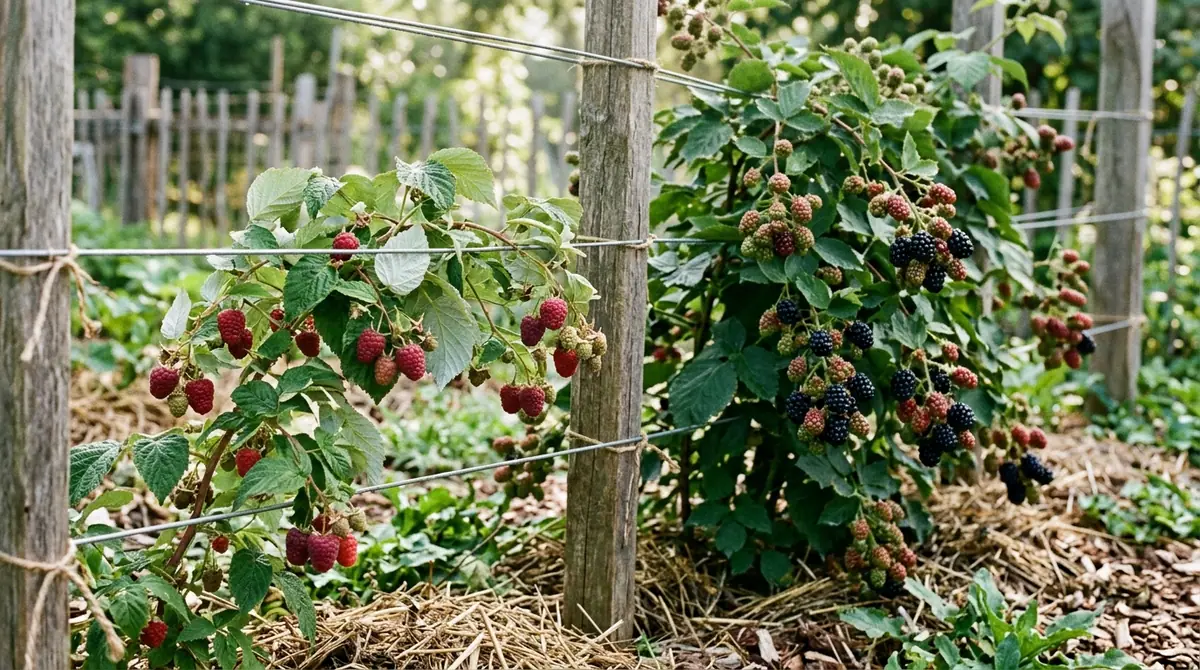
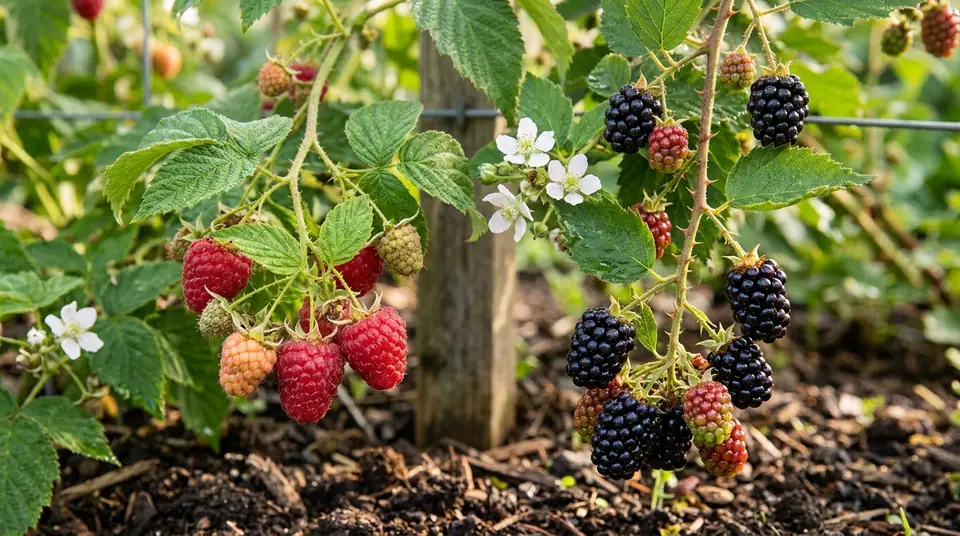
Raspberry and blackberry plants growing side by side with ripe berries
In their native woodland edge and forest clearing habitats, wild Rubus species function as classic ecological pioneers. They thrive in early successional zones where soil disturbance lets in full sun. Despite their shared ancestry, they occupy slightly different ecological niches. Red raspberries (Rubus idaeus) are naturally adapted to cooler boreal climates and mountainous regions, performing best in USDA Hardiness Zones 3 through 8. Blackberries (Rubus fruticosus and native North American hybrids) lean toward slightly warmer climates, thriving in Zones 5 through 9.
The most critical morphological difference lies in how their fruit detaches at harvest. When you pick a raspberry, the hollow aggregate fruit slips off its receptacle, leaving the white, conical core (the torus) attached to the plant. When you pick a blackberry, the torus stays firmly inside the fruit, giving it that solid, juicy center.
Understanding these botanical differences helps us design functional edible landscapes. If you are also planning your berry patch, you might find my guide on When to Plant Strawberries in Kansas: Zone 6a/6b Seasonal Calendar helpful for timing your companion berry installations. When mixing these cane fruits, you must account for their perennial root systems (rootstocks or crowns) paired with biennial aerial stems. The stems—known as floricanes—grow vegetatively in their first year (primocanes), fruit in their second year, and then die back to the soil line.
2. Essential Environmental & Care Requirements
Can you plant raspberries and blackberries together? Yes, but only if you respect their individual environmental thresholds. While they both demand full sun (a minimum of 6 to 8 hours of direct daily sunlight) and loamy, well-draining soil, their tolerance for moisture and soil chemistry differs subtly.
Blackberries possess exceptional drought tolerance once established, thanks to a deep taproot system that can probe down to 36 inches (91 cm) in search of water. Raspberries have a much shallower, more fibrous root system concentrated almost entirely in the top 12 inches (30 cm) of soil. If you plant them together and water them based on the blackberry's lower needs, your raspberries will suffer from drought stress during peak summer heat.
Parameter
Optimal Condition
Common Mistake
Why It Matters
Soil pH
6.0 to 6.5
Planting in soil below 5.5 or above 7.5
Extreme pH locks out essential micronutrients like iron and manganese, causing severe chlorosis.
Soil Depth
18–24 inches (45–60 cm) of loose loam
Planting in compacted claypan soils
Causes root rot (Phytophthora) and prevents blackberry taproots from anchoring.
Watering Volume
1 to 2 inches (2.5–5 cm) per week
Overhead sprinkler irrigation
Wet foliage invites fungal pathogens like grey mold (Botrytis cinerea).
Spacing
4–6 feet (1.2–1.8 m) between mixed rows
Crowding plants closer than 3 feet (0.9 m)
Promotes cross-contamination of pests and cuts off airflow.
Soil drainage is non-negotiable for both species. Heavy clay soils that stay waterlogged for more than 48 hours after a heavy rain will decimate root systems through Phytophthora root rot. For comprehensive guidance on managing root depth and soil volume, consult our breakdown on How Deep Do Pepper Plant Roots Go? Pot Size & Substrate Depth Guide, which outlines similar moisture management principles for sub-surface root structures.
💡 Pro-Tip: When designing a mixed berry hedgerow, always plant your blackberries on the northern side of your raspberries if you are in the Northern Hemisphere. Because blackberries grow significantly taller—often exceeding 7 feet (2.1 meters)—placing them on the south side will cast a shadow that starves your shorter red raspberries of necessary sunlight.
To grow raspberries and blackberries side-by-side without them warring for dominance, you must establish a disciplined cultural protocol. Follow this step-by-step planting and management sequence:
Site Selection and Soil Preparation: Select a site receiving at least 8 hours of unobstructed sunlight in early spring (March to April, when soil temperatures reach 55°F / 13°C). Clear all perennial weeds like quackgrass or bindweed, as removing them later inside a thorny berry patch is exceptionally difficult.
Amend the Substrate: Test your soil pH. If it falls below 5.6, incorporate agricultural limestone at a rate of 5 lbs per 100 square feet (2.2 kg per 9.3 square meters) to hit the ideal 6.0–6.5 window. Till in 3 inches (7.6 cm) of aged compost to a depth of 12 inches (30 cm).
Establish Physical Root Barriers: Dig a trench 18 inches (45 cm) deep between your raspberry row and your blackberry row. Insert heavy-duty, high-density polyethylene root barrier sheets vertically into the trench, leaving 1 inch (2.5 cm) protruding above the soil line. This stops their aggressive underground rhizomes from intermingling and creating an unmanageable hybrid thicket.
Planting Depth: Plant bare-root or potted nursery stock at the exact same depth they grew in the nursery. For raspberries, keep the crown no deeper than 1 inch (2.5 cm) below the surface; burying them deeper invites crown rot. Space blackberries 4 feet (1.2 m) apart and raspberries 3 feet (0.9 m) apart within their respective rows.
Pruning and Training Architecture: Install a heavy-duty T-post and high-tensile wire trellis system. Train blackberry primocanes to horizontal wires at 3 feet (0.9 m) and 5 feet (1.5 m) heights. Prune red raspberry floricanes back to 4 feet (1.2 m) in early spring to encourage lateral branching and maximize fruit set.
For authoritative recommendations on regional berry cultivation benchmarks, refer to the Oregon State University Extension Service, which provides exceptional research-backed documentation on cane fruit management in mixed plantings.
4. Common Problems, Pests & Troubleshooting
Planting raspberries and blackberries together creates a shared ecological buffet for several stubborn pests and pathogens. Because they belong to the same genus, they are susceptible to many of the same vectors.
Spotted Wing Drosophila (Drosophila suzukii)
Unlike traditional fruit flies that target overripe or rotting fruit, the Spotted Wing Drosophila attacks ripening berries just as they begin to turn from pink to red. Females slice into the firm skin with a serrated ovipositor to lay eggs.
Prevention & Control: Harvest fruit daily without leaving overripe berries on the vine. Install fine insect netting (mesh size under 1 km / 0.98 mm) over your entire combined berry patch as soon as petal fall occurs.
Cane Borers and Crown Gall
Red-necked cane borers and raspberry crown borers tunnel inside the stems, causing distinctive swellings (galls) or sudden wilting of the cane tips. Crown gall—a bacterial infection (Agrobacterium tumefaciens)—causes rough, woody tumors to form at or below the soil line.
Prevention & Control: Inspect your plants every spring. Prune out and immediately burn any swelling or damaged canes 4 inches (10 cm) below the damaged zone. Never plant Rubus species in soil where stone fruits (peaches, cherries) have grown within the last 3 years, as they share susceptibility to crown gall.
⚠️ Important Caution: Never apply broad-spectrum systemic insecticides to your mixed berry patch while plants are in bloom. This destroys populations of native bumblebees and honeybees (Apis mellifera) required for proper cross-pollination and fruit sizing. If pest intervention is required during bloom, apply horticultural soaps or neem oil strictly at dusk after pollinators have retreated.
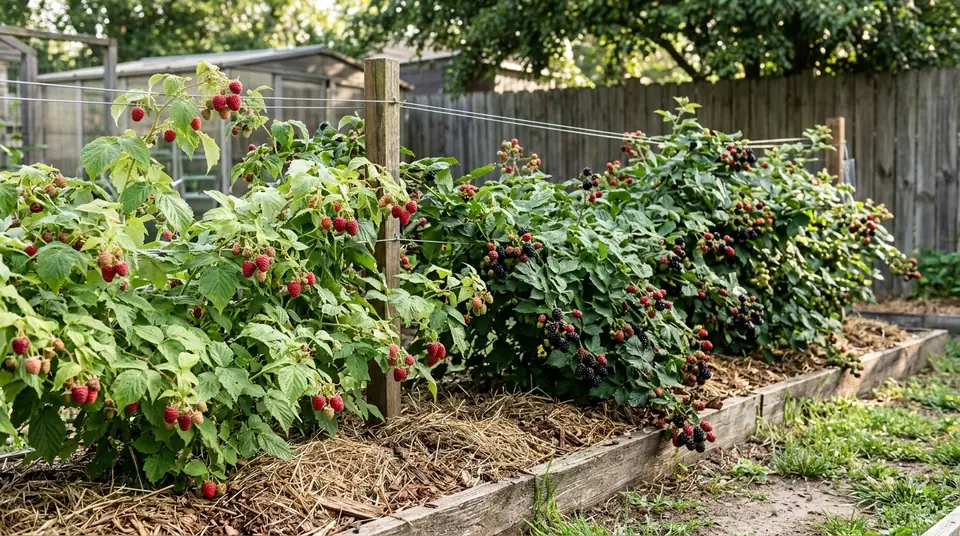
Raspberry and blackberry bushes growing side by side in raised garden beds supported by wires
5. Frequently Asked Questions
Can blackberries and raspberries cross-pollinate if planted next to each other?
No, they cannot successfully cross-pollinate to produce viable hybrid fruit. While they belong to the same family and genus (Rubus), they have distinct chromosome numbers and genetic structures. You will not end up with a bizarre mutant berry; the fruit borne on your raspberry canes will remain pure raspberry, and your blackberries will remain pure blackberry.
How far apart should I plant raspberries and blackberries to keep them from tangling?
You should maintain a minimum distance of 5 to 6 feet (1.5 to 1.8 meters) between separate rows of blackberries and raspberries. If you are planting them in the same continuous row, leave at least 4 feet (1.2 meters) of open space between the terminal end of the raspberry patch and the start of the blackberries, supplemented by an underground root barrier.
Do raspberries and blackberries need different fertilizer schedules?
Both species are moderate to heavy feeders that respond exceptionally well to balanced fertility inputs. Apply a balanced organic fertilizer (such as a 10-10-10 or a compost-alfalfa meal blend) at a rate of 2 lbs per 100 feet (0.9 kg per 30 meters) of row in early spring as new shoots emerge. Avoid high-nitrogen synthetic fertilizers late in the season, as this triggers tender, frost-vulnerable autumn growth.
Will blackberries take over and kill my red raspberries?
Yes, aggressive trailing or erect blackberry cultivars will systematically outcompete red raspberries if left unmanaged. Blackberries produce vigorous root suckers and towering floricanes that easily shade out the lower-growing, more delicate red raspberry canes. Strict annual pruning and physical root containment are mandatory to keep blackberries from overtaking the shared bed.
PlantSavvyWorld is an independent botanical education project. Articles are drafted with AI assistance, then edited and checked against university extension services, botanical garden collections and other published horticultural sources.