

Best Province to Live in Canada for Gardeners
Written with AI assistance, edited and checked against horticultural sources.
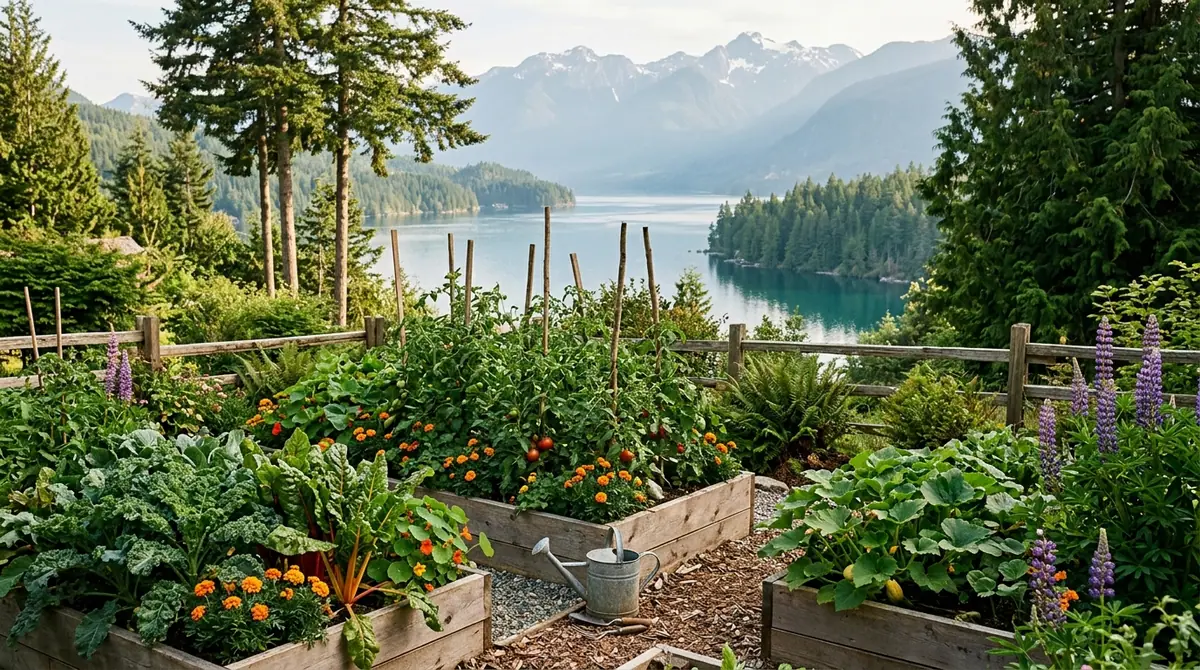
The soil on Salt Spring Island still clings to my fingernails whenever I think back to my first Canadian growing season. I had just moved from a continental interior zone, expecting the usual frantic scramble to beat autumn frosts by mid-September. Instead, I stood in a coastal maritime garden in late November, harvesting crisp, bolt-resistant ‘Winterbor’ kale in a light mist, while dahlias stubbornly refused to die back until December. That mild, maritime epiphany launched my decade-long obsession with mapping Canada’s microclimates. If you want to dig your spade into the most forgiving, ecologically diverse soil this country has to offer, you need to look west. Here is my definitive guide to the absolute best province to live in Canada for gardeners: British Columbia.
1. Botanical Overview & Natural Habitat
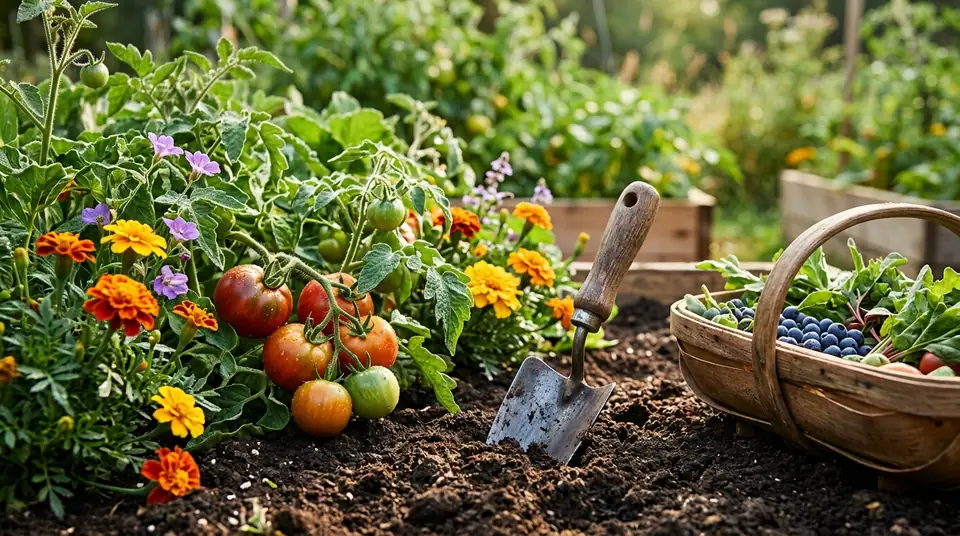
To understand why British Columbia reigns supreme for horticulture, we must examine its distinct ecological regions:
- The Coastal Maritime Zone (Greater Victoria, Vancouver, Gulf Islands): Characterized by mild, wet winters and warm, dry summers. Winter lows rarely drop below 32°F (0°C) for long, with average January lows hovering around 38°F to 41°F (3°C to 5°C). Summer highs stay comfortable, averaging 70°F to 78°F (21°C to 26°C). This Mediterranean-like weather allows for the cultivation of broadleaf evergreens, palm trees, delicate camellias, and olive trees that would instantly perish in Ontario, the Prairies, or Quebec.
- The Fraser Valley & Lower Mainland: An alluvial floodplain with rich, silt-heavy soils deposited by the Fraser River over millennia. This region boasts a frost-free period stretching from 180 to 240 days per year. Soil temperatures warm up earlier in spring, allowing direct-sowing of cool-season crops by mid-March.
- The Okanagan Valley (Interior Semiarid): Featuring a true desert-like microclimate with intense summer sun, soaring temperatures frequently exceeding 90°F (32°C), and low relative humidity. This is Canada's premier orchard and vineyard country, perfect for stone fruits, grapes, and heat-loving Mediterranean herbs like lavender, rosemary, and sage.
The natural habitat varies wildly from temperate rainforest floors blanketed in sword ferns (Polystichum munitum) and trailing blackberry to drought-tolerant, sage-steppe ecosystems in the south. This botanical diversity means you can cultivate everything from alpine rock-garden species to subtropical ornamentals within a few hours' drive.
| Parameter | Optimal Condition | Common Mistake | Why It Matters |
|---|---|---|---|
| Soil pH | 6.0 to 6.8 (Slightly acidic to neutral) | Ignoring native acidity in coastal forest soils (pH 4.5–5.5) | Extreme acidity locks up essential macronutrients like calcium and phosphorus. |
| Frost-Free Days | 180 to 240+ days (Coastal BC) | Planting tender annuals before soil hits 55°F (13°C) | Root rot thrives in cold, wet spring earth, stalling early growth permanently. |
| Summer Irrigation | 1 inch (2.5 cm) of water weekly via drip | Overhead watering during peak afternoon sun | Damp foliage combined with high humidity triggers fungal blights overnight. |
| Root Zone Depth | Minimum 12 inches (30 cm) of loose, organic-rich loam | Planting in compacted urban fill or clay pans | Restricted root expansion halts canopy growth and drastically reduces drought tolerance. |
2. Essential Environmental & Care Requirements
Gardening in British Columbia requires a nuanced understanding of moisture management and soil balancing. While the maritime climate grants you an exceptionally long growing season, it also presents unique environmental hurdles.
Sunlight and Photoperiod: Coastal BC experiences overcast, gray skies during late fall and winter, shifting to intense, unclouded sunlight from June through August. Gardeners must account for high UV index ratings during mid-summer. Sun-scorched foliage on Japanese maples (Acer palmatum) or tender hydrangeas is common if afternoon shade (from 1 PM to 4 PM) is not provided. Conversely, northern interior regions of BC experience massive photoperiod swings, gifting you 16+ hours of summer daylight that pushes vegetable growth into overdrive.
Moisture and Precipitation: Annual rainfall ranges drastically across the province. Tofino on the west coast of Vancouver Island receives over 118 inches (300 cm) of rain annually, while the southern Okanagan receives less than 12 inches (30 cm). For the majority of gardeners in the populous southwest, the challenge is temporal: 80% of rainfall arrives between October and April, leaving July and August bone-dry. Installing an automated drip irrigation system tied to rain sensors is not a luxury in BC; it is a foundational survival requirement for your landscape.
Soil Composition and Drainage: Native coastal forest soils are heavily leached and acidic, dominated by decaying coniferous needles. Amending these beds with well-rotted compost, aged manure, and agricultural lime is essential to elevate the pH to an optimal 6.5 for general vegetable and ornamental cultivation. If you are integrating structural trees into tight urban lots, consider reviewing our guide on 15 Best Trees for Driveways That Won't Crack Concrete to ensure your hardscaping remains protected from aggressive root systems as they mature.
💡 Pro-Tip: Never let winter rain leach all your soil nutrients away. In late October, chop down your spent annual crops, leave the roots intact to decompose naturally, and bury a 3-inch (7.6 cm) blanket of leaf mold and kelp meal across your beds. Cover this with a thick layer of woven landscape fabric or black silage tarp until early March. This simple trick prevents winter nutrient leaching, suppresses weed germination, and warms the soil 2 weeks earlier in spring.
3. Step-by-Step Cultivation, Feeding & Propagation
Establishing a thriving garden in Canada’s mildest province requires precise timing. Because winter temperatures remain moderate, you can operate on a 12-month calendar rather than the frantic 4-month sprint seen on the Prairies.
- Site Assessment and Soil Testing (Late February): Take core soil samples from 6 inches (15 cm) deep across your plot. Send them to a regional lab or use a reliable meter to check pH and macronutrient levels. If your pH registers below 6.0, broadcast agricultural limestone at a rate of 5 lbs per 100 square feet (2.4 kg per 9 square meters) and work it into the top 4 inches (10 cm).
- Bed Preparation and Amendment (Mid-March): Once soil is workable and no longer sticks to your boots in clods, turn over the top 8 to 12 inches (20 to 30 cm) of earth. Incorporate a 2-inch (5 cm) layer of finished vermicompost or mushroom manure to boost microbial activity.
- Direct Sowing Cool-Season Crops (Late March to Early April): Plant seeds of spinach, arugula, radish, and peas directly into the soil when soil temperatures consistently reach 45°F (7°C). Space rows 12 inches (30 cm) apart, planting seeds at a depth equal to twice their diameter (typically 0.5 inches / 1.3 cm).
- Hardening Off and Transplanting Warm-Season Crops (Mid-May): Move indoor-started tomatoes, peppers, and squash outdoors for progressively longer periods over 10 days. Transplant them into deeply dug holes amended with bone meal for strong root establishment, maintaining a spacing of 24 inches (60 cm) between indeterminate tomato plants.
- Summer Maintenance and Mulching (June to August): Apply a 3-inch (7.6 cm) blanket of untreated cedar or bark mulch around all perennials and shrubs, keeping the mulch 2 inches (5 cm) away from main stems to prevent collar rot. Water deeply at the base twice a week rather than light, daily sprinkling.
- Propagation via Softwood Cuttings (Late June): Take 6-inch (15 cm) tip cuttings from healthy, non-flowering deciduous shrubs like hydrangeas or viburnums. Strip the lower leaves, dip the base in rooting hormone powder (0.3% IBA), and insert them into a 50/50 mix of perlite and peat moss. Keep under a clear humidity dome until roots form in 4 to 6 weeks.
⚠️ Important Caution: Do not apply high-nitrogen synthetic fertilizers to your perennial garden after August 1st. Doing so triggers a flush of tender, succulent late-season growth that cannot harden off before the first autumn drop, leaving your plants critically vulnerable to sudden frost damage.
4. Common Problems, Pests & Troubleshooting
Even paradise has its pests. The damp, temperate climate that makes British Columbia a gardener's haven also rolls out the red carpet for slugs, snails, and persistent fungal pathogens.
- European Garden Slugs (Arion vulgaris): These slimy invaders thrive in BC's wet springs and damp autumns, chewing ragged, gaping holes in hostas, lettuce, and dahlias. Solution: Clear away all damp organic debris within 3 feet (1 meter) of vulnerable plants to eliminate daytime hiding spots. Sink shallow containers of stale beer flush with the soil surface, or apply certified organic iron phosphate bait around bed perimeters. For university-backed research on sustainable mollusk management, consult the Oregon State University Extension Service.
- Powdery Mildew (Podosphaera macularis / Erysiphe): Appearing as a stark white, talcum-powder-like coating on the leaves of squash, pumpkins, and monarda, this fungus thrives when warm days are followed by cool, dewy nights. Solution: Prune overcrowded branches to maximize air circulation through the canopy. Spray affected foliage preventatively every 10 days with a mixture of 1 tablespoon baking soda, 1 teaspoon liquid castile soap, and 1 gallon (3.7 liters) of water.
- Root Aphids and Fungus Gnats: Common in raised beds rich in organic matter and in poorly ventilated backyard greenhouses during wet shoulder seasons. Solution: Drench the soil with beneficial nematodes (Steinernema feltiae) to hunt down and parasitize larvae in the root zone. Allow the top 2 inches (5 cm) of soil to dry out completely between watering sessions.
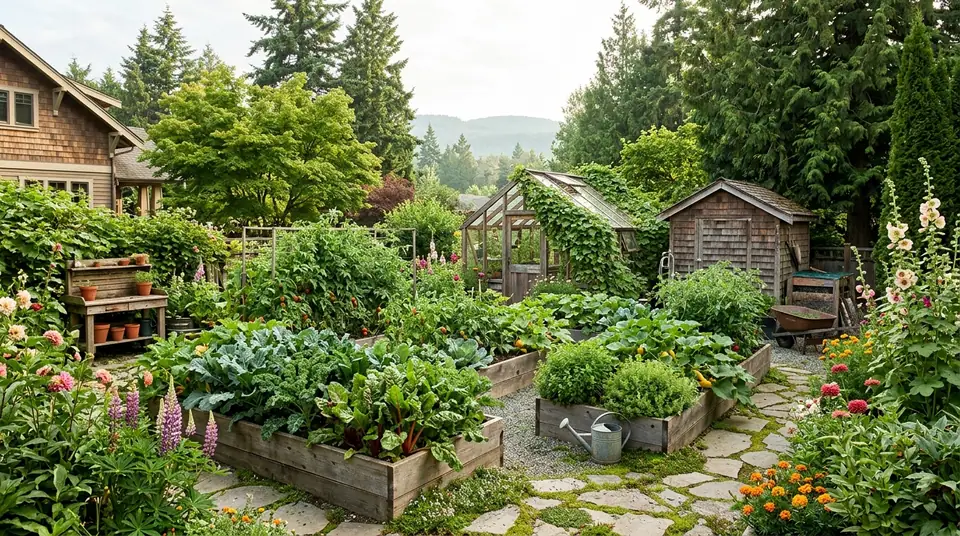
Lush Canadian garden with raised beds, a greenhouse, and a wooden shed against forest hills
5. Frequently Asked Questions
What makes British Columbia better for gardening than Ontario or Alberta?
British Columbia offers the mildest winter temperatures in Canada, meaning your garden season stretches from 8 to 12 months depending on the specific microclimate. While Ontario and the Prairies experience freezing winters that lock soil solid for half the year, coastal BC allows for continuous winter harvesting of brassicas, root vegetables, and overwintering greens. Furthermore, you can grow a vast array of broadleaf evergreens, exotic ornamentals, and tender fruit trees that cannot survive the harsh continental winters of central and eastern Canada.
Can I grow palm trees outdoors in British Columbia?
Yes, absolutely. The Windmill Palm (Trachycarpus fortunei) is fully hardy throughout USDA Zones 8a and 8b, which covers coastal Vancouver Island, the Gulf Islands, and parts of the Lower Mainland. These architectural palms can withstand winter lows down to 10°F (-12°C) without artificial protection, making tropical-themed urban landscape design entirely feasible in Canada.
How do I deal with heavy clay soil in the Fraser Valley?
Fraser Valley clay holds moisture tenaciously and becomes rock-hard when dry. Do not attempt to amend heavy clay with sand alone, as this creates a mixture resembling concrete. Instead, incorporate massive amounts of organic matter—such as well-rotted compost, leaf mold, and aged bark fines—annually. For deeper insights into soil structure and organic amendments, reference guidelines provided by the Royal Horticultural Society. Avoid walking on wet clay beds to prevent compaction.
What are the best vegetables to grow during BC’s long winter season?
The maritime zones of BC are ideal for cold-hardy brassicas and root vegetables. Plant 'Winterbor' kale, Brussels sprouts, parsnips, leeks, winter radishes, and savoy cabbage in mid-summer (July to August). These crops mature as the weather cools and actually improve in flavor after being kissed by autumn frosts, which convert starches into natural sugars, providing fresh harvests right through December and January.
Related Guides
📋 Table of Contents ▼ Click to expand
Tags:
Keep reading
🌿 Related Plants You Might Like



PlantSavvyWorld
Editorial team
PlantSavvyWorld is an independent botanical education project. Articles are drafted with AI assistance, then edited and checked against university extension services, botanical garden collections and other published horticultural sources.