

Best Herb Herbalism Courses Books
Written with AI assistance, edited and checked against horticultural sources.
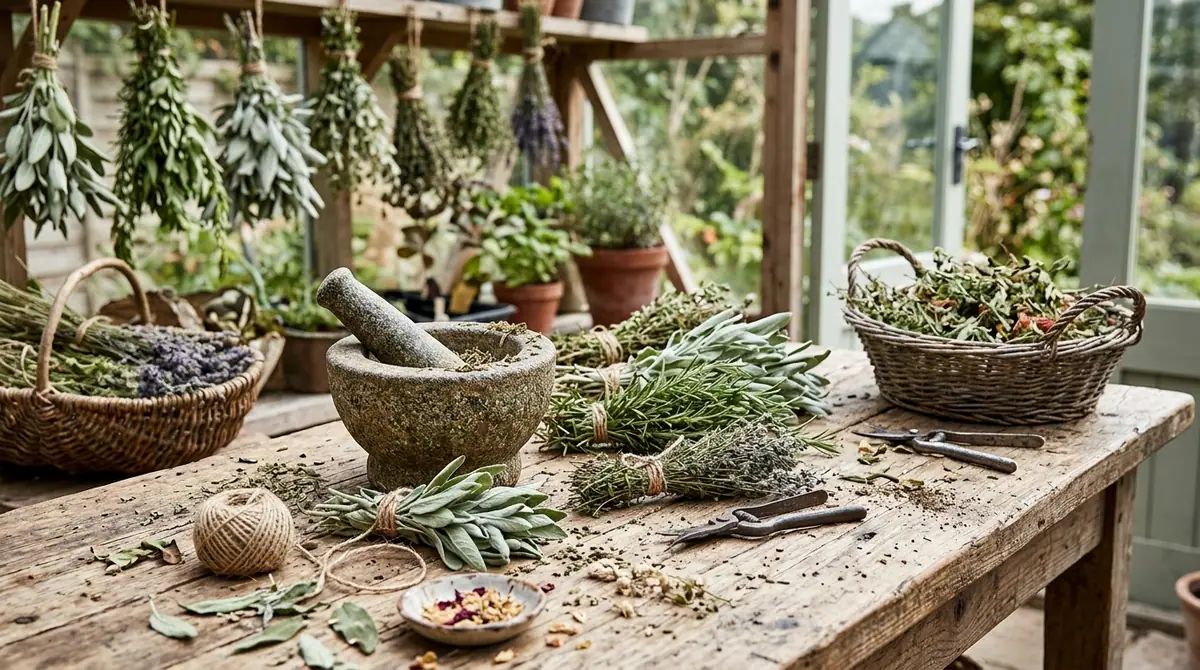
The rain was coming down in sheets that April morning, plastering my seed catalogues against the damp greenhouse potting bench. I had three boxes of new herbalism textbooks arriving by post, yet my hands were stained green from root-dividing an overgrown patch of Melissa officinalis (lemon balm) that had survived three sub-zero winters by sheer stubbornness. Books are invaluable, but holding a volume on medicinal plants while staring at chlorotic leaves teaches you that herbalism lives at the intersection of rigorous botany and dirt under your fingernails. Whether you are hunting for the best herb herbalism courses books to deepen your clinical practice, or wondering how to select foundational guides that don't just repeat plant folklore, bridging the gap between field botany and text-heavy theory is where true herbalists are forged.
1. Botanical Overview & Natural Habitat
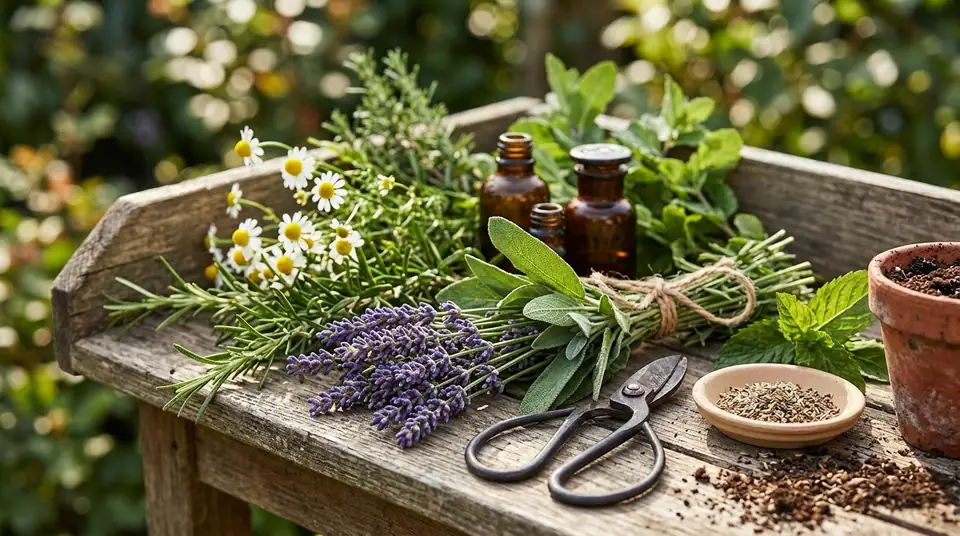
Most foundational culinary and medicinal herbs hail from the Mediterranean basin, adapting them to specific ecological niches. Understanding these natural habitats allows us to replicate them in our home gardens, ensuring the highest concentration of volatile secondary metabolites (the active constituents we harvest for medicine).
| Parameter | Optimal Condition | Common Mistake | Why It Matters |
|---|---|---|---|
| Soil Drainage | Highly permeable, sandy-loam (pH 6.5–7.0) | Heavy clay holding stagnant moisture | Prevents Pythium and root rot in Mediterranean herbs |
| Sun Exposure | Full sun (minimum 6–8 hours direct light) | Dappled shade under large canopies | Maximizes essential oil synthesis in leaves and flowers |
| Air Circulation | Moderate breezes, wide plant spacing | Crowded beds without wind movement | Prevents powdery mildew (Erysiphe species) outbreaks |
| Root Space | Deep taproot or spreading rhizome clearance | Shallow containers restricting expansion | Stunts structural development and nutrient uptake |
If you are planning your broader landscape layout alongside your medicinal herb gardens, remember to integrate your perennial zones thoughtfully—much like planning structural elements such as those detailed in our guide on 15 Best Trees for Driveways That Won't Crack Concrete.
2. Essential Environmental & Care Requirements
Selecting the best herb herbalism courses books often highlights the importance of environmental stress in medicinal plant cultivation. Unlike heavy vegetable crops, many of our most potent medicinal herbs—such as rosemary (Salvia rosmarinus), thyme (Thymus vulgaris), and lavender (Lavandula angustifolia)—produce higher concentrations of medicinal terpenes when subjected to modest drought and nutrient stress.
Temperature parameters dictate your growing schedule. While cool-season herbs like parsley (Petroselinum crispum) and cilantro (Coriandrum sativum) bolt when temperatures exceed 75°F (24°C), warmth-loving perennials thrive when ambient air ranges between 70°F and 85°F (21°C to 29°C) during their active growing phase.
Watering protocols must mimic Mediterranean weather patterns: a deep, thorough saturation followed by complete soil dry-down to a depth of 2 inches (5 cm) before the next application. Overhead watering should be minimized; drip irrigation or soaker hoses protect foliage from fungal spores splashing up from the soil.
💡 Pro-Tip: When studying your herbalism texts alongside live plants, crush a single leaf between your fingers during the afternoon heat. If the aroma is faint, your plant is likely receiving too much water or nitrogen fertilizer, which dilutes its medicinal essential oils.
3. Step-by-Step Cultivation, Feeding & Propagation
Growing your own materia medica transforms theoretical knowledge from a book into tangible medicine. Follow this propagation and cultivation protocol for perennial root and leaf herbs like echinacea, marshmallow, or sage:
- Seed Stratification & Sowing: Many medicinal perennial seeds require a cold-moist stratification period. Mix seeds with damp perlite, seal in a polyethylene bag, and store at 34°F to 38°F (1°C to 3°C) for 21 to 30 days. Surface-sow seeds in seed-starting trays filled with a sterile, fine-textured medium, pressing them down gently as they require light to germinate. Maintain a soil temperature of 68°F (20°C).
- Transplanting Out: Once seedlings develop their second set of true leaves and night temperatures consistently exceed 50°F (10°C), harden off the young plants over 10 days by gradually increasing exposure to outdoor wind and direct sunlight.
- Bed Preparation: Amend your garden bed with coarse horticultural sand and well-rotted compost to replicate lean, gritty native conditions. Dig planting holes twice as wide as the root ball but no deeper than the container depth, setting the crown 0.5 inches (1.2 cm) above the surrounding soil grade to prevent crown rot.
- Initial Watering & Mulching: Water newly set starts deeply with 1 inch (2.5 cm) of water equivalent. Apply a thin, 1-inch (2.5 cm) layer of crushed gravel or decomposed granite around the base rather than organic wood mulch, keeping moisture away from the stem base.
- Pruning and Harvesting: For perennial leaf and flower herbs, harvest in the morning after the dew has evaporated but before the afternoon sun bakes off the volatile oils. Prune back by one-third in mid-summer to encourage a flush of fresh, medicinal foliage, and cut back woody perennials to 4 inches (10 cm) above the old wood in early spring before new bud break.
For authoritative guidance on soil chemistry and nutrient management tailored to your specific region, consult the USDA Natural Resources Conservation Service for comprehensive regional soil surveys.
⚠️ Important Caution: Never harvest medicinal herbs from roadsides or industrial zones. Plants hyperaccumulate heavy metals, exhaust particulates, and systemic herbicides, rendering your home-brewed remedies toxic rather than healing.
4. Common Problems, Pests & Troubleshooting
Even the best herb herbalism courses books emphasize that pest and disease management in medicinal gardens must rely on cultural controls rather than synthetic pesticides, which can contaminate your herbal preparations.
- Root Rot (Phytophthora and Pythium species): Symptoms include sudden wilting, yellowing lower leaves, and black, mushy root crowns. This occurs almost exclusively due to heavy, poorly drained soils or overwatering. Remedy by withholding water immediately, improving drainage channels, and applying a biofungicide containing Bacillus subtilis. For a deeper dive into plant pathology standards, reference resources provided by the Royal Horticultural Society.
- Powdery Mildew: Appears as a white, powdery dusting on the upper leaf surfaces of monarda, sage, and mint during humid late-summer periods. Prevent by ensuring proper plant spacing (at least 18 inches / 45 cm apart) and removing infected debris in autumn. Treat active infections with a spray of 1 tablespoon baking soda mixed with 1 teaspoon horticultural oil per gallon of water.
- Aphids and Spider Mites: Sucking pests that colonize tender growing tips, causing leaf curl and stunted growth. Blast colonies off with a strong jet of cold water from a hose nozzle, or introduce beneficial predatory insects such as ladybird beetles (Hippodamia convergens) and lacewings.
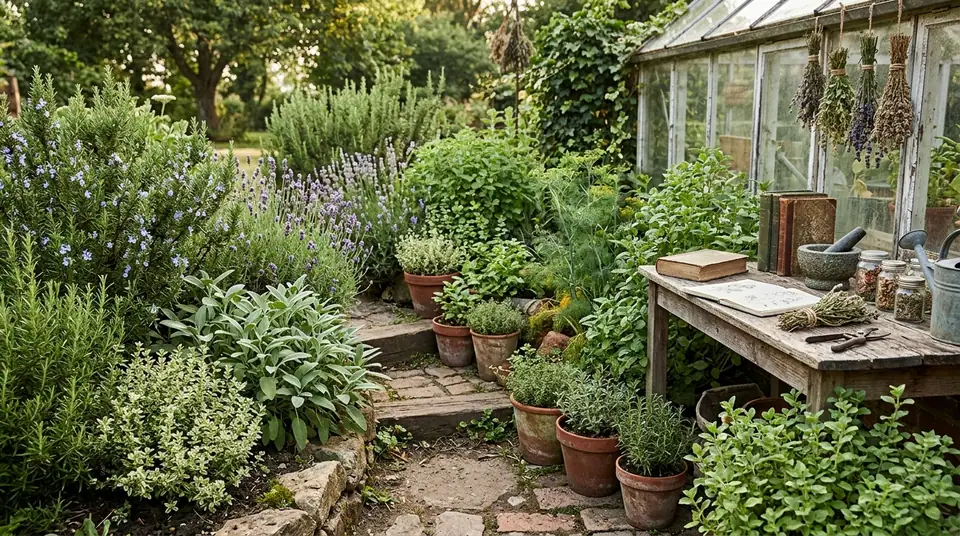
Lush herb garden with rosemary, lavender, sage, and a potting bench outside a rustic greenhouse
5. Frequently Asked Questions
Which beginner books bridge the gap between botany and practical herbalism?
Look for comprehensive texts written by trained clinical herbalists who have formal botanical backgrounds. Books that include detailed botanical keys, regional growing zones, and explicit chemical constituent profiles provide the most reliable foundation for making safe herbal preparations.
Can I grow medicinal herbs indoors on a windowsill?
Most medicinal herbs—especially Mediterranean varieties like rosemary, thyme, and oregano—require high-intensity light that standard indoor windowsills rarely provide. Without at least 6 hours of direct, unfiltered light or supplemental LED grow lights, these plants become leggy, lose their aromatic potency, and succumb quickly to root diseases.
How do I know when my perennial medicinal herbs are ready to harvest?
For leaf herbs, harvest just before the flower buds open, as this is when essential oil concentrations peak. For root herbs like burdock or echinacea, harvest in late autumn after the aerial growth has died back and the plant has redirected all its carbohydrates and active constituents down into the root system.
Are all book recommendations safe for identifying wild medicinal plants?
Never rely on a single book or photographs alone for wild foraging. Always cross-reference multiple authoritative field guides, use botanical line drawings that show diagnostic floral and leaf characteristics, and verify identifications with local botanical experts before consuming any wild-harvested plant material.
Related Guides
- Diy Balcony Herb Garden Ideas for Beginners
- Best Vegetable Gardening Books for Beginners
- When to Plant Tomatoes in Zone 7a
📋 Table of Contents ▼ Click to expand
Tags:
Keep reading
🌿 Related Plants You Might Like






PlantSavvyWorld
Editorial team
PlantSavvyWorld is an independent botanical education project. Articles are drafted with AI assistance, then edited and checked against university extension services, botanical garden collections and other published horticultural sources.