Mit KI-Unterstützung verfasst, redaktionell geprüft und mit Fachquellen abgeglichen.
When a massive, centuries-old live oak develops a muscular, serpentine root system that buckles brick pavers, burying the exposed roots under 6 inches (15 cm) of fresh topsoil to lay a smooth sod lawn should be avoided. Suffocating those structural anchors triggers a slow, agonizing decline for the tree. Instead, work with the biology of the tree by crafting a multi-layered shade garden that transforms an unsightly erosion hazard into the breathtaking focal point of the entire property.
Managing the subterranean architecture of mature trees while creating a visually stunning landscape requires an intimate understanding of how woody plants breathe, forage, and anchor themselves. Welcome to your definitive guide on creative landscaping ideas around tree roots.
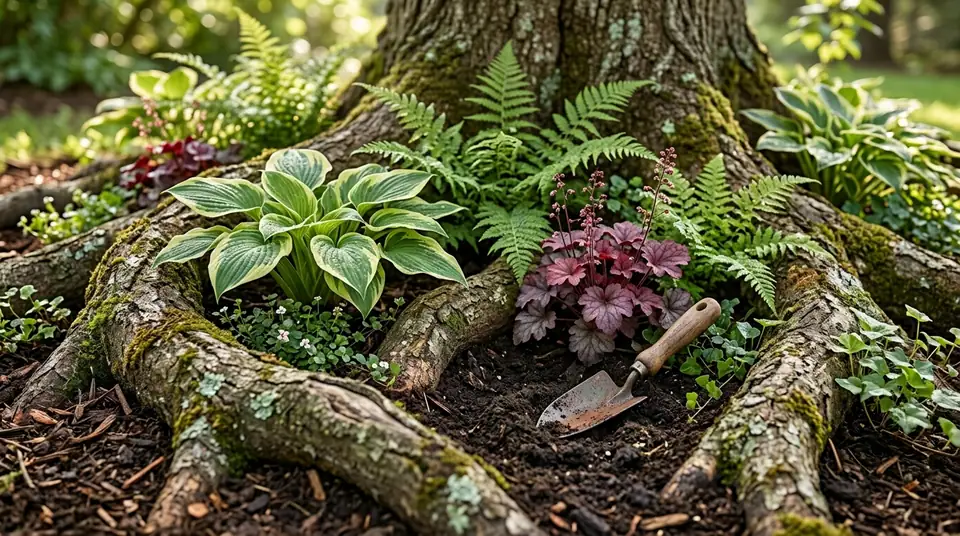
Hostas and ferns planted between the thick roots of a large tree with a small trowel resting in the dirt
1. Botanical Overview & Natural Habitat
When designing around tree roots, you are not simply decorating soil; you are interacting with a complex, living lifeline. In nature, trees do not grow long, deep taproots that plunge straight down like tent pegs—except during the earliest seedling stages. Instead, 90% of a mature tree's root system lives in the top 12 to 24 inches (30 to 60 cm) of soil.
The structural roots radiate outward like the spokes of a wheel, but the true workhorses are the feeder roots. These fine, hair-like extensions inhabit the "critical root zone" (CRZ), which typically extends outward from the trunk to a distance matching or exceeding the tree's canopy drip line. Feeder roots require constant oxygen exchange, gaseous diffusion, and moisture. When we compact soil with heavy foot traffic, pave over root zones, or pile on dense layers of soil, we essentially suffocate the tree by cutting off its oxygen supply.
Understanding this natural habitat shifts our design perspective. We must move away from digging deep, disruptive planting holes and toward surface-level, non-invasive landscaping techniques that respect the shallow, sprawling nature of tree roots. For those interested in how subterranean structures vary wildly across the plant kingdom, you might compare this behavior to root dynamics discussed in our guide on How Deep Do Pepper Plant Roots Go? Pot Size & Substrate Depth Guide.
2. Essential Environmental & Care Requirements
Creating a thriving landscape beneath and around a mature tree means navigating a fierce resource battle. Existing trees are already monopolizing soil moisture, nutrients, and sunlight. To help your understory plantings survive this competitive environment, you must tailor your care protocol.
Parameter
Optimal Condition
Common Mistake
Why It Matters
Soil Cover Depth
Maximum 1 to 2 inches (2.5 to 5 cm) of organic mulch
Piling 6+ inches (15+ cm) of soil or mulch against the trunk
Deep soil suffocation induces root rot, bark decay, and structural instability.
Moisture Management
Deep, infrequent irrigation soaking the top 8 inches (20 cm)
Frequent, shallow surface sprinklers
Shallow watering forces both tree and understory roots upward, increasing drought vulnerability.
Nutrient Application
Slow-release, balanced organic fertilizers applied to the drip line
Dumping high-nitrogen synthetic turf fertilizers near the trunk
Forces rapid, weak flush growth and burns delicate feeder roots.
Light Level
Matching shade-tolerant species to the tree canopy density
Forcing sun-loving perennials under a dense oak or maple
Deprived of adequate Photosynthetically Active Radiation (PAR), plants wither and die.
💡 Pro-Tip: When calculating moisture needs under a mature canopy, remember that the tree acts like a massive biological umbrella. Rain often misses the soil directly beneath the branches, meaning your understory plants may require supplementary deep-root watering even after a moderate summer thunderstorm.
Designing around tree roots requires a surgeon's precision rather than a bulldozer's force. Follow this step-by-step protocol to build a stunning, root-safe garden bed:
Map the Critical Root Zone: Walk the perimeter of the tree canopy. Flag the inner circle—roughly a 3-foot (1-meter) radius around the trunk—and declare it a strict "no-dig zone."
Clear Debris Without Trowels: Gently rake away fallen leaves and twigs by hand. Never use a metal rake or a rototiller within the drip line, as slicing through a structural root creates an open wound for soil-borne pathogens.
Select Shallow-Rooted Companion Plants: Choose plug plants or 4-inch (10 cm) pots rather than large 5-gallon shrubs. Smaller root balls require minimal digging, allowing you to nestle them safely between major tree roots without severing them.
Build a Zero-Dig Raised Island: If you want a lush, mounded flower bed, use the stacking method. Lay down a breathable landscape fabric or sheet of cardboard directly over the existing soil and roots, then apply a maximum of 2 inches (5 cm) of a rich compost and bark blend on top.
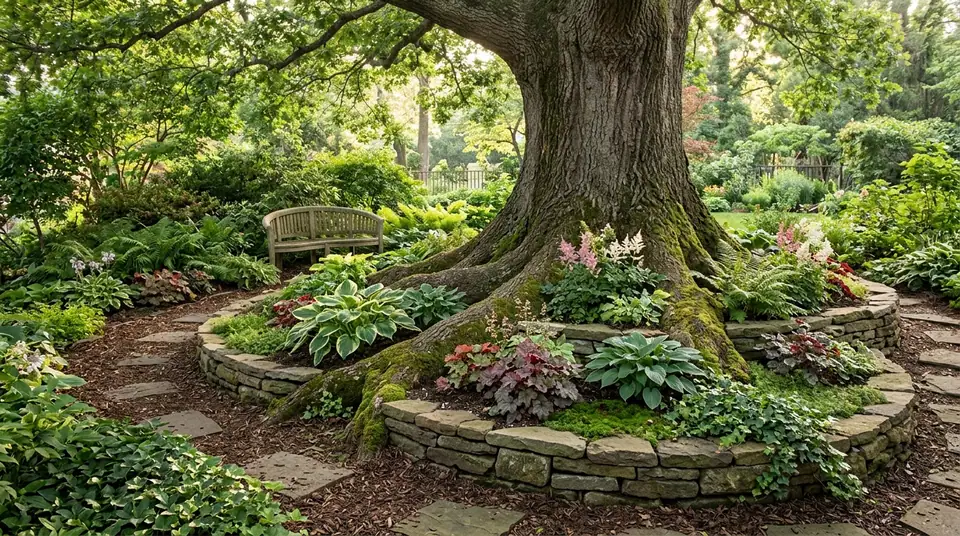
Install Dry-Stacked Borders: Avoid digging trenches for stone edging. Instead, use dry-stacked natural flagstones or timber frames resting flat on the soil surface to define your garden beds.
Mulch with Care: Apply a 2-inch (5 cm) layer of shredded hardwood bark across the bed to retain moisture. Maintain a strict 4-inch (10 cm) clearance gap between the mulch and the tree bark to prevent moisture-trapping collar rot.
Even with the best intentions, landscaping around trees can introduce stress. Here is how to diagnose and correct the most frequent issues:
Chlorosis (Yellowing Leaves): If your understory ferns or hostas develop yellow leaves with green veins, they are likely suffering from iron or nitrogen lockout caused by tree root competition. Combat this by applying chelated iron and top-dressing annually with 0.5 inches (1.2 cm) of leaf mold or worm castings.
Sudden Canopy Dieback: If the canopy of your mature tree begins thinning shortly after you install a new garden bed, you have likely violated the root zone. Immediately pull back any excess soil or mulch piled near the trunk and check for root compaction.
Fungal Conks and Mushrooms: The appearance of shelf fungi at the base of the tree or proliferating mushrooms in your new mulch beds indicates excess moisture or root wounding. Reduce irrigation frequency immediately and ensure your mulch layer is not touching the bark.
⚠️ Important Caution: Never use chemical pre-emergent herbicides or heavy weed killers within the drip line of a tree. Tree roots absorb these chemicals indiscriminately, which can lead to systemic defoliation, twig dieback, or the slow death of the specimen.
Low stone retaining walls holding garden beds around a large tree trunk
5. Frequently Asked Questions
Can I put soil over tree roots to level my yard?
No. Adding more than 2 inches (5 cm) of compacted soil over a root system cuts off the oxygen supply required for cellular respiration. If you must level an area, use porous materials like coarse gravel beneath a raised deck, or accept the natural grade and design step-down terraced planting pockets between the roots.
What are the best plants to grow directly over tree roots?
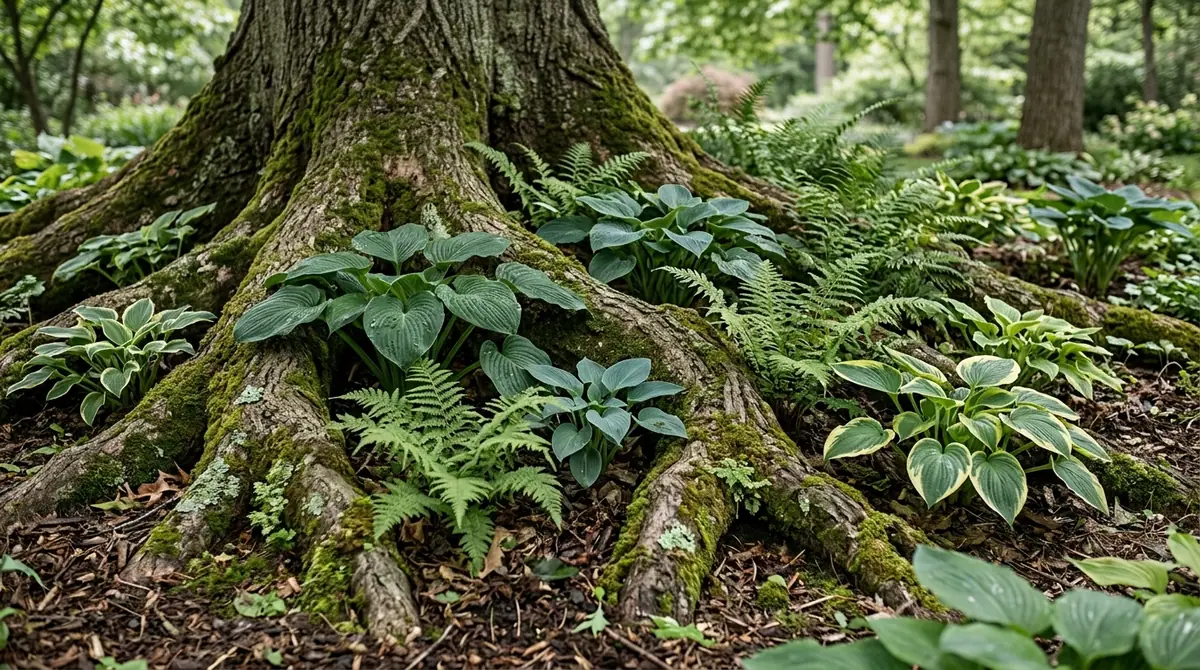
Opt for drought-tolerant, shade-loving perennials with shallow, non-aggressive root systems that will not fiercely compete with the tree. Excellent choices include hostas, ferns (such as Autumn Fern or Christmas Fern), Heuchera (Coral Bells), Liriope muscari (Lilyturf), and wild ginger. For additional inspiration on managing constrained growing spaces, review strategies found in structural guides like the Royal Horticultural Society Plant Finder and Care Advice.
How do I install a pathway over exposed tree roots without killing the tree?
Avoid cutting trenches for pavers. Instead, construct a floating boardwalk or an above-grade gravel path utilizing a permeable geotextile fabric laid flat on the surface, topped with 2 inches (5 cm) of crushed angular stone or wood chips. This allows air and water to freely percolate down to the roots below.
Is it safe to dig small holes for flowers near a tree?
Yes, provided you are outside the 3-foot (1-meter) trunk buffer zone and use a hand trowel rather than a spade shovel. If your trowel hits a woody root thicker than your thumb (roughly 0.75 inches or 2 cm in diameter), fill the hole back in and move your planting spot a few inches over. Never intentionally slice through structural roots to squeeze in a new perennial.
PlantSavvyWorld ist ein unabhängiges botanisches Bildungsprojekt. Artikel werden mit KI-Unterstützung verfasst und anschließend redaktionell geprüft und mit universitären Beratungsdiensten, botanischen Sammlungen und weiteren veröffentlichten Fachquellen abgeglichen.