

ZZ Plant
Zamioculcas zamiifolia
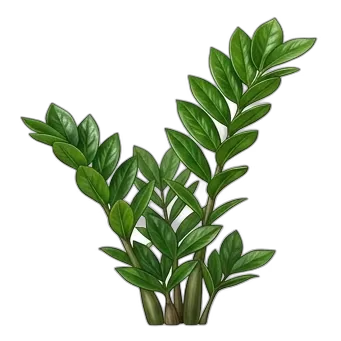
I once neglected a Zamioculcas zamiifolia tucked in the darkest corner of my drafting studio for four solid months while traveling and recovering from a knee surgery. When I finally dragged myself back to the office, expecting a heap of botanical compost, that stubborn plant looked just as glossy, upright, and infuriatingly pristine as the day I left it.

1. Botanical Overview & Natural Habitat
The ZZ plant belongs to the Araceae family, placing it in the same botanical lineage as monsteras, philodendrons, and anthuriums. Native to the semi-arid grasslands, dry forests, and rocky foothills of Eastern Africa—specifically spanning countries like Kenya, Tanzania, and South Africa—Zamioculcas zamiifolia evolved under extreme environmental pressures.
In its native habitat, the ZZ plant experiences a stark bimodal climate: months of intense, punishing drought followed by brief, torrential monsoon seasons. To survive this cycle, the plant developed thick, underground storage organs called rhizomes. These potato-like tubers store vast reserves of water and carbohydrates, allowing the plant to go completely dormant during dry spells.
Above the soil, what most growers call "stems" are actually complex, compound leaves attached to a very short, subterranean stem base. The rachis—the central stalk of the leaf—swells noticeably at its base. This succulent rachis acts as a secondary water reservoir, which accounts for the plant's signature glossy, waxy sheen. That thick cuticle layer on the leaflets drastically reduces transpirational water loss, allowing the plant to reflect harsh sunlight and retain internal moisture when ambient humidity drops near single digits.
Growth is characteristically slow. In a standard indoor environment, a mature ZZ plant will reach heights between 24 to 36 inches (60 to 90 cm) and spread roughly 24 inches (60 cm) wide over several years. Its upright, architectural habit makes it an exceptional counterpoint to trailing species like the Lipstick Plant (Aeschynanthus Radicans) Complete Care & Bloom Guide, which requires entirely different moisture management.
2. Essential Environmental & Care Requirements
Understanding the ZZ plant's native African savanna origins simplifies indoor care. You are not trying to replicate a humid tropical rainforest; you are mimicking a dry, bright woodland edge.
Light is the most flexible parameter for this species, though it dictates growth rate. While it is famous for surviving in windowless offices illuminated solely by fluorescent bulbs, it thrives best in bright, indirect light. An east-facing window or a spot several feet back from a south- or west-facing window provides optimal photon intake. Avoid direct midday sun, which can scorch the waxy leaves, turning them an unsightly bleached yellow-white.
Temperature tolerances are broad, reflecting its subtropical origins. Keep ambient temperatures between 65°F and 85°F (18°C to 29°C). Never expose a ZZ plant to temperatures below 50°F (10°C). Chilling injury occurs rapidly at lower thresholds, resulting in cell wall collapse, blackening of the stems, and eventual root rot.
Watering is where 95 percent of growers fail. Because of those subterranean rhizomes, overwatering is far more lethal than underwatering. Allow the potting mix to dry out completely throughout the entire depth of the container. For a standard 8-inch (20 cm) pot, this typically means watering every 3 to 4 weeks during the active spring and summer growing seasons, and extending that interval to every 6 to 8 weeks during autumn and winter dormancy. When you do water, drench the soil thoroughly until water runs freely through the drainage holes, then discard any standing water in the saucer within 15 minutes.
Soil composition must prioritize aeration and rapid drainage. Heavy, organic-rich garden soil retains too much moisture and suffocates the rhizomes. Instead, use a specialized potting mix formulated for succulents or cacti, or amend a standard peat-based potting soil with 40 percent coarse perlite, pumice, or horticultural grit. For deeper insight into how container depth affects root systems in succulent species, review principles outlined in the How Deep Do Pepper Plant Roots Go? Pot Size & Substrate Depth Guide.
| Parameter | Optimal Condition | Common Mistake | Why It Matters |
|---|---|---|---|
| Light | Bright, indirect light (500–1000 foot-candles) | Direct, scorching midday sun or pitch-black corners | Extreme sun bleaches leaves; total darkness stalls all metabolic activity and weakens the plant. |
| Watering | Complete dry-down between deep waterings | Frequent, shallow sips or continuous dampness | Constant moisture deprives roots of oxygen and triggers anaerobic fungal pathogens that rot rhizomes. |
| Substrate | Fast-draining, coarse mix (pH 6.0–6.5) | Dense, moisture-retaining organic garden soil | Compacted soil holds excess water, choking the root system and causing rapid tissue decay. |
| Temperature | 65°F – 85°F (18°C – 29°C) | Exposure to drafts or drops below 50°F (10°C) | Cold shock damages cellular membranes, leading to irreversible blackening and stem collapse. |
💡 Pro-Tip: If you want to maximize your ZZ plant's growth rate and encourage lush, upright arching stems, place it directly in front of an east-facing window where it receives 1 to 2 hours of gentle morning sun, and feed it with a half-strength, balanced liquid fertilizer twice a year.
3. Step-by-Step Cultivation, Feeding & Propagation
Propagation is one of the most rewarding aspects of working with Zamioculcas zamiifolia. Because of its unique cellular structure, you can propagate new plants through division, leaf cuttings, or stem cuttings. Leaf propagation takes patience—sometimes up to 6 to 12 months to form a viable rhizome—making division the preferred method for faster results.
Here is the step-by-step protocol for propagating a mature ZZ plant via division during its active spring growth phase:
- Unpot the Specimen: Gently ease the plant out of its nursery container. Support the base of the stems and tap the sides of the pot to loosen the root ball.
- Expose the Rhizomes: Shake and brush away old, exhausted potting soil from the root system. Take care not to tear the fragile, fleshy roots unnecessarily.
- Inspect and Sanitize: Locate natural separation points where clusters of rhizomes and stems meet. Sterilize a sharp pruning knife or shears with isopropyl alcohol.
- Divide the Clump: Cut cleanly through the connecting tissue, ensuring that each new division retains at least two healthy stems, an intact cluster of rhizomes, and a robust root system.
- Treat Wounds: Allow the cut surfaces to callous over in a dry, shaded area for 24 to 48 hours to prevent bacterial and fungal entry points.
- Repot Divisions: Plant each division into an appropriately sized container featuring bottom drainage holes, using a well-draining succulent substrate. Ensure the top of the rhizome sits just level with or slightly below the soil surface.
- Settle In: Water the newly potted division lightly to settle the soil around the roots, then withhold further watering for 14 days to encourage the roots to seek out moisture and heal any micro-wounds.
Feeding requirements are minimal. Unlike heavy feeders such as those featured in the The Complete Guide to Coleus Plants: 50+ Varieties, Care, Propagation & Landscaping, the ZZ plant requires very little fertility. Apply a balanced, water-soluble houseplant fertilizer diluted to half strength precisely twice a year—once in early spring and once in mid-summer. Excess fertilizer salts accumulate rapidly in dry potting mixes, causing chemical burn on the root tips and leading to brown leaf tips. For authoritative guidance on soil health and fertility management, consult the Royal Horticultural Society.
4. Common Problems, Pests & Troubleshooting
Even an indestructible plant experiences stress when environmental parameters drift too far outside its comfort zone. Diagnosing issues early prevents total crop loss.
Yellowing Leaves: When lower, older leaves turn bright yellow and drop off, it is often a natural aging process as the plant redirects energy to new shoots. However, if multiple leaves yellow simultaneously alongside mushy stems, you are dealing with overwatering and early-stage root rot. Immediately cease watering, unpot the plant, slice away decayed, brown, foul-smelling roots with sterilized shears, and repot in fresh, dry soil.
Brown Leaf Tips: This symptom usually points to low ambient humidity, irregular watering schedules, or a buildup of fertilizer salts in the root zone. Flush the soil thoroughly with distilled water to leach out excess mineral salts, and trim away dead tips with clean scissors.
Pests: The ZZ plant is remarkably pest-resistant due to its thick, leathery leaves and toxic sap. However, in dry indoor winter conditions, you may occasionally encounter mealybugs or spider mites. Mealybugs appear as white, cottony masses in the leaf axils and beneath the stems. Spider mites create fine webbing along the underside of the rachis.
⚠️ Important Caution: All parts of the ZZ plant contain high concentrations of calcium oxalate crystals. These microscopic, needle-like crystals act as a chemical defense mechanism against herbivores. If ingested, they cause intense irritation, burning, and swelling of the oral mucosa, tongue, and throat in humans and pets. Always wear gloves when dividing or pruning the plant, keep it out of reach of curious cats and dogs, and consult the ASPCA Poison Control Center immediately if ingestion occurs.

5. Frequently Asked Questions
Why are the stems on my ZZ plant turning yellow and falling over?
Stems turning yellow, becoming translucent, and collapsing at the base indicate advanced root rot caused by chronic overwatering or dense, poorly draining soil. The subterranean rhizomes have likely become waterlogged and can no longer transport water and nutrients upward. Immediately unpot the plant, inspect the root system, prune away rotting brown tissue, and repot the remaining healthy divisions in a dry, coarse succulent mix.
How often should I actually water my ZZ plant?
There is no rigid calendar schedule because evaporation rates vary depending on indoor humidity, temperature, and pot size. Instead, use the weight test and the finger test: lift the pot to gauge its weight, and insert your finger 2 inches (5 cm) deep into the soil. If the soil feels completely dry at that depth, water thoroughly until it runs out the drainage holes. For most indoor environments, this translates to every 3 to 4 weeks in summer and every 6 to 8 weeks in winter.
Can a ZZ plant survive in a room with zero natural sunlight?
No plant can survive indefinitely in absolute pitch blackness, as all green plants require light energy to drive photosynthesis. However, a ZZ plant can survive for extended periods under artificial office fluorescent or LED lighting without natural windows. If your space lacks windows entirely, keep the artificial lights turned on for at least 12 hours a day to provide enough energy for basic maintenance metabolism.
Is the ZZ plant toxic to cats and dogs?
Yes. Zamioculcas zamiifolia contains insoluble calcium oxalate crystals throughout its leaves, stems, and rhizomes. If a pet chews or ingests any part of the plant, these needle-like crystals pierce the soft tissues of the mouth and throat, causing immediate burning, excessive drooling, difficulty swallowing, and vomiting. Place your ZZ plant on high shelves or plant stands well out of reach of household pets.





