Spider Plant
Chlorophytum comosum
Standing on a gardener's sunlit mid-century modern landing in Pasadena three springs ago, I pulled a severely root-bound Chlorophytum comosum 'Vittatum' from an unglazed ceramic container, only to find its thick, tuberous roots had completely fractured the inner walls of the pot. That sculptural resilience—the sheer evolutionary will of a plant that stores moisture deep within its subterranean reserves while sending out architectural cascades of plantlets—is why I keep coming back to the spider plant. Whether you are designing a high-traffic interior or looking to balance your living space alongside architectural selections like the Lipstick Plant (Aeschynanthus Radicans) Complete Care & Bloom Guide, mastering this resilient perennial transforms ordinary spaces into dynamic botanical galleries.
1. Botanical Overview & Natural Habitat

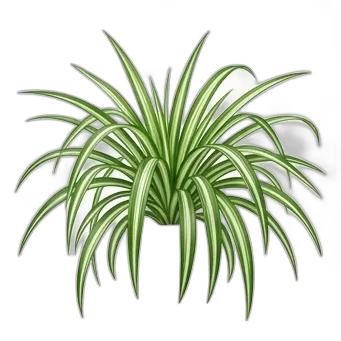
Morphologically, Chlorophytum comosum is characterized by its rosette-forming, arching linear leaves, which typically span 12 to 24 inches (30 to 60 cm) in length and 0.5 to 1 inch (1.2 to 2.5 cm) in width. The foliage can be solid green or variegated—most notably the cultivar 'Vittatum', which features a crisp white central stripe, and 'Variegatum', which displays green centers with white margins.
Beneath the soil surface lies a specialized root system consisting of fleshy, tuberous rhizomes. These storage organs allow the plant to endure extended periods of drought by holding moisture and nutrients, a crucial adaptation for surviving the distinct wet and dry seasons of its native South African range. Following periods of environmental stress or as day lengths shorten, mature specimens produce long, wiry, arching stems—known botanically as stolons or scapes—bearing tiny, star-shaped white flowers. These blossoms eventually give way to vegetative offsets, commonly called "pups" or spiderettes, which root readily upon contact with the soil. For deeper botanical insights into the broader Asparagaceae family, you can consult the Royal Botanic Gardens, Kew.
2. Essential Environmental & Care Requirements
Creating an indoor environment that mimics the dappled, temperate conditions of the South African understory ensures your spider plant thrives. Because indoor microclimates vary wildly, balancing light, water, and soil mechanics is critical.
| Parameter | Optimal Condition | Common Mistake | Why It Matters |
|---|---|---|---|
| Light | Bright, indirect light (10,000 to 20,000 lux) | Direct midday sun | Intense UV rays scorch delicate variegated leaf tissues, causing brown tip burn. |
| Watering | Allow top 2 inches (5 cm) to dry between waterings | Keeping soil constantly saturated | Waterlogged media suffocates roots, triggering rapid rhizome rot. |
| Temperature | 65°F to 85°F (18°C to 29°C) | Exposing to drafts below 50°F (10°C) | Cold stress induces severe leaf blackening and stalls all metabolic activity. |
| Substrate | Well-draining, pH 6.0–7.5, loamy mix | Dense, heavy clay garden soil | Compacted soil impedes oxygen exchange and traps excess moisture around tubers. |
Light exposure dictates the vibrancy of the foliage. While spider plants tolerate lower-light offices (down to 500 foot-candles), prolonged gloom mutes variegation and halts the production of flowering scapes. Conversely, direct afternoon sun causes irreversible photolytic damage to the leaf margins.
Water quality plays an underappreciated role in aesthetic health. Municipal tap water often contains fluorides and chloramines, alongside high concentrations of dissolved salts like calcium and magnesium. Spider plants are exceptionally sensitive to fluoride and boron accumulation, which manifests as necrotic, crispy brown leaf tips. Whenever possible, irrigate with rainwater, reverse-osmosis water, or tap water that has been left uncovered for 24 hours to allow chlorine gas to dissipate.
💡 Pro-Tip: If you notice persistent brown tips despite maintaining proper soil moisture, check your water source. Switch to distilled water for one month and flush the potting mix thoroughly every four weeks to leach out accumulated mineral salts.
3. Step-by-Step Cultivation, Feeding & Propagation
Propagation is where the spider plant truly shines as one of the most rewarding species in horticulture. The production of numerous offsets makes scaling your collection or designing expansive living walls exceptionally straightforward. When potting or repotting your specimens, ensure your container choice matches the root volume—much like calculating substrate depths for deep-rooting edibles as detailed in the How Deep Do Pepper Plant Roots Go? Pot Size & Substrate Depth Guide.
Step-by-Step Propagation and Repotting Sequence
- Select a Vigorous Offset: Choose a healthy, mature spiderette growing on the end of a flowering scape that has developed small, palpable root bumps (nodes) at its base. The offset should be at least 2 to 3 inches (5 to 7.5 cm) across.
- Prepare the Propagation Medium: Fill a small 4-inch (10 cm) nursery container with a sterile, fast-draining propagation mix consisting of equal parts peat-free coco coir, perlite, and fine horticultural grade compost. Moisten the medium until it is evenly damp, not soggy.
- Sever the Stolon: Using a pair of sterilized, sharp micro-pruners or scissors, cut the connecting stolon about 0.5 inches (1.2 cm) away from the base of the baby plantlet.
- Plant the Offset: Press the base of the spiderette gently into the surface of the prepared substrate, ensuring the tiny root nodes make firm contact with the medium. Do not bury the crown of the plantlet, as this invites stem rot.
- Establish High Humidity: Place the newly potted offset inside a clear plastic propagation dome or loosely drape a clear plastic bag over the top to lock in ambient relative humidity above 70%. Keep it in bright, indirect light at 72°F to 78°F (22°C to 26°C).
- Monitor Root Development: After 14 to 21 days, gently tug on the base of the plantlet. Resistance indicates successful root anchoring. Remove the humidity cover and transition the plant to standard maintenance care.
For established container plants, feed during the active growing season (spring through early autumn) every four weeks using a balanced, water-soluble houseplant fertilizer diluted to half-strength. Over-fertilizing leads to a surplus of soluble salts in the substrate, which directly burns the root tips and causes leaf tip necrosis. For seasonal planting benchmarks outside the indoor environment, gardeners in temperate regions often cross-reference indoor care routines with outdoor schedules, such as those found in the When to Plant Strawberries in Kansas: Zone 6a/6b Seasonal Calendar.
⚠️ Important Caution: Never let your spider plant sit in a saucer filled with standing water for more than 15 minutes. Prolonged water saturation cuts off atmospheric oxygen to the fleshy tuberous roots, causing rapid anaerobic decay that can kill a mature plant within days.
4. Common Problems, Pests & Troubleshooting
Even the toughest houseplants occasionally signal distress. Reading your spider plant's physiological cues prevents minor issues from escalating.
- Brown Leaf Tips: The most common affliction. If the tips are crisp and brown, the culprit is usually fluoride/chlorine toxicity, low ambient humidity (below 40%), or irregular watering cycles. Trim the dead tips at a 45-degree angle using sharp shears to mimic the natural leaf contour.
- Loss of Variegation: When a variegated cultivar reverts to solid green, it is almost always responding to insufficient light levels. Move the plant closer to an east- or bright north-facing window.
- Yellowing Lower Leaves: Older foliage naturally yellows and dies off as the plant matures. However, if multiple leaves turn soft, yellow, and translucent simultaneously, you are overwatering and the root system is experiencing hypoxia or root rot.
- Sucking Pests (Spider Mites and Aphids): Indoor environments with dry air and warm temperatures can attract two-spotted spider mites (Tetranychus urticae), which spin fine webbing on the undersides of leaves. Rinse the foliage thoroughly in a sink or shower with lukewarm water, then treat persistent infestations with insecticidal soap or horticultural oil applied every 7 days for a 3-week cycle. For comprehensive guidelines on managing agricultural and ornamental pests, consult the University of California Statewide Integrated Pest Management Program (UC IPM).

5. Frequently Asked Questions
Why are my spider plant leaves turning brown at the tips?
Leaf tip browning is typically caused by sensitivity to fluoride, chlorine, or chemical salts found in tap water, combined with low indoor humidity. Switch to distilled, filtered, or rain water, and ensure your potting mix is thoroughly leached of built-up fertilizer salts every month.
How often should I water my spider plant?
Allow the top 2 inches (5 cm) of the potting soil to dry out completely before watering thoroughly until water runs freely through the container's drainage holes. In a typical indoor environment at 70°F (21°C), this equates to watering roughly every 7 to 10 days during the growing season and every 14 to 21 days in the winter.
Are spider plants safe for cats and dogs?
Yes. According to the ASPCA, Chlorophytum comosum is entirely non-toxic to cats, dogs, and horses. However, cats are frequently attracted to the swaying foliage and mild hallucinogenic properties of the plant, so keep prized specimens out of paw's reach to prevent excessive nibbling and vomiting.
Why is my spider plant not producing babies (pups)?
Spider plants only produce offsets when they are mature (typically at least 12 to 18 months old) and receiving sufficient bright, indirect light. If your plant is kept in a low-light corner or is constantly constrained in an oversized pot where it must expend all its energy growing underground roots rather than top growth, it will not flower or set runners.
📋 Table of Contents ▼ Click to expand
Tags: