
Snake Plant
Sansevieria trifasciata
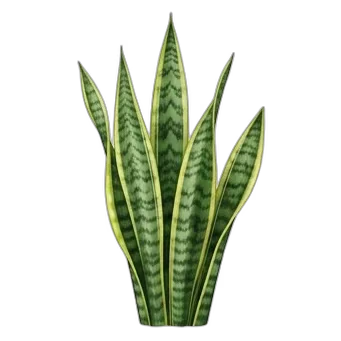
The snake plant, specifically Sansevieria trifasciata 'Laurentii', demonstrates exceptional resilience, surviving under fluorescent tubes for extended periods with minimal water while maintaining upright, sword-like, architectural, green, and turgid leaves even when root growth shatters nursery pots. By contrast, tropical plants like the Lipstick Plant (Aeschynanthus Radicans) Complete Care & Bloom Guide have delicate humidity needs, making the snake plant a benchmark for botanical tenacity in drought-tolerant interior scapes and urban container gardens.
1. Botanical Overview & Natural Habitat

Morphologically, the plant features stiff, succulent leaves that emerge directly from underground horizontal rhizomes. These leaves are structurally engineered for survival. Their thick epidermal layer and tightly regulated stomata utilize Crassulacean Acid Metabolism (CAM) photosynthesis, a specialized carbon fixation pathway. Unlike traditional plants that open their stomata during the heat of the day, snake plants open theirs at night to minimize transpirational water loss, absorbing carbon dioxide and storing it as malic acid until daylight breaks.
Taxonomically, collectors often confuse these structural variants. Sansevieria trifasciata features striking transverse gray-green banding across dark green leaves. Cultivars like 'Laurentii' add vibrant golden-yellow margins, while 'Zeylanica' showcases narrower, wavy green bands without the yellow edge. Dwarf variations, such as Dracaena trifasciata 'Hahnii', form tight, low-growing rosette clusters barely 6 inches (15 cm) tall, contrasting sharply with standard species that routinely reach heights of 3 feet to 4 feet (90 cm to 120 cm).
For a deeper scientific dive into the physiology of succulent species, consult the Missouri Botanical Garden Plant Finder.
2. Essential Environmental & Care Requirements
Mastering snake plant care requires mimicking its native West African scrubland habitat. While the plant is legendary for tolerating neglect, optimizing its environment accelerates growth and intensifies leaf coloration.
| Parameter | Optimal Condition | Common Mistake | Why It Matters |
|---|---|---|---|
| Light | 4 to 6 hours of bright, indirect light daily | Placing in deep, windowless corners | While it survives low light, growth halts and variegation fades without adequate photons. |
| Watering | Complete dry-out between waterings (every 14 to 21 days) | Following a strict weekly schedule | Constant moisture suffocates root hairs and triggers systemic stem rot. |
| Substrate | Gritty, fast-draining cactus and succulent mix | Heavy, organic potting soil that retains water | Dense soils hold perched water tables that rot the underground rhizome network. |
| Temperature | 60°F to 85°F (15°C to 29°C) | Exposing to drafts below 50°F (10°C) | Chilling injury damages cellular walls, leading to translucent, collapsing foliage. |
Light is often misunderstood. While snake plants adapt to low-light office environments, they thrive when given eastern or western exposures. Direct, scorching midday sun through south-facing glass can bleach the leaves or cause sunscald, leaving unsightly white patches.
Temperature management is equally straightforward. Keep your plants away from drafty exterior doors in winter and aggressive HVAC vents. If you enjoy studying how plant root systems adapt to varying container volumes and substrates, you might find structural parallels in guides like How Deep Do Pepper Plant Roots Go? Pot Size & Substrate Depth Guide.
💡 Pro-Tip: When checking your snake plant for moisture, never rely solely on touching the top inch of soil. Use a wooden dowel inserted all the way to the bottom of the pot. If any damp soil clings to the wood when pulled out, withhold water for another 7 days.
3. Step-by-Step Cultivation, Feeding & Propagation
Propagating and cultivating snake plants is remarkably straightforward if you respect their physiological limits. Whether you are potting a nursery specimen or multiplying your collection, precision matters.
Step-by-Step Propagation via Leaf Cuttings
- Select a Healthy Mother Leaf: Choose a mature, unblemished leaf from an established plant using sterilized pruning shears.
- Section the Leaf: Slice the leaf horizontally into 2-inch to 3-inch (5 cm to 7.5 cm) segments, keeping meticulous track of the original polarity—the bottom edge must always point downward.
- Callous the Cuts: Lay the segments out on a clean paper towel in a warm, shaded area for 48 to 72 hours to allow the cut wounds to callous over and prevent bacterial entry.
- Plant the Cuttings: Insert the bottom third of each cutting into a pre-moistened, sterile propagation mix composed of 50% perlite and 50% peat-free potting soil, ensuring the directional orientation remains correct.
- Provide Rooting Conditions: Place the container in bright, indirect light, maintaining an ambient temperature of 70°F to 75°F (21°C to 24°C). Mist the surface lightly every 5 to 7 days.
- Transplant New Offsets: After 60 to 90 days, vigorous root systems and small pups will emerge from the base of the cuttings. Transplant these individual divisions into standard 4-inch (10 cm) pots filled with succulent soil.
Feeding requirements are minimal. Apply a balanced, water-soluble houseplant fertilizer diluted to half-strength just twice a year—once in spring and once in mid-summer. Avoid high-nitrogen fertilizers, which force weak, floppy leaf growth susceptible to snapping.
⚠️ Important Caution: If you propagate variegated cultivars like Sansevieria trifasciata 'Laurentii' via leaf cuttings, the resulting pups will revert to solid green, losing their signature yellow margins. To preserve variegation, you must propagate exclusively through root division of existing rhizome offsets.
For broader landscape design applications, mixing textures and colors is vital. If you enjoy pairing architectural indoor plants with vibrant foliage contrast outdoors, take a look at The Complete Guide to Coleus Plants: 50+ Varieties, Care, Propagation & Landscaping.
4. Common Problems, Pests & Troubleshooting
Even the toughest houseplants encounter stress. Identifying symptoms early prevents catastrophic plant failure.
Root Rot (Rhizome Decay)
- Symptoms: Leaves turn yellow, become mushy at the soil line, and easily pull away from the root system. The base emits a foul, sulfurous odor.
- Cause: Overwatering combined with poor soil drainage and lack of container air circulation.
- Solution: Unpot the plant immediately. Use a sterilized blade to carve away all brown, mushy roots and rhizome tissue until you hit crisp, white, healthy flesh. Dust the remaining wounds with horticultural sulfur or ground cinnamon, let the plant dry bare-root for 48 hours, and repot into fresh, dry succulent mix.
Leaf Tip Dieback and Browning
- Symptoms: The sharp apex of the leaf turns brown, brittle, or black.
- Cause: Mechanical damage from brushing against high-traffic walkways, or chemical toxicity from fluoridated or chlorinated tap water accumulating in the leaf tips.
- Solution: Snip off the damaged tip at a 45-degree angle using clean shears, mimicking the natural leaf shape. Switch to filtered or rainwater for irrigation.
Pests: Mealybugs and Spider Mites
- Symptoms: Cottony white webs tucked into leaf joints (mealybugs) or fine stippling and webbing across the leaf surfaces (spider mites).
- Cause: Low indoor relative humidity and poor ambient air exchange.
- Solution: Wipe down all leaf surfaces with a cloth saturated in 70% isopropyl alcohol. For persistent infestations, apply a thorough spray of horticultural neem oil every 7 days for a three-week cycle.

5. Frequently Asked Questions
Why are my snake plant leaves turning yellow and falling over?
Yellowing, collapsing leaves are the textbook sign of overwatering and subsequent root rot. When the soil remains saturated for too long, the roots suffocate and can no longer transport water and nutrients upward. Cease watering immediately, inspect the root ball for decay, and ensure your container features functional drainage holes.
Do snake plants need direct sunlight to survive?
No. Snake plants naturally grow under the dappled canopy of taller shrubs and trees in their native African habitat. While they adapt to low-light indoor spaces, they flourish best under bright, indirect light. Direct, harsh afternoon sun will scorch their leaves, leaving bleached, papery scars.
How often should I water my snake plant in the winter?
During winter, indoor heating drops relative humidity, but the plant's metabolic rate also slows down due to reduced daylight hours. Water your snake plant sparingly—typically every 4 to 6 weeks. Always verify that the soil is 100% dry from top to bottom before applying moisture.
Are snake plants toxic to cats and dogs?
Yes. Snake plants contain saponins, which are natural chemical compounds produced by the plant as a defense mechanism against herbivores. If ingested by domestic pets, saponins cause excessive salivation, vomiting, nausea, and diarrhea. Keep your plants elevated on plant stands or display shelves out of reach of curious cats and dogs.
📋 Table of Contents ▼ Click to expand
Tags: