

Wax Plant
Hoya carnosa
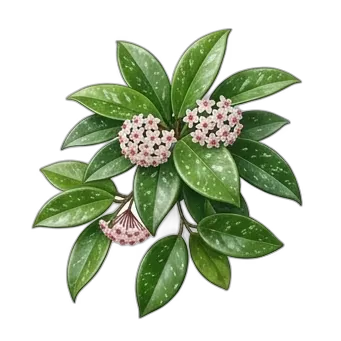
It was a sticky Tuesday morning in a greenhouse when I noticed the faint, intoxicating scent of chocolate and honey drifting down from the rafters. My oldest Hoya carnosa, a sprawling specimen I rescued from a neglected office lobby twelve years ago, had finally opened its umbel of porcelain-pink, star-shaped flowers. For three years prior, that vine had produced nothing but lush, glossy green foliage. The secret wasn't a secret formula or an expensive fertilizer; it was a simple lesson I had learned the hard way: neglect it just enough to make it think it’s fighting for survival in a Taiwanese tree canopy.

1. Botanical Overview & Natural Habitat
Hoya carnosa, commonly known as the porcelain flower or wax plant, belongs to the Asclepiadaceae subfamily within the vast Apocynaceae (dogbane) family. Native to warm, humid regions of East Asia and Australia—spanning from southern China and Taiwan down to Queensland—this plant is an epiphyte or lithophyte in its natural state.
Instead of anchoring itself deeply into nutrient-rich forest floors, the wax plant creeps along tree trunks or clings to mossy rock faces. Its roots are exposed to rapid wet-dry cycles, receiving torrential tropical rains followed by intense, drying winds. This evolutionary history dictates every single aspect of its indoor care.
The leaves of Hoya carnosa are thick, ovate, and heavily suberized—meaning they are coated in a thick, waxy cuticle designed to minimize moisture loss through transpiration. This succulent adaptation allows the plant to endure weeks of drought without cellular collapse.
When mature, the plant produces distinctive, dome-shaped umbels consisting of 15 to 30 star-shaped flowers. Each individual bloom features a double corolla: a fuzzy, porcelain-like outer star cradling a glossy, nectar-rich inner corona. If you are comparing floral curiosities for your indoor jungle, you might also appreciate the cascading habit of the Lipstick Plant (Aeschynanthus Radicans) Complete Care & Bloom Guide, another brilliant epiphyte with contrasting tubular blooms.
2. Essential Environmental & Care Requirements
Replicating an epiphytic habitat indoors requires balancing light, moisture, and airflow. The most common pitfall with Hoya carnosa is treating it like a standard tropical fern when it behaves much more like a drought-tolerant succulent.
| Parameter | Optimal Condition | Common Mistake | Why It Matters |
|---|---|---|---|
| Light | Bright, indirect light (4 hours of gentle direct morning sun) | Low-light interior corners | Prevents the vine from flowering and causes elongated, weak internodes |
| Watering | Soak completely, then let dry 100% down to 2–3 inches (5–7 cm) deep | Frequent, shallow sips | Causes root rot by keeping the lower root zone perpetually saturated |
| Substrate | Chunky, fast-draining mix (orchid bark, perlite, coco coir) | Dense standard potting soil | Suffocates epiphyte roots that require high atmospheric oxygen exchange |
| Temperature | 60°F to 85°F (15°C to 29°C) | Sudden drafts below 50°F (10°C) | Triggers leaf drop and severe cold shock in tropical tissues |
Light and Temperature Dynamics
To trigger blooms, your wax plant needs bright light. Place it within 3 feet (1 meter) of an east- or west-facing window. Temperatures should remain stable between 60°F and 85°F (15°C to 29°C). For authoritative guidelines on regional hardiness and microclimates when moving plants outdoors during warm months, consult the Royal Horticultural Society (RHS) Plant Finder.
💡 Pro-Tip: Never pluck the old flower spurs (peduncles) after blossoms fade. Hoya carnosa produces flowers from the exact same woody spur year after year. Removing a peduncle forces the plant to waste months growing a new one before it can bloom again.
3. Step-by-Step Cultivation, Feeding & Propagation
Growing a specimen-grade wax plant requires patience and precision. Whether you are potting a fresh cutting or reviving a root-bound basket, follow this exact cultivation protocol.
- Select and Prepare the Container: Choose a pot with wide drainage holes that is only slightly larger than the root ball—typically 4 to 6 inches (10 to 15 cm) in diameter. Hoyas actually bloom more reliably when slightly root-bound.
- Mix the Epiphytic Substrate: Combine 40% high-quality orchid bark, 30% coarse perlite or pumice, and 30% nutrient-rich coco coir or peat-based potting mix. This guarantees high air porosity.
- Planting Depth: Position the crown level with the soil surface. Do not bury the stems deeply; ensure the upper roots sit roughly 1 inch (2.5 cm) below the rim to prevent stem rot.
- Initial Watering and Settle-In: Water thoroughly until it runs freely from the drainage holes. Allow excess moisture to drain completely for 20 minutes.
- Feeding Regimen: Apply a balanced, water-soluble fertilizer diluted to half-strength once every 4 weeks strictly during the active growing season (spring through late summer). Cease fertilization entirely from November through February.
Propagation via Stem Cuttings
Multiplying your collection is remarkably straightforward. Use clean pruning shears to snip a 4 to 6 inch (10 to 15 cm) stem tip containing at least two node sites and two leaves. Strip the lower leaves off, leaving the top two intact. Dip the cut end in rooting hormone powder and insert it into a mixture of damp perlite and peat. Keep the medium consistently humid at 75°F (24°C). Roots will reliably emerge from the nodes within 14 to 21 days. If you enjoy experimenting with diverse plant propagation methods, you will find striking parallels in The Complete Guide to Coleus Plants: 50+ Varieties, Care, Propagation & Landscaping, which roots just as effortlessly in water or substrate.
⚠️ Important Caution: Hoya carnosa sap contains milky latex compounds that can cause mild contact dermatitis in sensitive individuals and moderate gastrointestinal irritation if ingested by curious cats or dogs. Keep prized cultivars out of reach of household pets.
4. Common Problems, Pests & Troubleshooting
Even resilient plants throw tantrums when environmental parameters drift. Here is how to diagnose and correct the most frequent issues facing wax plant growers.
Leaf Drop and Stem Dieback
Sudden shedding of plump, green leaves usually points to overwatering and subsequent anaerobic root rot. Conversely, if the leaves are paper-thin, wrinkled, and brittle, the plant is severely underwatered. Adjust your watering cadence immediately and inspect the root system; trim away black, mushy roots with sterilized shears before repotting in dry, chunky media.
Mealybugs and Scale Insects

5. Frequently Asked Questions
Why is my wax plant growing long, naked vines with no leaves?
Those naked vines are searchers looking for a structure to climb. In low-light environments, the plant stretches out internodes rapidly in search of better sun exposure. Increase light levels immediately and prune the vine back to a node to encourage branching and compact foliage production.
How long does it take for a Hoya carnosa to flower from a cutting?
From a fresh stem cutting, expect anywhere from 2 to 4 years of maturation before the plant produces its first umbel. Young vines prioritize foliar and root development; patience is required until the root system fills its container and hormonal maturity is reached.
Should I mist my wax plant to increase humidity?
Misting provides only fleeting humidity and can trap moisture in tight leaf axils, encouraging fungal leaf spot and bacterial rot. Instead of misting, maintain ambient indoor humidity between 40% and 60% using a mechanical room humidifier or place the pot on a pebble tray filled with water.
Why are the leaves turning yellow and dropping off?
Yellowing foliage is the classic diagnostic indicator of root suffocation caused by heavy, water-retentive soil or a container lacking adequate drainage holes. Allow the substrate to dry out entirely between irrigation cycles, and switch to a coarser, bark-heavy medium if drainage remains sluggish.
📋 Table of Contents ▼ Click to expand
Tags:





