Friendship Plant
Pilea involucrata
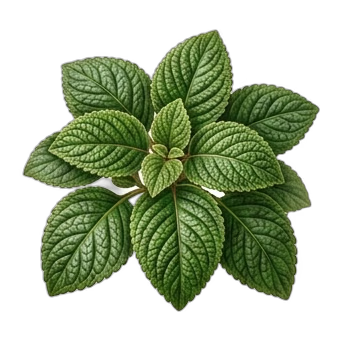
I am kneeling on the cold terracotta tile of my home conservatory, squinting through a hand lens at a patch of velvety, bronze-tinted foliage that has suddenly started sending out tiny, insignificant pinkish-white flower spikes. That was ten years ago, when I first brought home a scraggly, 4-inch nursery pot labeled simply "Friendship Plant." Since then, I have watched Pilea involucrata transform from a trendy greenhouse novelty into one of the most reliable, communicative groundcovers and terrarium subjects in my landscape design portfolio. When gardeners ask for a plant that tells you precisely what it needs without throwing a dramatic tantrum, this is the species I hand them.
1. Botanical Overview & Natural Habitat

Morphologically, Pilea involucrata is celebrated for its highly textured, quilted leaves. The foliage features deep veins and a puckered, dimpled surface texture known as bullate foliage. Leaves are oval to elliptic, growing typically to lengths of 1.5 to 3 inches (3.8 to 7.6 cm), and display a rich dark green or bronze center framed by deep reddish-bronze or chocolate margins. The undersides of the leaves often exhibit a striking purplish-red hue.
The plant has a creeping, spreading growth habit, rarely exceeding 12 inches (30 cm) in height while spreading laterally up to 12 to 18 inches (30 to 45 cm) or more. Stems are succulent, semi-translucent, and segmented with swollen nodes where adventitious roots easily form upon soil contact. Because of its structural affinity for tropical understories, its growth speed is moderate to fast during the active growing season, making it a stellar companion plant for terrariums, bottle gardens, and moisture-retentive woodland shade settings.
When evaluating shade-tolerant and textured understory plantings, Pilea involucrata shares several management parallels with plants like The Complete Guide to Coleus Plants: 50+ Varieties, Care, Propagation & Landscaping, particularly regarding its sensitivity to direct solar radiation and its need for pinching to encourage a bushy, dense structural form.
2. Essential Environmental & Care Requirements
Replicating a tropical rainforest floor inside a climate-controlled home or office requires strict attention to environmental parameters.
Light must be bright, indirect, and gentle. Direct midday sun will scorch the delicate, puckered leaf tissue, bleaching the bronze highlights into an unsightly white or brown paper-thin crust. An east-facing windowsill or a spot set back 3 to 5 feet (0.9 to 1.5 m) from a bright south- or west-facing window provides the ideal 10,000 to 15,000 lux.
Temperature ranges must remain stable. Pilea involucrata thrives in ambient temperatures between 65°F and 75°F (18°C to 24°C). Temperatures dipping below 50°F (10°C) will cause the succulent stems to turn mushy and collapse from chilling injury. Drafts from air conditioning vents or winter heating registers will rapidly desiccate the foliage, leading to crisp, brown leaf margins.
Humidity is the single most critical factor for success. While a standard home with 30% humidity won't kill the plant instantly, its leaves will lose their saturated luster and curl inward. To maintain its velvety texture, target a relative humidity of 50% to 70%. This makes the friendship plant an exceptional candidate for terrariums, glass cloches, or bathroom windowsills where ambient steam provides natural atmospheric moisture.
Watering requires a delicate balance. The substrate should be kept consistently moist—comparable to a wrung-out sponge—but never waterlogged. Allow the top 0.5 inches (1.3 cm) of the soil mix to dry out between waterings, but never let the root ball dry out completely.
| Parameter | Optimal Condition | Common Mistake | Why It Matters |
|---|---|---|---|
| Light | Bright, indirect (10,000–15,000 lux) | Direct midday sun | Scorches delicate leaf tissue and fades bronze pigmentation |
| Temperature | 65°F–75°F (18°C–24°C) | Exposure below 50°F (10°C) | Causes cell wall collapse and fatal stem rot |
| Humidity | 50%–70% relative humidity | Dry indoor air (<30% RH) | Leads to crisp leaf margins, curling, and stunted growth |
| Substrate | Peat-rich, highly porous, pH 6.0–6.5 | Heavy clay or dense garden soil | Suffocates fine roots and promotes Pythium root rot |
For a broader academic perspective on indoor tropical foliage management and microclimate optimization, consult the Royal Horticultural Society Pilea Cultivation Guide.
3. Step-by-Step Cultivation, Feeding & Propagation
Growing a specimen-quality friendship plant requires an understanding of its root system. Unlike taprooted perennials, Pilea involucrata possesses a shallow, fibrous root architecture that demands loose, aerated media. When potting or repotting, use a custom soil blend consisting of 40% high-quality peat moss or coco coir, 30% perlite or pumice for drainage, and 30% organic compost or worm castings.
Feeding should be approached conservatively. Because its stems are semi-succulent and its roots are fine, heavy synthetic fertilizers will burn the root tips. Apply a balanced, water-soluble houseplant fertilizer diluted to quarter-strength once every 4 weeks strictly during the active growing season (April through September). Withhold all fertilizer entirely during the low-light winter months (October through March).
Propagation is exceptionally easy, which is how the plant earned its common name—gardeners traditionally snip stems to share with friends.
💡 Pro-Tip: When propagating Pilea involucrata, always take tip cuttings that include at least two exposed nodes. The rooting hormone concentration is highest at the apical meristem, and rooting these in a closed propagation box or clear plastic bag guarantees a 95%+ success rate within 14 days.
Step- végétal: Stem Cutting Propagation Protocol
- Select Mother Material: Choose a healthy, actively growing stem free of pests or mechanical damage during the spring or early summer.
- Make the Cut: Using a pair of sharp, disinfected floral shears, snip a 3 to 4-inch (7.6 to 10 cm) section of stem just below a lower leaf node.
- Strip Lower Foliage: Remove the lower leaves from the bottom 1 inch (2.5 cm) of the cutting to expose bare nodes, leaving only one or two leaves at the top.
- Prepare the Propagation Medium: Fill a small propagation tray or 3-inch (7.6 cm) pot with a pre-moistened 1:1 blend of perlite and peat moss.
- Insert the Cutting: Poke a pilot hole with a pencil, insert the stripped node 1 inch (2.5 cm) deep into the medium, and gently press the mix around the stem to secure it.
- Create a Humidity Tent: Cover the container with a clear plastic dome or bag to lock in 100% humidity, placing it in bright, indirect light at 70°F–75°F (21°C–24°C).
- Monitor and Acclimate: Check for root resistance by gently tugging on the cutting after 14 to 21 days. Once roots reach 1 inch (2.5 cm) in length, remove the humidity dome gradually over 4 days to harden off the new plant before potting it into standard soil.
4. Common Problems, Pests & Troubleshooting
Even experienced indoor horticulturists occasionally encounter issues with Pilea involucrata. Diagnosing them requires looking closely at the leaves and stems.
- Edema and Stem Rot: If the lower stems turn translucent, black, and mushy, you are overwatering or using a heavy, poorly draining substrate. Immediately cease watering, cut away rotting sections, and repot healthy stem tips into fresh, dry perlite-rich mix.
- Crispy, Brown Leaf Tips: This indicates low ambient humidity or underwatering. Mist the surrounding air daily or group the plant with other tropical species to raise local humidity. If you live in an arid zone where maintaining ambient humidity is a perpetual challenge, you may want to review strategies used in regional water-conscious landscape setups, such as those detailed in When to Plant Onions in Southern California (Zone 9 & 10 Planting Calendar).
- Leggy, Sparse Growth: When stems stretch out with long internodes and small leaves, the plant is starving for light. Move it closer to an east-facing window and aggressively pinch back the growing tips to stimulate lateral branching.
- Pest Infestations: Spider mites (Tetranychus urticae) and fungus gnats (Bradysia species) are the primary insect threats. Spider mites thrive in warm, dry indoor air, spinning fine webs on the undersides of leaves and causing stippling. Treat mites by wiping leaves down with insecticidal soap or horticultural oil. Fungus gnats indicate over-wet topsoil; let the top 1 inch (2.5 cm) dry out completely and apply biological larvicides like Bacillus thuringiensis israelensis (BTI) to the watering can.
⚠️ Important Caution: Never apply heavy dormant oils or harsh petroleum-based insecticidal sprays directly to the delicate, puckered foliage of Pilea involucrata. The leaf texture traps chemicals easily, leading to severe chemical burns and rapid leaf drop. Always test any treatment on a single hidden leaf 24 hours before full application.

5. Frequently Asked Questions
Why are the leaves on my friendship plant turning yellow and dropping off?
Yellowing and dropping leaves are almost always a symptom of overwatering or root asphyxiation. When the soil remains saturated for too long, oxygen is driven out of the pore spaces, causing the fine roots to suffocate and die. Check the moisture level deep in the pot. If the soil is wet, allow it to dry out, remove damaged foliage, and ensure your pot has functional drainage holes.
Is the friendship plant safe for cats and dogs?
Yes, Pilea involucrata is completely non-toxic to cats, dogs, and horses, according to the ASPCA. This makes it a fantastic, worry-free choice for households with curious pets who like to inspect indoor greenery.
Why is my friendship plant losing its dark bronze and red colors?
A loss of deep coloration and a turn toward a pale, washed-out green usually indicates insufficient light. While the plant tolerates low light, it requires bright, indirect sunlight to synthesize the anthocyanin pigments that create its rich bronze and chocolate tones. Move it closer to a natural light source, but avoid direct sunbeams that cause leaf scorch.
How do I make my friendship plant bushier instead of long and trailing?
To encourage a dense, mounding habit, you must practice regular pinching. Every few weeks during the spring and summer, use clean fingernails or small snips to pinch off the very tips of the growing stems right above a leaf node. This halts vertical dominance and forces the dormant nodes below to break, doubling your stem count and creating a lush, full canopy.
📋 Table of Contents ▼ Click to expand
Tags: