

Air Plant
Tillandsia ionantha
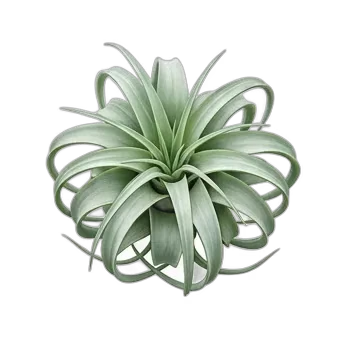
Placing a cluster of Tillandsia ionantha on a vertical slab of driftwood without a single gram of potting soil allows the specimens to blush a brilliant, fiery crimson within six months, send up delicate violet tubular flowers, and double their footprint by pushing out sturdy basal pups. That setup captures the magic of the air plant: it challenges assumptions about plant biology by substituting soil and pots for architectural freedom.

1. Botanical Overview & Natural Habitat
Tillandsia ionantha, commonly known as the blushing bride or simply an air plant, is a dwarf epiphytic perennial belonging to the Bromeliaceae family. Native to the broadleaf forests, scrublands, and mountainous terrains of Central America and Mexico—stretching from southern Mexico through Costa Rica—this species grows clinging to the bark of host trees or bare rock faces at elevations ranging from sea level up to 5,000 feet (1,500 meters).
Because they are epiphytes, Tillandsia ionantha are strictly non-parasitic. They use their short, wiry roots solely as anchors to secure themselves against gravity and wind shear on vertical surfaces, absorbing all of their required moisture and nutrients directly from the ambient air through specialized foliar structures called trichomes.
These trichomes are microscopic, umbrella-shaped epidermal cells that give the leaves their characteristic silvery-gray or frosted appearance. When ambient humidity is high or during watering, these scales open up like tiny sponges to absorb water and dissolved minerals rapidly; when dry, they clamp shut to minimize transpiration, reflecting harsh sunlight and preventing desiccation.
Morphologically, Tillandsia ionantha forms tight, symmetrical rosettes of rigid, succulent, tapered leaves measuring roughly 2 to 4 inches (5 to 10 cm) in height and width at maturity. The species exhibits striking polymorphism across its various cultivars (fuego, variegata, rubra, and mexica robusta), but the botanical hallmark of the species is its dramatic anthesis (flowering phase). As the plant reaches maturity, the inner leaves of the rosette undergo a chemical transition, blushing a vibrant, neon red, pink, or orange over a period of 14 to 30 days. From the center of this colored bract emerges a cluster of tubular, deep violet-blue flowers that typically last for 3 to 7 days.
While Tillandsia ionantha is remarkably distinct, the principles of managing epiphyte architecture and moisture stress share functional parallels with managing indoor humidity and light requirements found in tropical trailing specimens like the Lipstick Plant (Aeschynanthus Radicans) Complete Care & Bloom Guide, where understanding specialized foliar uptake and airflow prevents the root rot and leaf drop common in stagnant indoor environments.
2. Environmental & Care Requirements
Growing air plants successfully indoors requires mimicking the dynamic airflow, shifting light patterns, and alternating wet-dry cycles of a tropical canopy. When translating these wild adaptations to human habitats, precise metrics make the difference between thriving specimens and desiccated skeletons.
| Parameter | Optimal Condition | Common Mistake | Why It Matters |
|---|---|---|---|
| Light | Bright, indirect light; 2,000 to 4,000 foot-candles (filtered morning sun) | Direct, scorching midday sun through glass | Direct sun cooks the internal leaf tissue, causing irreversible cellular collapse and sunburn. |
| Watering | Submersion for 20–30 minutes every 7–10 days, followed by inverted shake | Misting once a day or letting water pool in the rosette base | Misting provides insufficient hydration to the inner trichomes, while pooled water causes basal rot. |
| Temperature | 65°F to 85°F (18°C to 29°C) | Exposure to frost or prolonged temperatures below 40°F (4°C) | Sub-freezing temperatures rupture the water-filled cells of the succulent foliage, leading to rapid cell death. |
| Airflow | High horizontal air circulation; drying completely within 4 hours | Stagnant, humid enclosures like closed glass terrariums | Trapped moisture prevents the trichomes from drying, inviting opportunistic fungal pathogens. |
Light is the primary engine of Tillandsia ionantha growth. Place your plants within 3 to 5 feet (1 to 1.5 meters) of an unobstructed east- or south-facing window. If natural light is insufficient, full-spectrum LED grow lights delivering roughly 500 to 800 photosynthetic photon flux density (PPFD) for 12 hours daily will maintain vigorous growth and trigger the brilliant red blooming blush.
Air movement is the most commonly overlooked variable. In nature, wind constantly sweeps across the forest canopy, drying the plant within minutes of a rain shower. Indoors, never place your Tillandsia inside a sealed glass globe or terrarium unless active, mechanical ventilation is supplied. For deeper insights into balancing root-zone and canopy moisture in restricted spaces, you can reference structural soil-depth dynamics discussed in How Deep Do Pepper Plant Roots Go? Pot Size & Substrate Depth Guide, which details how restricted gas exchange suffocates plant tissue.
💡 Pro-Tip: Always shake your Tillandsia ionantha upside down vigorously three to five times immediately after every watering session. This flings out excess water trapped deep inside the central leaf funnel, completely eliminating the risk of catastrophic crown rot.
3. Step-by-Step Cultivation, Feeding & Propagation
Propagation of Tillandsia ionantha relies entirely on offsets, known botanically as "pups." After the mother plant finishes flowering—a process that drains its energy reserves—it will slowly decline over several months to a year, but not before investing its remaining resources into producing between one and four vigorous pups at its base.
Here is the exact horticultural protocol for watering, mounting, feeding, and separating your air plants for maximum longevity and display density:
- Hydration Phase: Submerge your Tillandsia ionantha completely in a bowl of room-temperature, chemical-free water (rainwater, distilled water, or aged tap water allowed to sit out for 24 hours to off-gas chlorine) for 20 to 30 minutes.
- Drying & Inversion: Remove the plant from the water bath and gently shake it upside down over the sink. Place it upside down on a clean, absorbent towel in a well-ventilated area for 2 to 4 hours until the silver trichomes dry completely and the leaves return to their frosted state.
- Fertilization (Bi-Weekly): During the active growing season (spring through summer), prepare a weak foliar fertilizer solution formulated specifically for bromeliads or orchids, diluted to 1/4 strength (roughly 1/4 teaspoon per gallon of water). Mist the plant with this solution once every 3 to 4 weeks instead of your standard water soak. Never use standard houseplant fertilizers containing high levels of copper or boron, as these elements are toxic to Tillandsia.
- Mounting: Secure your dry air plant to a piece of cork bark, driftwood, or a ceramic wall mount using non-copper floral wire, natural jute twine, or a chemically inert, waterproof adhesive like E6000 or hot glue applied exclusively to the non-living anchor roots. Never use copper wire, as copper leaches toxins directly into plant tissues.
- Pup Separation: Wait until the basal pups reach at least one-third to one-half the size of the mother plant (typically 6 to 9 months after they first appear). Gently grasp the base of the pup and the mother plant, then rock the pup side-to-side with a firm, twisting motion until it snaps cleanly away from the stem. You can leave the cluster intact to form a magnificent, multi-generational clump (known as a "hemisphaerical specimen"), or separate them to populate new displays.
For complementary design strategies involving striking foliage color contrasts and dynamic seasonal plantings in shaded garden beds or containers, consider pairing your architectural bromeliads with colorful selections detailed in The Complete Guide to Coleus Plants: 50+ Varieties, Care, Propagation & Landscaping.
4. Common Problems, Pests & Troubleshooting
Even resilient epiphytes encounter physiological stress when environmental parameters deviate from their natural tolerances. Recognizing the early warning signs saves specimens from terminal decline.
- Rotting Base (Crown Rot): The leaves at the very center of the rosette turn dark brown or black, feel mushy to the touch, and easily pull away from the base in a foul-smelling clump. This is caused by water remaining trapped in the leaf funnel for more than 6 hours, particularly in cool, stagnant air. Remedy: Once crown rot reaches the stem, the plant cannot be saved. Prevent this by strictly adhering to the inverted drying protocol outlined in Section 3.
- Desiccation and Curling Leaf Tips: The leaves curl inward aggressively, feel brittle, and the tips turn crispy and brown. This indicates severe underwatering or excessive, dry airflow combined with low humidity (below 40% RH). Remedy: Give the plant an extended 2-hour soaking in tepid water, then increase ambient humidity using a room humidifier or by moving the display away from heating vents.
- Foliar Chlorosis (Pale, Weak Growth): The leaves lose their rich green or silvery hue, stretching out long and thin with weak structural integrity. This is a direct symptom of insufficient light exposure. Remedy: Relocate the plant immediately to a brighter location receiving direct morning light or install an overhead LED grow light fixture.
- Pest Infestations (Mealybugs and Scale): While relatively pest-free indoors due to their dry leaf surfaces, air plants can occasionally harbor cottony white mealybugs tucked deep within the tight crevices of the leaf base. Remedy: Dab the pests directly using a cotton swab dipped in 70% isopropyl alcohol. Rinse the plant thoroughly with clean water 30 minutes after treatment to prevent chemical burn on the delicate trichomes.
⚠️ Important Caution: Never mount or display Tillandsia ionantha using treated pressure-impregnated lumber, copper wire, or copper-containing hardware. Copper is a potent phytotoxin to bromeliads and will cause rapid, irreversible necrosis of plant tissues within 48 to 72 hours of contact.

5. Frequently Asked Questions
Can air plants live without water if they get enough light?
No. Tillandsia ionantha requires both light and water to survive. While light provides the energy for photosynthesis, water is essential to drive biochemical reactions, transport nutrients, and maintain cellular turgor pressure within the succulent leaf tissue. Without water, the plant will completely exhaust its internal moisture reserves, dry out, and die within several weeks.
Do I need to remove the dead flowers after blooming?
Yes. Once the vibrant violet flowers have withered and turned brown, use a pair of clean, sterilized micro-snips to carefully trim away the spent floral spike at its base. Removing the old inflorescence improves the plant's aesthetic appearance and directs all remaining photosynthetic energy into fueling the growth of new basal pups.
Can I grow Tillandsia ionantha outdoors year-round?
You can grow Tillandsia ionantha outdoors year-round if you live within USDA Hardiness Zones 9 through 11, where temperatures never drop below 30°F (-1°C) and frost is absent. Hang them in the dappled shade of a tree canopy where they will receive natural morning dew, warm air circulation, and rain showers. In colder climates, bring them indoors whenever ambient autumn temperatures dip consistently below 50°F (10°C).
Why are my air plant leaves turning brown at the tips?
Tip browning is almost universally caused by low environmental humidity, underwatering, or exposure to chemically treated tap water containing high concentrations of sodium, fluoride, or chlorine. To correct this, transition to using rain or distilled water for your weekly soaks, increase your indoor humidity levels above 50%, and gently trim away dead brown tips with sterile scissors at a 45-degree angle to mimic natural leaf contours. For authoritative guidance on regional climate adaptations and watering schedules across varying hardiness zones, consult resources provided by the Royal Horticultural Society or the University of Florida IFAS Extension.
📋 Table of Contents ▼ Click to expand
Tags:





