Baby Rubber Plant
Peperomia obtusifolia

1. Botanical Overview & Natural Habitat
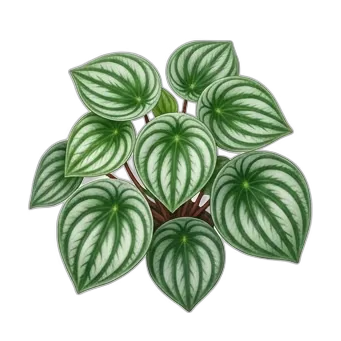
The Baby Rubber Plant (Peperomia obtusifolia) belongs to the Piperaceae family, making it a botanical cousin to true black pepper (Piper nigrum). Native to the tropical rainforests and coastal regions of Florida, Mexico, and the Caribbean, this species grows primarily as an epiphyte or lithophyte in its natural habitat. This means it often scrambles up the bark of mature trees or wedges itself into the mossy crevices of shaded rock faces, receiving filtered sunlight and feeding on decaying organic matter rather than digging deep into mineral-rich soils.
Morphologically, Peperomia obtusifolia is characterized by its succulent, thick, spoon-shaped (obovate) leaves that alternate along fleshy, upright stems. These leaves are evolutionary storage tanks, designed to store water during periods of irregular rainfall in the tropical canopy. The leaves typically measure between 2.0 to 5.0 inches (5.0 to 12.7 cm) in length and showcase a glossy, waxy cuticle that minimizes transpirational water loss.
While the species type features deep, glossy green foliage, several cultivars dominate the modern horticulture market, most notably 'Variegata', which exhibits striking creamy-white and pale yellow margins splashed across the leaf blade. When mature and grown under optimal light conditions, the plant produces slender, upright spikes—often described as resembling rat tails—that carry tiny, greenish-white flowers. These spikes do not offer showy petals, but their minimalist architectural form adds a subtle, fascinating texture to the indoor landscape.
Because its root system is naturally shallow and adapted to clinging onto rough surfaces rather than anchoring deep underground, you must tailor your container selections carefully. For insights on how root architecture dictates container dimensions across different plant families, you might find our How Deep Do Pepper Plant Roots Go? Pot Size & Substrate Depth Guide helpful when comparing contrasting plant root structures.
2. Essential Environmental & Care Requirements
Replicating a tropical canopy floor inside a climate-controlled home requires attention to specific environmental ranges. When growers run into trouble with Peperomia obtusifolia, it is almost always because these environmental metrics have strayed too far from the plant's evolutionary comfort zone.
| Parameter | Optimal Condition | Common Mistake | Why It Matters |
|---|---|---|---|
| Light | Bright, indirect light (3,000–5,000 lux) | Direct midday sun or deep shade | Direct sun scorches the waxy leaves; deep shade causes etiolation and loss of variegation. |
| Temperature | 65°F–80°F (18°C–27°C) | Exposure below 50°F (10°C) | Chilling injury damages cellular walls, leading to rapid stem collapse and rot. |
| Watering | Soak-and-dry method (dry to 2.0 inches / 5.0 cm depth) | Keeping soil constantly damp | Fleshy roots suffocate and rot rapidly in waterlogged, anaerobic substrates. |
| Humidity | 40%–60% relative humidity | Dry indoor heating (<30%) | Causes leaf tip browning and leaves the plant vulnerable to spider mites. |
| Soil pH | 6.0 to 6.5 (slightly acidic) | Heavy, clay-based garden soil | Compacted soil prevents oxygen exchange at the root level and retains excess moisture. |
Lighting is the primary driver of compact, bushy growth. Place your Baby Rubber Plant within 3.0 to 5.0 feet (0.9 to 1.5 m) of an east-facing window, or right behind a sheer curtain on a south- or west-facing sill. If you notice the stems stretching out, with large gaps between the leaves—a condition known as etiolation—your plant is starving for photons.
Watering frequency changes seasonally. During the active growing season (spring through summer), water thoroughly until liquid runs freely through the drainage holes, then let the top 2.0 inches (5.0 cm) of substrate dry out completely before watering again. During the dormant autumn and winter months, extend the drying interval, allowing the top 3.0 inches (7.6 cm) to dry out. For further reading on managing specialized plant care during seasonal transitions, consult resources like the University of Florida IFAS Extension for regional indoor adaptation guidelines.
💡 Pro-Tip: Never rely on a strict calendar schedule for watering your Baby Rubber Plant. Instead, use the "lift test." Pick up your nursery pot immediately after a thorough watering to memorize its heavy weight, and lift it again when bone dry. Once you calibrate your hands to these weight extremes, you will never overwater a succulent-leaved peperomia again.
3. Step-by-Step Cultivation, Feeding & Propagation
When it comes to repotting and multiplying your collection, Peperomia obtusifolia offers remarkable ease. Because its root system is compact and non-aggressive, mature plants rarely need containers larger than 6.0 to 8.0 inches (15.0 to 20.3 cm) in diameter.
Substrate Formulation
Mix a custom soil blend designed to mimic a loose, well-aerated forest floor. Combine:
- 50% high-quality peat-free potting soil or coco coir
- 30% perlite or pumice (to ensure rapid drainage)
- 20% orchid bark (grades 0.25 to 0.5 inches / 0.6 to 1.3 cm) to introduce air pockets
Step-by-Step Leaf-Cutting Propagation Sequence
Propagation via stem and leaf cuttings is nearly 100% successful if executed cleanly. Follow these steps:
- Select Material: Using a pair of sterile pruning shears, select a healthy, turgid stem section measuring 3.0 to 4.0 inches (7.6 to 10.2 cm) in length, ensuring it contains at least two to three mature leaves and active nodes.
- Make the Cut: Cut cleanly just below a leaf node at a 45-degree angle to maximize the surface area available for root initiation.
- Strip Lower Leaves: Carefully pinch off the bottom one or two leaves, leaving only the top pair intact to reduce transpirational stress.
- Apply Hormone (Optional): Dip the basal cut end into a rooting hormone powder containing IBA (indole-3-butyric acid) to accelerate callus formation.
- Plant the Cutting: Insert the stem 1.5 inches (3.8 cm) deep into a pre-moistened propagation medium consisting of 50% perlite and 50% peat moss.
- Create a Humid Environment: Enclose the pot in a clear plastic bag or propagation dome, ensuring the plastic does not touch the remaining leaves. Place it in bright, indirect light at 70°F–75°F (21°C–24°C).
- Monitor and Transplant: Check for root resistance by gently tugging on the stem after 21 to 28 days. Once roots reach 1.0 inch (2.5 cm) in length, transplant the cutting into a permanent container using the standard substrate blend.
For feeding, apply a balanced, water-soluble houseplant fertilizer diluted to half-strength once every four weeks throughout spring and summer. Withhold all fertilizer completely from October through February, as the plant's metabolic rate slows down and excess mineral salts will burn the tender root hairs.
4. Common Problems, Pests & Troubleshooting
Even resilient plants flash warning signals when their environment is out of balance. Diagnosing these symptoms early prevents minor cultural errors from turning into fatal failures.
Leaf Drop and Stem Mushiness
If your Baby Rubber Plant is dropping green leaves or showing translucent, mushy stems near the soil line, you are dealing with root rot (Pythium or Phytophthora species). This is caused by chronic overwatering or heavy, poorly draining soil.
- The Fix: Unpot the plant immediately, wash away the rotting soil, and use sterilized shears to trim away all black, mushy roots. Repot the healthy upper stem segments into a fresh, dry, highly porous substrate and withhold water for 7 days to let the wounds callous over.
Lower Leaf Yellowing
If older leaves at the bottom of the plant turn a uniform yellow and fall off, it is usually a sign of natural senescence combined with occasional overwatering. However, if multiple leaves yellow simultaneously alongside stunted top growth, your plant is likely suffering from nutrient leaching due to exhausted soil.
Pest Infestations: Mealybugs and Spider Mites
Indoor environments with dry air (under 30% relative humidity) frequently invite pests.
- Mealybugs: Look for white, cottony masses tucked into leaf axils and stem joints. They feed on plant sap, leaving behind sticky honeydew.
- Spider Mites: Indicated by fine, silky webbing across the undersides of leaves and a stippled, dusty-yellow appearance on the upper leaf surface.
- The Treatment Protocol: Isolate the infected plant immediately. Wipe down all stems and leaf surfaces using a microfiber cloth dipped in a mixture of 1.0 quart (0.95 liters) of water, 1.0 teaspoon of mild castile soap, and 1.0 tablespoon of horticultural neem oil. Repeat this application every 7 days for a 21-day cycle to break the pest reproductive timeline.
⚠️ Important Caution: Never use heavy petroleum-based leaf shine sprays on Peperomia obtusifolia. These commercial polishes clog the plant's stomata, suffocating the tissue and causing irreversible leaf necrosis within 72 hours. Rely instead on a gentle lukewarm water wipe with a soft cloth to maintain its natural luster.

5. Frequently Asked Questions
Why are the leaves on my Baby Rubber Plant curling inward?
Leaf curling is typically a physiological response to extreme underwatering or localized heat stress. When the plant experiences severe drought, it curls its succulent leaves inward to minimize surface area exposure and reduce water loss through transpiration. Check your soil moisture; if it is bone dry, give the plant a thorough, deep soak. For more detailed botanical reference guides, check out the Royal Horticultural Society (RHS) database for comprehensive houseplant physiology standards.
Is Peperomia obtusifolia toxic to cats and dogs?
No, Peperomia obtusifolia is completely non-toxic to cats, dogs, and horses, making it one of the safest structural foliage plants for households with curious pets. According to the ASPCA toxic and non-toxic plant database, ingestion of this plant will not cause systemic poisoning, though chewing on fibrous stems may occasionally cause mild, transient gastrointestinal upset.
How do I make my Baby Rubber Plant branch out and look bushier?
To encourage lateral branching rather than a single tall, leggy stem, you need to trigger the plant's auxiliary buds. Use sterilized pruning shears to cut the main growing tip (the apical meristem) right above a leaf node in early spring. This removes the dominant hormone suppressing side growth, forcing the plant to push out two or more new stems from the nodes below the cut within 14 to 21 days.
Can I grow a Baby Rubber Plant in low-light office conditions with no windows?
While Peperomia obtusifolia is adaptable and tolerates lower light levels better than many tropicals, it cannot survive indefinitely in windowless rooms relying solely on standard fluorescent office lighting. In true low-light environments, the plant will rapidly lose its variegation, become stretched and weak, and eventually succumb to root rot because the soil takes too long to dry. If natural light is unavailable, install a full-spectrum LED grow light positioned 12.0 to 18.0 inches (30.5 to 45.7 cm) above the canopy, running on a 12-hour timer.
📋 Table of Contents ▼ Click to expand
Tags: