Jade Plant
Crassula ovata
1. Botanical Overview & Natural Habitat

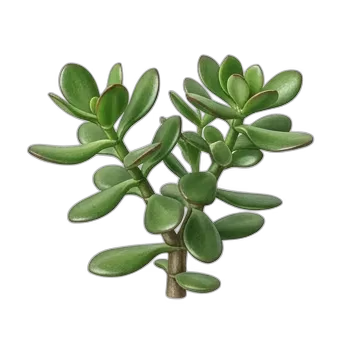
Morphologically, Crassula ovata is engineered for extreme survival. It grows as an evergreen, branching succulent shrub that can reach heights of 3 to 6 feet (0.9 to 1.8 meters) outdoors in frost-free climates, though indoor specimens typically top out at 12 to 36 inches (30 to 90 cm). The stems are initially fleshy and green, but as they mature, they develop a thick, woody, greyish-brown trunk with prominent horizontal leaf scars. The leaves are jade-green, glossy, obovate (teardrop-shaped), and measure roughly 1 to 2 inches (2.5 to 5 cm) in length. Under high light intensity, the leaf margins develop a distinct reddish blush.
Like many dry-climate xerophytes, the jade plant utilizes Crassulacean Acid Metabolism (CAM) photosynthesis. While most plants open their stomata during the day to take in carbon dioxide—risking massive water loss through transpiration—jade plants keep their stomata tightly sealed during the scorching daylight hours. They open them only at night to absorb $\text{CO}_2$, storing it as malic acid until sunrise, when solar energy drives the photosynthetic reactions. This physiological marvel is why jade plants require high light and minimal nighttime disruption to thrive, and it also dictates every rule of their cultivation. For broader insights on how succulent and woody root architectures handle constrained environments, you can look at root-zone mechanics similar to those outlined in this How Deep Do Pepper Plant Roots Go? Pot Size & Substrate Depth Guide.
2. Essential Environmental & Care Requirements
Growing a thriving jade plant requires mimicking the dry, high-mineral, sun-drenched environment of its native South African kopjes.
Light is the single most critical environmental variable. Jade plants demand a minimum of 4 to 6 hours of direct, unfiltered sunlight daily. South-facing or unobstructed west-facing windows are ideal indoors. When jade plants are deprived of light—receiving only indirect indoor illumination—they exhibit rapid, weak etiolation: stems elongate abnormally, internodes stretch, and the leaves become small, pale, and structurally weak, unable to support their own weight.
Temperature tolerances are straightforward. Crassula ovata thrives in daytime temperatures between 65°F and 85°F (18°C to 29°C) and night temperatures dropping down to 50°F to 55°F (10°C to 13°C), which mimics its natural thermal amplitude. While mature plants can endure brief, light frosts down to 28°F (-2°C) if kept completely bone-dry, any sustained freeze turns the water-stuffed cellular walls to mush.
Watering must follow a strict "soak and dry" methodology. During the active growing season (spring through summer), water the substrate thoroughly until it runs freely out of the drainage holes, but only after the top 2 to 3 inches (5 to 7.5 cm) of soil are completely dry. In autumn and winter, as daylight shortens and growth slows, reduce watering frequency by half to two-thirds.
| Parameter | Optimal Condition | Common Mistake | Why It Matters |
|---|---|---|---|
| Light | 6+ hours direct sun | Placing in dark indoor corners | Causes weak etiolation and structural collapse |
| Substrate | 50% grit, 50% organic | Standard dense potting soil | Retains moisture too long, causing root rot |
| Temperature | 65°F–85°F (18°C–29°C) | Exposure to hard frost below 28°F (-2°C) | Freezes leaf water content, rupturing cell walls |
| Humidity | 30%–50% ambient | Misting or high humidity rooms | Encourages fungal leaf spot and edema |
For specialized insights into seasonal timing and environmental shifts for hardy garden perennials, consult this When to Plant Strawberries in Kansas: Zone 6a/6b Seasonal Calendar.
3. Step-by-Step Cultivation, Feeding & Propagation
Repotting and propagating jade plants should always be timed for early spring as the plant emerges from its semi-dormant winter state.
Substrate Formulation
Never plant a jade plant in pure potting soil or peat-heavy mixes. Create a custom soil blend using 40% high-quality organic potting compost, 30% coarse horticultural pumice or perlite, and 30% coarse builders' sand or decomposed granite. This guarantees rapid drainage and prevents compaction.
Step-by-Step Repotting & Propagation Sequence
- Select the Vessel: Choose a heavy ceramic or terra-cotta pot with a generous drainage hole. Terra-cotta is superior because its porous walls allow moisture to evaporate from the soil profile quickly. Ensure the pot is only 1 to 2 inches (2.5 to 5 cm) wider than the current root ball; jade plants prefer to be slightly root-bound.
- Unpot and Inspect: Gently ease the jade plant out of its old container. Use your fingers to comb away exhausted, compacted soil from the root mass. Inspect the roots, using sterile pruning shears to snip away any brown, mushy, or brittle roots back to firm, white tissue.
- Take Leaf or Stem Cuttings (Optional): If propagating, select a healthy, plump stem cutting measuring 3 to 5 inches (7.5 to 12.5 cm) long, or cleanly twist off a single mature, undamaged leaf.
- Callus the Wounds: Place the cuttings in a warm, dry, shaded area for 3 to 7 days. This crucial waiting period allows a protective, corky callus to form over the cut surface, locking out soil pathogens and fungi.
- Pot the Specimen: Fill the new pot with your dry substrate blend, positioning the main plant at the exact same soil depth it was previously growing at. For leaf cuttings, lay them flat on top of dry propagation sand; for stem cuttings, insert the callused end 1 inch (2.5 cm) deep into the dry mix.
- Withhold Water: Do not water the newly potted plant or cuttings for 14 days. This forces the plant to push out searching roots in quest of moisture without risking rot on unrooted tissue. After two weeks, give a light watering, then resume normal care schedules.
💡 Pro-Tip: When pruning a jade plant to encourage a thick, tree-like trunk (standardization), always make your cut precisely 1/4 inch (0.6 cm) above a node (the ring where leaves attach). This prompts the auxiliary buds at that node to break dormancy in pairs, instantly doubling your branching density and giving you a robust, self-supporting canopy.
4. Common Problems, Pests & Troubleshooting
Even though Crassula ovata is exceptionally tough, it will signal distress clearly if its cultural conditions drift out of balance.
Oedema and Leaf Blisters: Water-soaked blisters or corky, scab-like brown bumps on the undersides of the leaves indicate edema. This physiological disorder happens when the roots take up water faster than the leaves can transpire it, causing individual plant cells to rupture. Remedy this by increasing airflow, reducing watering frequency, and switching to a faster-draining mineral substrate.
Mealybugs: These cottony, white, sap-sucking insects love tucking themselves into the tight axils where leaves meet the woody stems. Dab them directly with a cotton swab dipped in 70% isopropyl alcohol to dissolve their protective waxy coating, followed by a thorough spraying with horticultural insecticidal soap.
⚠️ Important Caution: Never use standard petroleum-based horticultural oils or heavy dormant oils on jade plants. Their succulent leaves are highly sensitive to oil-based smothering agents, which can quickly strip the protective epicuticular wax and cause severe chemical burns and permanent leaf drop.

5. Frequently Asked Questions
Why are the leaves on my jade plant turning yellow and falling off?
Yellowing, dropping leaves are almost always a symptom of overwatering and subsequent root rot. When the root system is suffocated by soggy, oxygen-deprived soil, it can no longer transport water and nutrients upward, causing the lower leaves to turn translucent yellow and drop off at the slightest touch. Let the soil dry out entirely, inspect the roots for rot, and adjust your watering frequency.
How do I make my jade plant grow a thick trunk?
Trunk thickness is a function of age, vigorous root development, and aggressive pruning. To encourage a sturdy, woody trunk rather than a floppy, herbaceous stem, prune back long vertical shoots annually to stimulate lateral growth. Additionally, growing the plant in a slightly confined container and exposing it to natural outdoor wind creates micro-stress that triggers secondary trunk thickening.
Why is my jade plant getting wrinkled leaves?
Wrinkled, puckered, or soft leaves are a sign of underwatering. Unlike overwatered leaves (which feel mushy and translucent), underwatered jade leaves lose their internal turgor pressure and pucker as the plant draws upon its internal water reserves to survive. Give the plant a thorough, deep watering, and it will typically plump back up within 48 to 72 hours.
Can jade plants survive in low-light office environments?
While jade plants can technically persist for a few months in low-light indoor offices, they will not thrive. Without at least 4 hours of direct sunlight, growth will stall, leaves will thin out, and the plant will become highly susceptible to pest infestations and root rot because the soil takes too long to dry out between waterings. If natural sun is unavailable, supplement with a full-spectrum LED grow light placed 12 inches (30 cm) above the canopy for 12 hours a day.
📋 Table of Contents ▼ Click to expand
Tags: