


Have you been showering your String of Pearls every time the topsoil looks dry?
Written with AI assistance, edited and checked against horticultural sources.
If you have been showering your String of Pearls every time the topsoil looks dry, you are inadvertently setting up a ecological trap that leads directly to root rot, stem collapse, and plant failure.
1. Botanical Overview & Natural Habitat
To understand why traditional topsoil watering destroys a String of Pearls, we must look at where this fascinating succulent evolved. Native to the dry, rocky desert environments of the Eastern Cape of South Africa, Curio rowleyanus (formerly Senecio rowleyanus) does not grow suspended in mid-air in nature. Instead, it creeps along the ground, forming dense mats shaded by taller rocks and scrub brush.

PLAY22 Gardening Tools Set of 10
A 10-piece hand tool set with a carry bag — trowel, transplanter, pruners and weeder. Suited to repotting and general container work.
View on Amazon ↗In this arid habitat, rain is sporadic, brief, and followed by intense sunlight and high wind movement. To survive, the plant evolved specialized morphological structures:
- Spherical Succulent Leaves: The iconic "pearls" are modified leaves engineered to store water efficiently while minimizing the surface area exposed to scorching sun and dry winds.
- Epidermal Windows: Look closely at an individual bead under bright light. You will see a thin, translucent longitudinal stripe. This is an "epidermal window"—a specialized band of clear cells that allows sunlight to penetrate deep into the interior of the leaf, illuminating the chloroplast-rich tissue inside without exposing a large surface area to heat and evaporation.
- Shallow Adventitious Roots: String of Pearls produces delicate, shallow roots along its trailing stems (nodes). These root hairs sit within the top 0.5 to 1.5 inches (1.3 to 3.8 cm) of soil, designed to quickly absorb morning dew and sudden, light rainfall before the moisture evaporates from the rocky terrain.
The Biological Hazard of "Showering" Topsoil
At the root zone (rhizosphere), gas exchange is just as critical as moisture. When potting mix becomes dense, muddy, or suffocated by standing drainage water, fine root hairs quickly suffer from hypoxia (oxygen deprivation), leaving the door wide open for opportunistic fungal pathogens like Pythium and Phytophthora.
When you shower a String of Pearls from above simply because the topsoil appears dry, three physiological disasters happen simultaneously:
- Crown Trapped Moisture: Moisture becomes trapped in the dense canopy of pearls resting on top of the soil. Because the stems and leaves sit flat against the dirt, water droplets create persistent micro-pockets of 100% relative humidity right at the root crown. Without desert-level wind currents to evaporate this trapped moisture, bacterial soft rot sets in within 48 to 72 hours.
- The Perched Water Table Delusion: Soil in deep decorative pots dries from the top down due to air evaporation. The top 0.5 inches (1.3 cm) may feel bone dry within 48 hours, while the bottom 3 to 4 inches (7.6 to 10.2 cm) remains a saturated, anaerobic sponge. Daily or frequent shallow showering drowns the lower root zone while repeatedly soaking the sensitive crown.
- Epidermal Window Occlusion: Dust and hard water minerals from tap water shower sprays settle over the epidermal windows, blocking light penetration and stalling photosynthesis.
"Successful indoor gardening isn't a game of luck—it is the art of respecting root biology and working in harmony with natural physiological cycles."
For a deeper understanding of succulent morphology and cellular water distribution, review the plant anatomy archives hosted by the University of Wisconsin-Madison Horticulture Extension.
2. Essential Environmental & Care Requirements
Creating an optimal home environment for Curio rowleyanus requires mimicking the ambient temperature, light intensity, and air circulation of its native African scrublands.
Ambient Temperature & Lighting
String of Pearls requires high light levels focused directly on the top of the pot. A common design mistake is hanging the basket high above an eye-level window frame. While the trailing strands receive light, the top of the pot—where the roots and growing crown reside—is shaded. This shadow slows down water evaporation from the soil surface and triggers crown decay.
- Optimal Foot-Candles: 1,000 to 1,500 foot-candles (bright, indirect light with 2 to 4 hours of direct morning sunlight).
- Temperature Range: Maintain daytime temperatures between 70°F and 85°F (21°C to 29°C). Nighttime temperatures can safely drop to 55°F to 65°F (13°C to 18°C). Avoid exposing the plant to temperatures below 50°F (10°C).
- Air Movement: Gentle air circulation is vital. A room fan operating on low speed prevents stagnant air pockets from forming around the succulent canopy.
⚠️ Important Caution: Never let pots stand in saucer runoff water for more than fifteen minutes; stagnant water creates anaerobic conditions that rapidly cause root rot.
Substrate Composition & Aeration
Standard commercial potting soils hold far too much water for Curio rowleyanus. To maintain ideal rhizosphere gas exchange, your substrate must contain at least 50% coarse inorganic aggregate.
3. Step-by-Step Cultivation, Feeding & Propagation
Here is the proven, systematic protocol I personally follow in a greenhouse:
- Optimize Container Aeration & Depth: Select an unglazed terracotta pot that is wider than it is deep (shallow bulb pans work exceptionally well). Ensure containers have generous drainage holes. Line the base with screen mesh and fill with a aggregate-rich soil mix amended with 30% coarse perlite or pumice to prevent compaction.
- Stabilize Climate & Micro-Environment: Position plants at least 3 feet (0.9 meters) away from cold winter drafts and forced-air heating registers to prevent extreme humidity shock and rapid tissue desiccation. Ensure the rim of the pot receives full light exposure.
- Perform the "Epidermal Window Check" Before Hydrating: Ignore the topsoil dryness! Instead, inspect the pearls. When fully hydrated, the pearls are firm, round spheres with wide, translucent window slits. When the plant actually needs water, the pearls lose cell turgor pressure, showing slight puckering or indentation, and the window slits narrow into thin lines.
- Execute the Bottom-Watering Soak Routine: Fill a shallow basin with 1.5 to 2 inches (3.8 to 5.0 cm) of water. Set the terracotta pot into the basin. Allow the porous substrate to draw water upward via capillary action for 10 to 15 minutes, until the surface soil feels slightly cool to the touch. Remove the pot immediately and let it drain completely. Never shower the top leaves.
- Apply Dilute Organic Nutrients: During active metabolic growth phases (early spring through mid-summer), nourish with a balanced, half-strength organic liquid seaweed or low-nitrogen succulent feed once every 4 to 6 weeks. This gently fuels cell division without inducing fertilizer salt burns on sensitive root hairs.
- Propagate via Stem Contact (The Coil Method): To fill out a sparse pot, prune a healthy 4- to 6-inch (10 to 15 cm) trailing strand. Gently lay the stem flat across the surface of moist, gritty substrate. Secure the stem nodes against the soil using bent paperclips or floral pins. Maintain bright light and light ambient humidity. Within 14 to 21 days, new adventitious roots will anchor into the mix at each node.
💡 Pro-Tip: Always hydrate with room-temperature water (around 68°F to 72°F / 20°C to 22°C); icy tap water induces thermal root shock, causes vascular constriction, and halts nutrient absorption for hours.
For detailed guidelines on environmental light monitoring for arid flora, consult the educational resources provided by the Royal Horticultural Society.
4. Common Problems, Pests & Troubleshooting
Recognizing the early visual cues of stress allows you to intervene before root system collapse occurs.
Pathogens & Physiological Rot
- Stem Rot & Crown Decay: Stems near the soil line turn translucent brown, become slimy, and detach easily. This is a direct consequence of overhead showering or wet topsoil.
- Remedy: Cut away all affected stems cleanly using isopropyl-sanitized shears. Save the healthy upper stem tips, let them callus for 24 hours, and lay them on fresh, dry substrate to re-root.
- Hypoxic Root Mortality: The plant appears shriveled despite frequent watering. Upon inspection, the roots are black, stringy, and hollow instead of crisp and white.
- Remedy: The root system has suffocated and rotted away due to excess moisture; it can no longer transport water up to the foliage. Trim away dead roots, soak remaining sound tissue in 3% hydrogen peroxide diluted 1:4 with water, and re-start the plant in an unglazed terracotta container.
Common Insect Pests
- *Mealybugs (Pseudococcidae):* These slow-moving, cotton-like pests hide in the tiny crevices where the leaf pedicel connects to the main trailing stem. They suck plant sap, leading to leaf drop.
- Control: Dip a fine cotton swab in 70% isopropyl alcohol and directly touch each pest. For widespread infestations, spray thoroughly with a mild insecticidal soap, ensuring the plant dries rapidly under a fan afterward.
- *Fungus Gnats (Sciaridae):* Small black flies hovering around the soil surface indicate that the organic matter in your topsoil is remaining damp for too long.
- Control: Stop top-watering entirely. Switch to bottom-soaking, allow the top 2 inches (5 cm) of substrate to dry out completely, and introduce beneficial nematodes (Steinernema feltiae) or apply Bacillus thuringiensis israelensis (BTI) drops during your scheduled watering.
5. Frequently Asked Questions
Why are my String of Pearls turning mushy and dying even though the soil feels dry?
Topsoil dries rapidly from ambient surface evaporation, but moisture remains trapped beneath the surface around the lower roots. If you shower the plant from above, water gets trapped between the dense pearls at the crown while drowning the deep roots. The mushiness is a symptom of fungal rot (Pythium) caused by trapped stem moisture and root hypoxia, not a sign of thirst.
Should I water String of Pearls from the top or bottom?
Always water String of Pearls from the bottom. Bottom-watering allows the porous soil substrate to wick moisture upward directly to the root zone via capillary action without wetting the delicate pearls or crown. Submerge the base of the pot in room-temperature water for 10 to 15 minutes, then drain completely.
How do I know if my String of Pearls actually needs water?
Ignore the soil moisture and look at the physical cues of the foliage. Healthy, hydrated pearls are firm, spherical, and exhibit wide translucent "epidermal windows." When the plant requires hydration, the pearls will lose cell turgor pressure, showing subtle puckering, wrinkling, or a narrowing of the window slits.
How quickly will my String of Pearls recover after fixing overwatering?
When you stop overhead showering and transition to bottom-watering in an aggregate-rich substrate, most plants show visible improvements within 7 to 14 days. You will observe restored leaf turgidity, firm stem structures, deeper emerald color, and active apical shoot emergence.
Can I spray or mist my String of Pearls to increase humidity?
No. Misting succulent plants like Curio rowleyanus is counterproductive and dangerous. High ambient leaf moisture combined with low air circulation encourages fungal infection and bacterial leaf rot. String of Pearls thrives in low-to-average household humidity (30% to 50%).
Have you tried switching to bottom-watering with your own succulents? Share your progress and photos with our global grower community on the Community Forum, explore more expert botanical guides on Plant Tips, or visit our Home Page for our complete plant care archives.
📋 Table of Contents ▼ Click to expand
PlantSavvyWorld
Editorial team
PlantSavvyWorld is an independent botanical education project. Articles are drafted with AI assistance, then edited and checked against university extension services, botanical garden collections and other published horticultural sources.
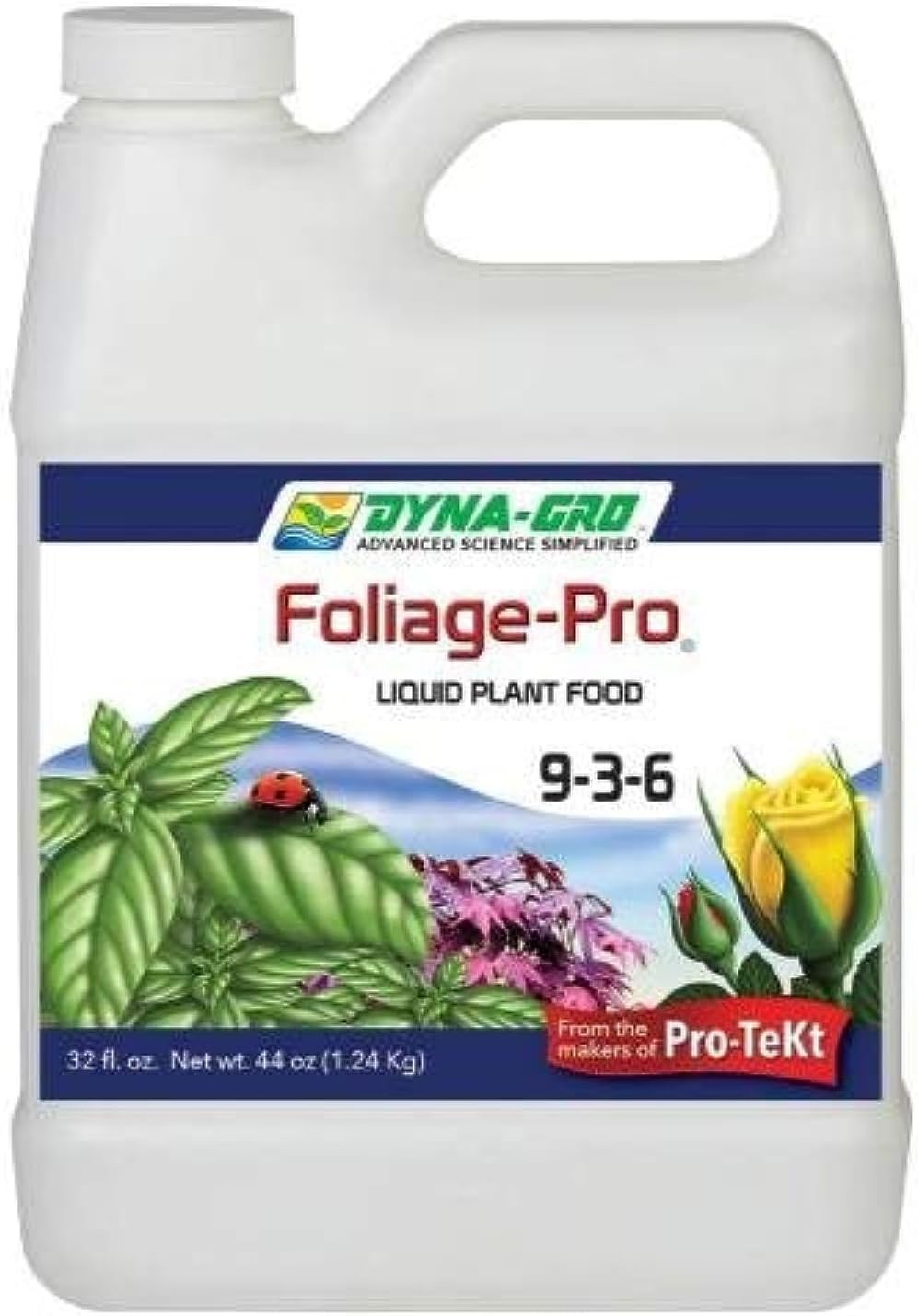
Organic Liquid Plant Food (FoxFarm)
A liquid organic plant food. Applied at label rate during active growth; most houseplants do better at reduced strength and not at all in winter.
View on Amazon ↗
PlantSavvyWorld
Editorial team
PlantSavvyWorld is an independent botanical education project. Articles are drafted with AI assistance, then edited and checked against university extension services, botanical garden collections and other published horticultural sources.
💬 Discussion