


Are you still sprinkling crushed eggshells on top of your soil?
Written with AI assistance, edited and checked against horticultural sources.
If you are still sprinkling crushed eggshells on top of your soil, it is time to look at the soil chemistry beneath the surface. While eggshells are composed of over 95% calcium carbonate ($CaCO_3$), scattering coarse pieces on top of your container soil delivers virtually zero usable nutrients to your plants in the short term. In fact, without proper soil processing, this common trend can cause micro-climate issues right at the rhizosphere level.
1. Botanical Overview & Natural Habitat
To understand why surface-applied eggshells fail to deliver results, we must examine plant cellular physiology and soil biochemistry. Calcium ($Ca^{2+}$) is an essential structural nutrient for plants. It binds pectins in the middle lamella of plant cell walls, acting as the microscopic "cement" that provides structural rigidity, drives cell elongation, and signals stress responses within tissue.

PLAY22 Gardening Tools Set of 10
A 10-piece hand tool set with a carry bag — trowel, transplanter, pruners and weeder. Suited to repotting and general container work.
View on Amazon ↗Plants absorb calcium exclusively in its ionic form ($Ca^{2+}$) dissolved in soil water. Calcium uptake occurs passively via young, non-suberized root tips through a process called mass flow—pulled upward by transpiration as water evaporates through leaf stomata.
When you place raw eggshells on top of potting mix, several biological barriers prevent this uptake:
- Insolubility at Neutral pH: Calcium carbonate ($CaCO_3$) is practically insoluble in water at a neutral or slightly acidic pH (6.0 to 7.0), which is the ideal range for most houseplants and garden crops. Without heavy fungal activity and organic acids, the calcium remains locked in its mineral matrix.
- Decomposition Timelines: Research from university agricultural research stations shows that coarse, crushed eggshells can take anywhere from 2 to 5 years (730 to 1,825 days) to break down in outdoor garden soil. In potted indoor environments—where natural soil macrofauna like earthworms and isopods are absent—decomposition slows down even further.
- Lack of Root Contact: Calcium is not mobile within plant tissue once deposited, nor is it mobile in dry surface soil. Nutrients sitting on top of dry topsoil cannot reach the active root tips located 2 to 8 inches (5 to 20 cm) below the surface.
At the root zone (rhizosphere), gas exchange is just as critical as moisture. When potting mix becomes dense, muddy, or suffocated by standing drainage water, fine root hairs quickly suffer from hypoxia (oxygen deprivation), leaving the door wide open for opportunistic fungal pathogens like Pythium and Phytophthora. Conversely, an open, biologically active substrate enables robust nutrient uptake and rapid vegetative vigor.
"Successful indoor gardening isn't a game of luck—it is the art of respecting root biology and working in harmony with natural physiological cycles."
In natural forest habitats, plants do not rely on hard mineral shells sitting on top of dry litter layers. Soil calcium is continuously cycled through decomposing forest humus, where saprophytic fungi and bacteria excrete organic acids (such as citric and oxalic acids) that break down mineral compounds into water-soluble $Ca^{2+}$ ions. To mirror this in domestic cultivation, we must work with organic decomposition rather than against it.
2. Essential Environmental & Care Requirements
Creating a root environment capable of processing nutrients requires strict control over physical substrate architecture, ambient moisture, light energy, and temperature. Adding calcium—whether through amendments or balanced liquid fertilizers—will yield no benefit if the primary drivers of transpiration and respiration are out of balance.
Calcium uptake is tied directly to ambient humidity and leaf transpiration. If relative humidity drops below 30%, or if light levels are too low to drive photosynthesis, transpirational pull stalls. Consequently, calcium remains trapped in the lower vascular tissue, causing localized tissue necrosis such as tip burn in tropical foliage or blossom-end rot in fruiting species.
To learn more about soil science and plant nutrition dynamics, consult resources provided by the Oregon State University Extension Service and environmental guidelines from the Royal Horticultural Society.
Substrate Parameters & Growth Environment
The table below outlines the core environmental parameters required to maintain active biological nutrient cycling and strong root physiology:
3. Step-by-Step Cultivation, Feeding & Propagation
Instead of dropping sharp, non-functional eggshell shards on top of your soil, follow this systematic protocol to supply bio-available nutrients while maximizing substrate performance.
Here is the proven, systematic protocol I personally follow in a greenhouse:
Protocol 1: Transforming Eggshells into Bio-Available Water-Soluble Calcium (Calcium Acetate)
If you wish to use kitchen waste like eggshells, you must extract the calcium chemically using food-grade acid (vinegar) before applying it to plants.
- Rinse and Sanitize: Thoroughly wash raw eggshells in warm water to remove residual egg white membranes. Residual proteins attract fruit flies, ants, and Bradysia (fungus gnats).
- Thermal Sterilization: Bake the dry shells on a baking tray at 200°F (93°C) for 15 to 20 minutes to eliminate bacterial contaminants like Salmonella and dry the shell matrix.
- Pulverize to Powder: Grind the baked shells in a clean coffee grinder or mortar until they reach a talcum-powder consistency (particle size under 0.5 mm). Never leave shells in coarse pieces.
- Acid Extraction Reaction: Place 2 tablespoons of fine eggshell powder into a jar and slowly add 1 cup (240 mL) of raw organic apple cider vinegar or white distilled vinegar (5% acetic acid). The mixture will effervesce vigorously as carbon dioxide ($CO_2$) gas escapes:
$$\text{CaCO}_3 + 2\text{CH}_3\text{COOH} \rightarrow \text{Ca}(\text{CH}_3\text{COO})_2 + \text{H}_2\text{O} + \text{CO}_2 \uparrow$$
- Cure and Dilute: Let the reaction sit open for 48 to 72 hours until bubbling completely stops. Strain out any remaining sediment. The resulting liquid is water-soluble calcium acetate.
- Application Rate: Dilute 1 tablespoon (15 mL) of this concentrate into 1 gallon (3.8 liters) of room-temperature water. Apply as a soil drench once every 30 days during active vegetative growth.
Protocol 2: Standard Soil Improvement Routine
- Optimize Container Aeration: Ensure containers have generous drainage holes and amend standard potting mix with 30% coarse perlite or pumice to prevent compaction.
- Stabilize Climate & Micro-Environment: Position plants at least 3 feet (0.9 meters) away from cold winter drafts and forced-air heating registers to prevent humidity shock.
- Apply Dilute Organic Nutrients: During active vegetative phases, nourish with half-strength organic liquid feeds to gently fuel cell division without root burn.
💡 Pro-Tip: If you prefer instant commercial solutions over DIY extractions, skip eggshells entirely and use agricultural gypsum (calcium sulfate). Gypsum provides immediate bio-available calcium ($Ca^{2+}$) and sulfur without raising your soil pH or requiring chemical extraction. Mix 1 teaspoon (5 grams) per gallon of potting mix during soil prep.
⚠️ Important Caution: Never let pots stand in saucer runoff water for more than 15 minutes. Stagnant water starves fine root hairs of dissolved oxygen, triggering root rot within 48 to 72 hours. Always discard drained water immediately.
4. Common Problems, Pests & Troubleshooting
Scattering raw, unwashed eggshells directly on top of indoor potting soil introduces physical and biological issues that compromise root zone health.
1. Persistent Pest Infestations (Fungus Gnats & Flies)
- The Cause: Organic albumin residue left inside unwashed eggshells decomposes on top of moist potting soil, serving as a breeding ground for fungus gnat larvae (Bradysia spp.) and shore flies.
- The Solution: Remove all surface debris immediately. Scrape away the top 1 inch (2.5 cm) of infested soil and replace it with clean substrate. Treat the soil with a drench containing Bacillus thuringiensis israelensis (BTI) or beneficial nematodes (Heterorhabditis bacteriophora).
2. Surface Soil Crusting & Reduced Aeration
- The Cause: Large shell fragments lock together with topsoil fines, forming a dense physical barrier. This reduces ambient gas exchange, slowing oxygen diffusion into the rhizosphere.
- The Solution: Manually pick off coarse eggshell pieces. Cultivate the upper 0.5 inches (1.2 cm) of soil gently with a hand fork to break up crusting and restore oxygen permeability.
3. Misdiagnosing Calcium Deficiency vs. Environmental Stress
- Symptoms: Leaves curving downward, chlorotic margins, or distorted tip expansion.
- Diagnostic Check: True calcium deficiency in foliage plants is rare if tap water (which typically contains dissolved calcium and magnesium) or balanced fertilizers are used. Distorted growth is far more frequently caused by inconsistent watering, low humidity (under 30%), or root damage from over-fertilization.
5. Frequently Asked Questions
Do crushed eggshells lower soil acidity or change soil pH?
Crushed eggshells can slightly raise soil pH over extended periods (months to years), but only if finely ground into powder and thoroughly incorporated into highly acidic soil (pH below 5.5). Sprinkling coarse eggshell pieces on top of neutral or mildly acidic potting mix will have no measurable impact on substrate pH due to its low solubility rate.
How long does it take for eggshells to break down in potted plant soil?
In a closed potted environment lacking macro-decomposers like earthworms, coarse eggshell shards can remain unchanged for 2 to 5 years. Without mechanical breakdown, acid hydrolysis, or continuous fungal action, the calcium inside raw eggshells remains completely inaccessible to root system uptake.
Will eggshells on top of potting mix stop slugs, snails, or soft-bodied pests?
No. Controlled horticultural trials show that soft-bodied pests like slugs and snails easily crawl over crushed eggshells by producing extra mucus to protect their foot tissue. Furthermore, indoor houseplants rarely suffer from outdoor slug pressures; instead, surface shells create hiding spots for fungus gnats, mealybugs, and soil mites.
What is the fastest way to fix a calcium deficiency in houseplants or garden tomatoes?
The fastest correction method is applying a foliage spray or soil drench of water-soluble calcium nitrate or calcium chloride formulated for horticultural use. For organic applications, apply the quick-acting water-soluble calcium acetate recipe outlined in Section 3, or amend soil with micronized agricultural gypsum.
When is the best time of year to implement these nutrient changes?
Early spring through mid-summer represents the active metabolic window when plants can rapidly utilize increased light and fresh nutrients. During winter dormancy, reduce hydration frequency and hold off on nutrient applications accordingly.
How quickly will I see visible improvements after fixing calcium uptake?
Most foliage houseplants respond within 7 to 14 days with noticeable leaf turgidity, deeper emerald color, and active apical shoot emergence once transpiration and aeration are restored.
Is an open, highly aerated aggregate substrate suitable for all indoor plant varieties?
Yes! It is exceptionally effective for Monstera, Philodendron, Pothos, Sansevieria (Snake Plants), and tropical foliage collections.
Have you tried extracting calcium or adjusting your substrate aeration with your own houseplants? Share your results with our global grower community on the Community Forum, explore more expert guides on Plant Tips, or visit our Home Page for comprehensive plant care archives.
📋 Table of Contents ▼ Click to expand
PlantSavvyWorld
Editorial team
PlantSavvyWorld is an independent botanical education project. Articles are drafted with AI assistance, then edited and checked against university extension services, botanical garden collections and other published horticultural sources.
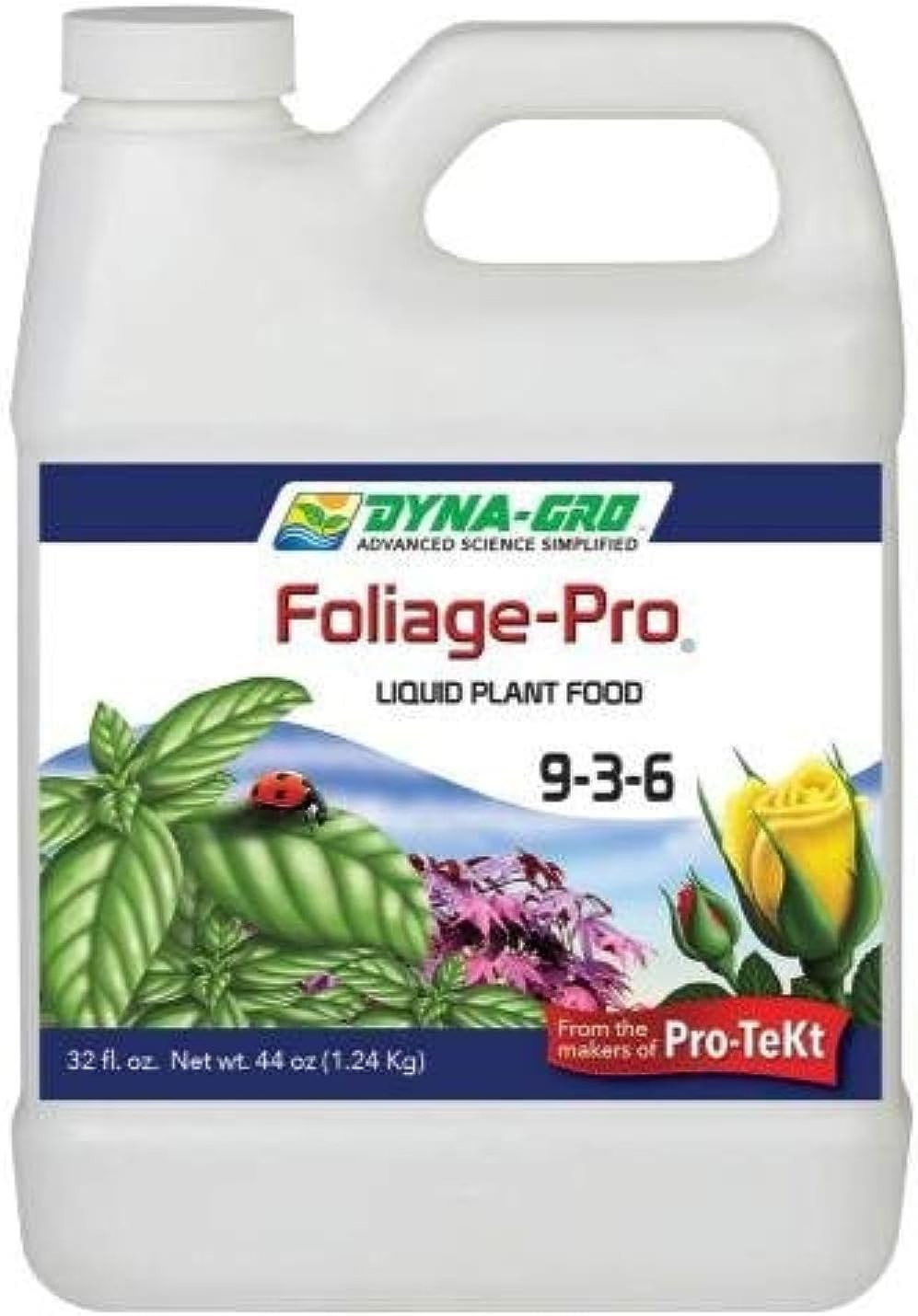
Organic Liquid Plant Food (FoxFarm)
A liquid organic plant food. Applied at label rate during active growth; most houseplants do better at reduced strength and not at all in winter.
View on Amazon ↗
PlantSavvyWorld
Editorial team
PlantSavvyWorld is an independent botanical education project. Articles are drafted with AI assistance, then edited and checked against university extension services, botanical garden collections and other published horticultural sources.
💬 Discussion