


Are the tips of your beautiful Dracaena turning crispy and brown?
Written with AI assistance, edited and checked against horticultural sources.
1. Botanical Overview & Natural Habitat
The genus Dracaena comprises over 120 species of flowering trees and shrubs belonging to the family Asparagaceae. Native predominantly to sub-Saharan Africa, South Asia, and parts of tropical America, these plants have evolved to thrive in seasonally dry tropical forests and scrublands. In their endemic habitats, species like Dracaena reflexa and Dracaena dragia endure periods of bright, dappled sunlight, high ambient air movement, and well-draining, rocky soils that cycle rapidly between heavy monsoon rains and dry spells.
To understand why leaf tips crisp up indoors, we must examine the plant's internal vascular architecture. Dracaenas rely on a specialized transpiration stream: water and dissolved minerals travel upward from the fine root hairs through xylem vessels, terminating at the very tips and outer margins of the leaves. When a Dracaena experiences environmental stress, excess mineral salts, or inadequate cell turgor, water fails to reach these terminal cells. As a result, the leaf margins dry out, desiccate, and turn brown.

PLAY22 Gardening Tools Set of 10
A 10-piece hand tool set with a carry bag — trowel, transplanter, pruners and weeder. Suited to repotting and general container work.
View on Amazon ↗At the root zone (rhizosphere), gas exchange is just as critical as moisture. When potting mix becomes dense, muddy, or suffocated by standing drainage water, fine root hairs quickly suffer from hypoxia (oxygen deprivation), leaving the door wide open for opportunistic fungal pathogens like Pythium and Phytophthora. Conversely, an open, biologically active substrate enables robust nutrient uptake and rapid vegetative vigor.
Furthermore, Dracaena foliage is uniquely sensitive to halogen buildup. Chemical elements like fluoride, chlorine, and soluble boron—commonly added to municipal tap water or present in low-grade fertilizers—are carried up the plant's vascular system. Because these elements cannot volatilize out of the leaf tissues, they accumulate at the leaf apex until toxic concentrations kill the local cells, manifesting as dry, brittle brown tips bounded by a yellow halo.
"Successful indoor gardening isn't a game of luck—it is the art of respecting root biology and working in harmony with natural physiological cycles."
2. Essential Environmental & Care Requirements
Maintaining immaculate foliage on your Dracaena requires aligning your home environment with the plant's natural microclimate. Key factors include ambient light intensity, atmospheric moisture, irrigation purity, and soil aeration.
3. Step-by-Step Cultivation, Feeding & Propagation
If your Dracaena is already showing brown, papery edges, follow this step-by-step protocol to reset its root environment, nourish new foliage, and propagate healthy canes.
Step 1: Substrate Flushing & Aeration Reset
If mineral crust (white crusty buildup) is visible on top of your potting mix, perform a thorough soil flush. Place the pot under a sink or shower stream using distilled or rainwater. Allow 2–3 times the pot's volume in water to run through the substrate over 15 minutes. This leaches out accumulated fertilizer salts and excess fluorides. If the soil is dense or decaying, repot into a container with generous drainage holes using a mix of 50% coconut coir, 30% coarse pumice (or rinsed perlite), and 20% medium orchid bark.
Step 2: Precision Pruning of Necrotic Tissue
To restore aesthetic appeal without stressing the plant, trim away dead brown tips using sharp, sterilized micro-tip shears. Cut along the natural shape of the leaf margin, leaving a hairline margin (1/16 inch or 1.5 mm) of brown dead tissue intact. Avoid cutting into healthy green tissue, as opening an active wound triggers fresh cellular necrosis and yellowing.
Step 3: Implement Pure Water Hydration
Switch immediately from tap water to purified water (rainwater, distilled, or reverse osmosis). Hydrate only when the top 2 to 3 inches (5 to 7.5 cm) of soil have dried completely—typically every 9 to 14 days, depending on light and season. When watering, apply water evenly across the soil surface until it flows freely from the bottom drainage holes.
Step 4: Calibrated Spring/Summer Nutrition
Dracaenas are slow to moderate feeders. During active vegetative growth (early spring to late summer), apply a low-fluoride, balanced organic liquid fertilizer (such as an NPK 3-1-2 ratio) diluted to 1/4 or 1/2 strength every 4 weeks. Keep electrical conductivity (EC) below 1.2 mS/cm. Cease fertilization completely during autumn and winter when plant metabolism naturally slows.
Step 5: Cane Propagation & Top-Cutting Renewal
If your Dracaena has become leggy or lost lower foliage due to past root stress, renew the plant via stem propagation:
- Using a sharp, disinfected bypass pruner, slice a healthy cane 4 to 6 inches (10 to 15 cm) below the leaf tuft at a 45-degree angle.
- Dip the cut end of the top cutting into a 0.1% Indole-3-butyric acid (IBA) rooting hormone gel.
- Insert the cutting 2 inches (5 cm) deep into a pre-moistened mixture of 50% perlite and 50% peat moss.
- Maintain a soil temperature of 75°F–80°F (24°C–27°C) using a propagation heat mat. Roots will establish within 21 to 28 days.
- Retain the parent cane base; fresh dormant buds will break along the stem within 3 to 5 weeks, yielding new multi-stemmed growth.
💡 Pro-Tip: Always hydrate your plants with room-temperature water (around 68°F–72°F / 20°C–22°C). Using icy tap water induces thermal shock in the root zone, causing immediate vascular constriction that halts water and nutrient absorption for up to 48 hours.
⚠️ Important Caution: Never let your container sit in standing runoff water inside a saucer for longer than 15 minutes. Stagnant drain water starves the root zone of atmospheric oxygen, creating an anaerobic environment where destructive water molds like Pythium can destroy the root system in fewer than 7 days.
4. Common Problems, Pests & Troubleshooting
Identifying leaf symptoms early allows you to correct environmental errors before widespread defoliation occurs.
Diagnostic Guide: Symptoms, Root Causes & Remediation
- Crispy Brown Tips with Narrow Yellow Halos:
- Cause: Fluoride or chlorine toxicity from tap water; low humidity (<35%); or fertilizer salt accumulation.
- Action: Flush soil with distilled water, increase ambient humidity to >45%, and cut back on synthetic fertilizers.
- Soggy Yellow Leaves & Soft, Squishy Stem Base:
- Cause: Root rot (Pythium spp.) driven by poorly draining soil or overwatering.
- Action: Unpot the plant immediately, trim off black, slimy roots, spray remaining root mass with 3% hydrogen peroxide, and repot into fresh, highly aerated potting mix.
- Bleached White or Straw-Colored Dry Patches:
- Cause: Solarization / sunburn from sudden exposure to direct sun.
- Action: Move plant 3 to 5 feet (0.9 to 1.5 meters) away from south- or west-facing windows, shielding foliage with sheer curtains.
- Fine White Webbing and Stippled Yellowing Foliage:
- Cause: Twospotted Spider Mites (Tetranychus urticae), which thrive in warm, dry indoors.
- Action: Wipe down all leaves with a mild insecticidal soap or dilute neem oil solution (0.5%) every 5 to 7 days for 3 consecutive weeks. Increase surrounding air humidity.
- Sticky Sap Residue & White Cottony Clusters:
- Cause: Mealybug infestation (Pseudococcidae) resting in node crevices.
- Action: Spot-treat individuals directly using a cotton swab dipped in 70% isopropyl alcohol, then rinse the plant with warm water.
For detailed diagnostic resources on tropical houseplant diseases, consult authoritative guides like the University of Florida IFAS Extension or review plant pathology frameworks provided by the Royal Horticultural Society.
5. Frequently Asked Questions
Should I cut the brown tips off my Dracaena leaves?
Yes, you can trim away dead brown tips to improve your plant's appearance. Use sharp, disinfected scissors and cut along the natural pointed shape of the leaf blade. Crucially, leave a tiny border (about 1/16 of an inch or 1.5 mm) of the brown dead tissue intact. Cutting directly into healthy green leaf tissue creates fresh plant wounds that quickly dry out, producing a new ring of brown tissue.
Why are my Dracaena leaf tips turning brown even though I water it regularly?
Regular watering does not guarantee adequate root hydration or healthy transpiration. If your tap water contains fluoride, chlorine, or high levels of dissolved minerals, those compounds build up in the leaf tips over time, killing apical tissues regardless of soil moisture. Alternatively, watering too frequently causes root hypoxia and root decay; dead roots cannot lift water up to the leaves, leading to paradoxically dry, crisp leaf tips.
Can tap water turn Dracaena leaf tips crispy?
Yes. Dracaena species are among the most fluoride-sensitive houseplants in cultivation. Municipal tap water treated with fluoride (even at low concentrations of 0.7 to 1.2 mg/L) causes chronic phytotoxicity in Dracaena marginata, fragrans, and reflexa. The fluoride ions accumulate at the terminal leaf margins, disrupting photosynthesis and causing cell necrosis. Switch to distilled water, rainwater, or reverse osmosis water to stop this issue.
How do I know if my Dracaena has root rot or just dry soil?
Inspect the soil moisture deep in the pot using a wooden dowel or moisture meter, and check the structural integrity of the stems and roots. If the plant has dry soil, the leaves will droop slightly, but the roots remain firm, tan-white, and pliable, bouncing back quickly after a deep watering. If the plant has root rot, the soil will feel damp or emit a sour odor, lower leaves will turn yellow and soft, and roots will appear black, mushy, and easily slip apart when gently tugged.
Have you tried implementing pure water flushes or modifying your substrate aggregate mix for your own Dracaena collection? Share your results and questions with our global grower community on the Community Forum, explore more expert foliage guides on Plant Tips, or visit our Home Page for comprehensive plant care archives.
📋 Table of Contents ▼ Click to expand
PlantSavvyWorld
Editorial team
PlantSavvyWorld is an independent botanical education project. Articles are drafted with AI assistance, then edited and checked against university extension services, botanical garden collections and other published horticultural sources.
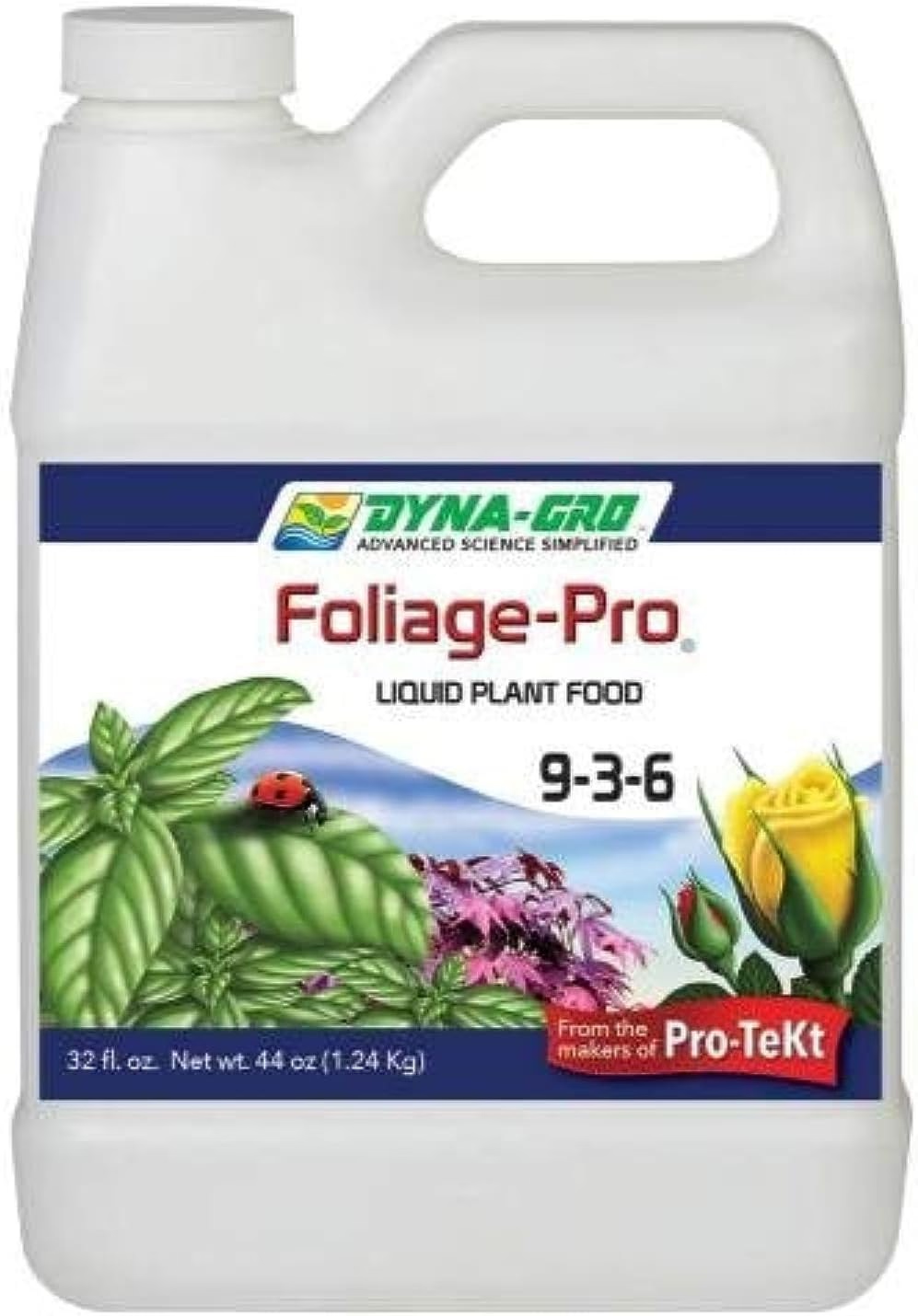
Organic Liquid Plant Food (FoxFarm)
A liquid organic plant food. Applied at label rate during active growth; most houseplants do better at reduced strength and not at all in winter.
View on Amazon ↗
PlantSavvyWorld
Editorial team
PlantSavvyWorld is an independent botanical education project. Articles are drafted with AI assistance, then edited and checked against university extension services, botanical garden collections and other published horticultural sources.
💬 Discussion