Weeping Fig
Ficus benjamina
1. Botanical Overview & Natural Habitat

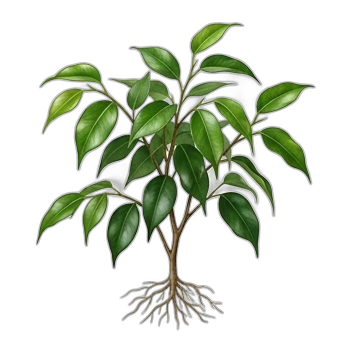
Indoors and in controlled Mediterranean landscapes, it typically behaves as a refined woody perennial, maturing between 4 to 10 feet (1.2 to 3 meters) tall when container-grown. The species is characterized by its smooth, light-gray bark that naturally twists and thickens with age, and its distinctive pendent, gracefully arching branches. The leaves are ovate to elliptic, measuring 2 to 5 inches (5 to 13 cm) in length, terminating in a distinct, elongated drip-tip. This anatomical feature is an evolutionary adaptation designed to shed heavy tropical rainfall rapidly, preventing fungal pathogens from colonizing the leaf lamina.
Unlike many herbaceous houseplants, Ficus benjamina is a woody dicot featuring prominent secondary growth. Over decades of cultivation, its trunk can be braided, trained into topiary standards, or allowed to develop massive, exposed nebari (surface root systems) reminiscent of ancient bonsai specimens. When pruned or injured, the plant immediately exudes a milky-white latex sap. This latex is rich in defense compounds, serving as a natural sealant and deterrent against herbivores, though it requires caution during handling due to its allergenic properties.
2. Essential Environmental & Care Requirements
Mastering the indoor cultivation of Ficus benjamina requires balancing its tropical origins with the realities of modern interior microclimates. Let us look at the precise metrics required for thriving specimens:
| Parameter | Optimal Condition | Common Mistake | Why It Matters |
|---|---|---|---|
| Light | Bright, indirect light (4 hours direct morning sun max) | Placing in deep interior rooms or sudden dark corners | Insufficient light triggers massive photo-acclimation leaf drop. |
| Temperature | 65°F to 80°F (18°C to 27°C) constant | Exposing to temperatures below 50°F (10°C) or cold drafts | Thermal shock induces immediate, systemic abscission. |
| Humidity | 50% to 70% relative humidity | Placing near forced-air heating vents or dry AC units | Low humidity dries leaf tips and invites spider mite infestations. |
| Watering | Water when top 2 to 3 inches (5 to 7.5 cm) are dry | Keeping soil constantly soggy or erratic dry spells | Soggy soil causes root rot; severe drought causes crisping and shedding. |
💡 Pro-Tip: When moving your Weeping Fig from a lower-light indoor spot to a brighter summer patio, introduce it to direct sunlight over a 14-day period. Increase direct exposure by no more than 45 minutes every second day to prevent catastrophic sunburn on the tender leaf cuticles.
Light is the single most critical environmental trigger for Ficus benjamina. While it tolerates lower light levels, it does so by sacrificing large portions of its foliage mass to reach a state of lower metabolic equilibrium. To maintain a lush, full canopy, provide at least 2,000 to 3,000 foot-candles of bright, filtered light daily.
Temperature stability is equally non-negotiable. Ficus benjamina will drop leaves if subjected to temperature fluctuations exceeding 10°F (5.5°C) within a 24-hour cycle, or if chilled by drafts from windows and doors. Keep ambient room temperatures consistently within the 65°F to 80°F (18°C to 27°C) window.
⚠️ Important Caution: Never place a Weeping Fig directly adjacent to unvented gas heaters, wood stoves, or forced-air floor registers. Ethylene gas from combustion appliances and dry heat currents will strip the plant of its leaves within 48 to 72 hours, leaving bare woody skeletons that take months to recover.
3. Step-by-Step Cultivation, Feeding & Propagation
Successful long-term cultivation relies on precise timing and a strict adherence to root health. Here is the operational protocol I use in my professional landscape design practice for repotting and maintaining mature specimens:
- Select the Correct Vessel and Substrate: Choose a heavy ceramic or terracotta pot that is only 2 inches (5 cm) wider in diameter than the existing root ball. Mix a high-porosity soil blend consisting of 40% high-grade peat or coco coir, 30% coarse horticultural perlite or pumice, and 30% composted bark to ensure rapid drainage and optimal oxygen exchange for the roots.
- Timing and Extraction: Perform repotting strictly in early spring (late March to April) as the plant breaks dormancy. Gently tip the plant on its side, slide it from its container, and use your fingers to tease apart the outer 10% to 15% of circling or root-bound fibers to stimulate outward root growth.
- Planting Depth: Position the tree in the fresh substrate at precisely the same soil depth it occupied in its previous container. Burying the root flare too deeply in the potting mix restricts gas exchange at the trunk base and invites collar rot. Tamp the soil gently to eliminate large air pockets and water thoroughly until runoff appears through the drainage holes.
- Fertilization Regimen: Feed actively growing specimens every 14 days from May through August using a balanced, water-soluble liquid fertilizer formulated with a 3-1-2 N-P-K ratio (such as a 9-3-6 formulation), diluted to half-strength. Cease all fertilization completely between October and February when natural daylight diminishes and the plant enters semi-dormancy.
- Propagation via Air Layering: For mature wood propagation, select a pencil-thick, healthy lateral branch in late spring. Make an upward-sloping, 1.5-inch (3.8 cm) cut into the stem, insert a toothpick to keep the wound open, and pack moist sphagnum moss around the cut. Wrap the moss tightly in clear plastic sheeting, securing both ends with waterproof tape. Roots will form inside the moss within 45 to 60 days, at which point you can sever the branch cleanly below the root mass and pot it independently.
For further scientific insights on fig biology and regional hardiness, consult the guidelines provided by the University of Florida IFAS Extension.
4. Common Problems, Pests & Troubleshooting
When a Weeping Fig encounters stress, its language is unequivocal: it drops leaves. However, decoding the manner of the drop tells you exactly what is wrong.
- Massive Green Leaf Drop: If the leaves falling off are entirely green, pliable, and healthy-looking, the cause is almost universally environmental shock. Check for sudden drafts, a recent move to a darker location, or an erratic watering schedule where the root ball completely dried out and was then heavily saturated.
- Yellowing Lower Leaves with Drop: If the older, interior leaves turn bright yellow and drop, you are dealing with overwatering or poor soil drainage. Ensure the bottom drainage tray never holds standing water for more than 15 minutes after a watering cycle.
- Sticky Residue and Sooty Mold: Check the undersides of leaves and leaf axils for scale insects or mealybugs. Scale appears as small, immobile brown bumps, while mealybugs resemble tiny cotton tufts. Both excrete sticky honeydew that fosters black, unsightly sooty mold. Eradicate infestations by wiping all surfaces with a soft cloth saturated in 70% isopropyl alcohol, followed by a thorough spraying of horticultural neem oil emulsion every 7 days for a 21-day cycle to break the pest reproductive timeline.
- Crispy, Brown Leaf Tips: This is the classic signature of low indoor relative humidity, compounded by a buildup of municipal water salts (fluoride and chlorine) in the potting mix. Flush the soil thoroughly twice a year by running clean, filtered water through the pot until the volume of water passing out the bottom equals three times the volume of the container.

5. Frequently Asked Questions
Why is my Weeping Fig dropping leaves when I haven't moved it?
Even if you haven't physically moved the plant, seasonal changes in indoor environments can trigger leaf drop. As autumn transitions to winter, indoor humidity drops drastically, and the angle of natural light shifting through windows reduces the total daily solar radiation the plant receives. Compensate by moving the plant closer to an unshaded window and running a dedicated ultrasonic humidifier nearby to maintain ambient humidity above 50%.
How often should I water my indoor Ficus benjamina?
There is no calendar-based schedule for watering a Weeping Fig. Instead, insert your index finger deep into the soil up to the second knuckle (about 2 to 3 inches or 5 to 7.5 cm deep). If the soil feels dry and cool at that depth, water thoroughly until it runs freely from the drainage holes. If it still feels moist, wait another 3 to 5 days and check again. In winter, this interval may stretch out to every 14 to 21 days, whereas in summer it may be every 5 to 7 days.
Can I prune my Weeping Fig to control its size?
Yes, Ficus benjamina responds exceptionally well to structural pruning. The best time to prune is late winter or early spring before the active growth flush begins. Use sterilized, sharp bypass pruners to cut back overly long stems just above a node or lateral branch. To stop the milky latex sap from bleeding onto floors, dab the fresh cuts immediately with a damp paper towel or dust them lightly with powdered charcoal.
Is Ficus benjamina toxic to cats and dogs?
Yes, Ficus benjamina contains calcium oxalate crystals and bioactive ficin latex in its sap. If chewed, ingested, or allowed to contact the mucous membranes of cats, dogs, or horses, it causes immediate oral irritation, excessive drooling, intense burning sensations, vomiting, and potential gastrointestinal distress. Keep specimens elevated on plant stands or out of reach if you share your home with curious pets.
📋 Table of Contents ▼ Click to expand
Tags: