
Tree Aeonium
Aeonium arboreum
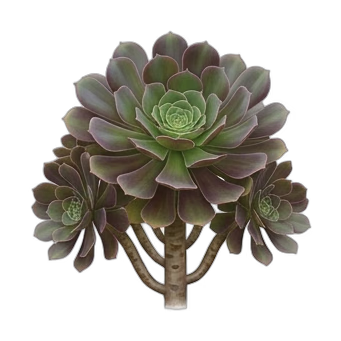
The heavy terracotta container tipped three inches to the left during an unexpected winter storm in my Pacific Northwest garden, nearly snapping the central woody stem of my favorite Aeonium arboreum. I caught it just in time, bracing its architectural, deep-purple rosette against the patio wall, and it reminded me why this striking succulent commands such loyalty among landscape designers. Horticultural practice has spent decades evaluating how architectural plants handle the transition from wild cliffs to domestic gardens. The Tree Aeonium is a masterclass in structural drama, bringing a sculptural, branching silhouette that few other succulents can match.

1. Botanical Overview & Natural Habitat
The Tree Aeonium (Aeonium arboreum), belonging to the Crassulaceae family, is an evergreen, subtropical subshrub native primarily to the Canary Islands, as well as parts of North Africa and the Mediterranean basin. Unlike many ground-hugging succulents, Aeonium arboreum develops a woody, branching stem system that can elevate its striking leaf rosettes anywhere from 3 feet to 5 feet (0.9 m to 1.5 m) off the ground over a span of 3 to 5 years.
The rosettes—often measuring 6 inches to 8 inches (15 cm to 20 cm) in diameter—are composed of fleshy, spatulate leaves arranged in tight, geometric spirals. Species and cultivars like 'Zwartkop' boast deep, near-black pigmentation that intensifies when exposed to direct ultraviolet light, creating a dramatic contrast against lime-green or golden varieties like Aeonium arboreum 'Atropurpureum' or 'Variegatum'.
Unlike desert cacti that lie dormant during scorching summer months, Tree Aeoniums are winter-growing (hibernating) plants. They experience active vegetative growth from autumn through spring, driven by cooler temperatures and seasonal rains, and often enter a state of semi-dormancy during the dry heat of mid-summer.
2. Essential Environmental & Care Requirements
Creating an environment that mimics the mild, maritime conditions of the Canary Islands is the secret to keeping your Tree Aeonium thriving. Because they hail from oceanic cliffs, they despise extreme heat combined with high humidity, preferring steady, temperate conditions.
| Parameter | Optimal Condition | Common Mistake | Why It Matters |
|---|---|---|---|
| Temperature | 65°F to 75°F (18°C to 24°C) | Exposing to hard freezes below 30°F (-1.1°C) | Fleshy stems hold high water content; ice crystals rupture cell walls, causing mushy collapse. |
| Light Exposure | 6+ hours of bright, direct sun | Growing in deep indoor shade | Insufficient light causes stems to stretch (etiolate) and deep purple cultivars to revert to green. |
| Soil Mix | Gritty, fast-draining cactus/succulent blend (pH 6.0–7.0) | Heavy, moisture-retaining potting soil | Prolonged root moisture triggers Pythium root rot and stem base failure. |
| Watering Frequency | Deep soak when top 2 inches (5 cm) are dry | Frequent, shallow sips | Shallow watering encourages weak root systems near the surface rather than deep, anchoring roots. |
To understand more about the specific regional adaptation of these plants, consult the Royal Horticultural Society plant profile.
💡 Pro-Tip: If you live in an inland climate with scorching summer afternoons exceeding 90°F (32°C), provide your Tree Aeonium with light afternoon shade. While they love the sun, intense inland heat forces them into a defensive, premature dormancy where leaf drop is common.
3. Step-by-Step Cultivation, Feeding & Propagation
Propagating and cultivating Tree Aeoniums is remarkably straightforward once you understand their growth cycle. Because their stems are naturally branching and woody, they lend themselves perfectly to stem cuttings. Follow this step-by-step sequence to propagate your plant during its active growing season in early spring or autumn:
- Select a healthy stem: Choose a firm, disease-free terminal rosette with at least 4 inches (10 cm) of stem attached below the lower leaves.
- Make a clean cut: Using a sterilized razor blade or pruning shears wiped with 70% isopropyl alcohol, sever the stem cleanly at a 45-degree angle to maximize surface area for root production.
- Strip lower foliage: Gently pluck away the bottom 2 inches (5 cm) of leaves from the cutting to expose bare stem nodes where roots will emerge.
- Cure the wound: Place the cutting in a warm, dry, shaded location indoors for 5 to 7 days. This allows the cut end to form a hard, protective callus, preventing fungal pathogens from entering when planted.
- Prepare the rooting medium: Fill a 4-inch (10 cm) nursery pot with a dry, sterile mix consisting of 50% perlite or pumice and 50% standard succulent soil.
- Plant the cutting: Insert the callused stem 1.5 inches (3.8 cm) deep into the dry medium. Prop the stem upright with small stones if it is top-heavy.
- Withhold water temporarily: Keep the pot completely dry for the first 14 days to encourage the plant to send out searching roots in response to thirst.
- Initiate watering: After two weeks, give the soil a thorough watering. Repeat watering only when the soil is completely dry throughout the root zone. New root systems typically anchor firmly within 30 to 45 days.
Feeding requirements are modest. Apply a balanced, water-soluble fertilizer diluted to half-strength once every 4 weeks strictly during their active winter-to-spring growing season. Cease all fertilization entirely during the summer dormancy period.
4. Common Problems, Pests & Troubleshooting
Even resilient succulents face occasional health hurdles. Catching environmental stress early saves you from losing the entire structural canopy.
- Lower Leaf Yellowing and Drop: If older leaves at the base of the rosette turn yellow, dry up, and drop off, this is completely normal. The plant continually sheds old foliage to fuel new crown growth. However, if multiple upper leaves turn yellow and translucent simultaneously, you are likely overwatering.
- Stretched, Weak Stems (Etiolation): When a Tree Aeonium stretches rapidly toward a distant light source, the stems become pale, weak, and incapable of supporting the heavy head. Prune the leggy top back to a sturdy node, move the plant to a brighter exposure, and use the top cutting to start a new, compact specimen.
- Aphids on Flower Stalks: In late winter, mature plants may send out central yellow panicles of flowers. These blooms frequently attract colonies of black aphids.
- Stem Rot: Caused by standing water or over-saturated, poorly draining soil. The base of the stem turns black, soft, and foul-smelling.
⚠️ Important Caution: When your Tree Aeonium finishes blooming, that specific rosette will die—this is a monocarpic trait in many aeonium species. Do not panic; simply prune away the spent flower stalk and dead rosette. The plant will have already produced lateral offsets or "pups" along the lower stem to carry on its life cycle.

5. Frequently Asked Questions
Why is my Tree Aeonium dropping all its leaves in the summer?
This is typically a natural survival mechanism known as summer dormancy. When temperatures spike and rainfall drops, the outer leaves of the rosette curl inward and drop off to minimize surface area and transpirational moisture loss. Reduce watering significantly during this period, and your plant will re-hydrate and push out fresh rosettes once autumn temperatures cool down.
Can Tree Aeoniums survive winter outdoors?
It depends entirely on your USDA Hardiness Zone. Tree Aeoniums are reliably perennial only in Zones 9 through 11, where winter temperatures rarely dip below 25°F to 30°F (-4°C to -1.1°C). If you live in Zone 8 or colder, you must cultivate them in containers and bring them indoors or into a greenhouse before the first hard autumn frost.
How often should I water a potted Tree Aeonium?
As a general rule, water deeply until moisture runs out of the drainage holes, then let the soil dry out completely—down to the bottom of the pot—before watering again. During active autumn-to-spring growth, this may mean watering every 10 to 14 days. During summer dormancy, stretch watering intervals to every 3 to 4 weeks to prevent root rot.
Why is my green Tree Aeonium turning black?
If you are growing a cultivar like Aeonium arboreum 'Zwartkop', this color shift is a sign of excellent health and high light exposure. The deep burgundy and black pigmentation is a natural sun-stress response driven by anthocyanin production. It protects the plant's cellular structure from intense ultraviolet radiation, so no intervention is needed unless the leaves show signs of physical sunburn (bleaching or crisp, brown scorch marks).
📋 Table of Contents ▼ Click to expand
Tags: