String of Tears
Senecio citriformis

1. Botanical Overview & Natural Habitat
The "String of Tears"—scientifically classified as Senecio citriformis (though frequently sold under the synonymous moniker Curio citriformis)—belongs to the massive, diverse Asteraceae family. Native primarily to the arid, rocky regions of South Africa, this succulent has evolved a suite of physiological adaptations to survive blistering heat and prolonged periods of severe drought.
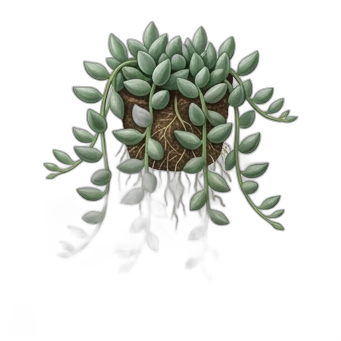
Unlike its popular cousin Senecio rowleyanus (String of Pearls), which features spherical leaves, Senecio citriformis produces distinctive, pointed, teardrop- or lemon-shaped leaves (hence the specific epithet citriformis, meaning "citrus-shaped"). These leaves measure roughly 0.4 to 0.7 inches (1.0 to 1.8 cm) in length and feature a unique, longitudinal translucent line or "window." In nature, these epidermal windows allow filtered sunlight to penetrate the interior photosynthetic tissue while minimizing surface area exposure to the desiccating sun, drastically reducing transpirational water loss.
The stems are slender, wiry, and initially upright before succumbing to gravity, naturally draping over cliffs, rock outcrops, or hanging baskets as they reach lengths of 3 to 4 feet (0.9 to 1.2 m). During late autumn to winter, mature plants produce small, insignificant, yet delightfully fragrant white or pale yellow disk flowers elevated on short stalks. These flowers emit a pleasant, clove-like scent that signals nocturnal pollinators in their native habitat.
Understanding this arid, cliff-dwelling background immediately shifts how we must cultivate them indoors or in Mediterranean garden zones. They are not jungle understory dwellers; they are rugged lithophytes that demand sharp drainage, intense illumination, and rigorous dry-out cycles between irrigations.
2. Essential Environmental & Care Requirements
Mastering the cultivation of Senecio citriformis requires balancing light, substrate composition, thermal thresholds, and precise watering intervals. Let us break down these critical parameters.
| Parameter | Optimal Condition | Common Mistake | Why It Matters |
|---|---|---|---|
| Light | 6+ hours of bright, direct-to-filtered sunlight daily (east or unobstructed west exposure) | Placing in low-light interior rooms or dark corners | Causes etiolation, stretching stems, flattened leaves, and loss of the translucent leaf windows |
| Substrate | Gritty, fast-draining mix (50% succulent soil, 50% pumice/perlite) | Using standard, heavy peat-based potting soil | Retains moisture too long around fine root hairs, rapidly inducing fatal phytophthora and root rot |
| Watering | Soak-and-dry method: water deeply only when the soil is 100% dry and leaves soften slightly | Watering on a rigid calendar schedule (e.g., every 7 days) | Drowns roots during low-light periods or dehydrates the plant when growth stalls |
| Temperature | 65°F to 85°F (18°C to 29°C) active range; minimum 40°F (4°C) | Exposing to unexpected winter frost or cold indoor drafts | Freezes cellular water inside the succulent leaves, turning them to translucent mush |
| Humidity | Low to moderate ambient humidity (30% to 50%) | Stagnant, humid environments without airflow | Encourages fungal leaf spot and invites sap-sucking pests like mealybugs |
💡 Pro-Tip: When evaluating your light levels, look closely at the shape of the new growth tips. If the teardrops maintain their plump, elongated lemon shape and sit tightly along the stem with less than 0.5 inches (1.2 cm) between nodes, your lighting is ideal. If the stem stretches out with wide spacing and tiny, flat leaves, your plant is starving for photons.
To deepen your understanding of how succulent root systems interact with moisture gradients, consult the guidelines provided by the University of California Agriculture and Natural Resources Extension. Their research on arid-adapted flora underscores the absolute necessity of coarse soil aggregates.
3. Step-by-Step Cultivation, Feeding & Propagation
Propagating and maintaining a flourishing pot of Senecio citriformis is remarkably straightforward once you establish a reliable operational rhythm. Here is my tried-and-true protocol for potting, feeding, and multiplying your collection.
Step 1: Selecting the Right Vessel and Soil Mix
Choose a container—preferably terracotta or unglazed ceramic with a generous drainage hole—that is proportional to the root ball. Avoid putting a small cutting into an 8-inch (20 cm) pot, as the excess soil will retain moisture far too long. Mix 50% high-quality organic cactus and succulent potting soil with 50% inorganic grit, such as 1/8-inch pumice or horticultural perlite.
Step 2: The Soak-and-Dry Irrigation Technique
Never give your string of tears frequent sips of water. Instead, take the pot to a sink and saturate the medium thoroughly until water flushes freely out of the bottom drainage hole. Allow every drop of excess water to drain completely. Do not water again until you insert a wooden dowel 2 inches (5 cm) into the mix and it comes out completely dry, and the teardrop leaves exhibit a slight give when gently squeezed between your fingers.
Step 3: Minimalist Fertilization Protocol
Because Senecio citriformis grows in nutrient-poor rocky soils natively, heavy feeding will cause rapid, weak, structurally unsound stem growth. Dilute a balanced, water-soluble succulent fertilizer (such as a 10-10-10 or specialized cactus formula) to one-quarter strength. Apply this solution strictly once every 4 to 6 weeks exclusively during the active spring and summer growing seasons. Withhold all fertilizer completely from late autumn through winter.
Step 4: Propagating via Stem Cuttings
Select a healthy, robust trailing stem and take a cutting measuring at least 4 to 6 inches (10 to 15 cm) long using sterilized shears. Snip off the bottom 1 inch (2.5 cm) of teardrop leaves to expose bare nodes. Allow the cut end to callus over in a warm, dry, shaded spot for 48 to 72 hours to prevent fungal entry. Lay the callused stem horizontally across a shallow tray filled with dry, gritty propagation mix, gently pressing the bare nodes into the surface. Alternatively, push the stripped end 1 inch (2.5 cm) directly into a small pot filled with dry soil. Keep the medium completely dry for the first 14 days to stimulate root initiation, then introduce a few drops of water around the base. Roots will actively emerge from the nodes within 21 to 30 days.
For additional botanical classification context and global specimen data on succulent genera, you can cross-reference nomenclature databases through the Royal Botanic Gardens, Kew.
4. Common Problems, Pests & Troubleshooting
Even experienced growers occasionally encounter setbacks with trailing succulents. Here is how to diagnose and correct the most common issues before they threaten the entire plant.
- Müshiness, Yellowing, and Sudden Stem Collapse: This is the unmistakable signature of overwatering and root rot. The potting medium is staying wet too long, suffocating the roots and causing cellular rupture. Immediately unpot the plant, slice away all black, mushy, or foul-smelling roots with a sterile blade down to firm, white tissue, and repot into fresh, dry, gritty mix.
- Shriveling, Wrinkled, or Deflated Teardrops: If the leaves look puckered and thin, your plant is severely dehydrated. However, if the soil is soaking wet and the leaves are shriveled, the roots have already rotted away and can no longer transport water—a condition known as physiological drought. Check the roots immediately to determine which scenario you are facing.
- Mealybugs and Scale Insects: These sap-sucking pests love hiding in the tight crevices where the leaves attach to the wiry stems, appearing as small white cottony masses. Isolate the affected plant immediately. Dip a cotton swab in 70% isopropyl alcohol and dab it directly onto every visible pest to dissolve their protective waxy coatings. For heavy infestations, apply a thorough spray of insecticidal soap or horticultural oil, ensuring complete coverage of all stem joints.
⚠️ Important Caution: Senecio citriformis, like many members of the Asteraceae family and specifically the Senecio genus, contains toxic pyrrolizidine alkaloids. Ingestion by household pets (dogs and cats) or humans can lead to severe liver damage, vomiting, and lethargy. Always keep trailing strands safely elevated and out of reach of curious animals and children.

5. Frequently Asked Questions
Why is my String of Tears turning flat instead of round?
Flattened leaves are a direct physiological response to insufficient light levels. When a Senecio citriformis does not receive enough photons, it alters its leaf morphology to maximize surface area for light capture, losing its signature plump, lemon-like 3D shape. Move the plant immediately to a brighter location receiving direct morning sun.
How often should I water my String of Tears indoors?
There is no fixed calendar day for watering succulents because indoor environmental conditions fluctuate wildly. Instead, test the soil depth and check leaf firmness. On average, mature plants in bright indoor conditions require a deep soaking every 14 to 21 days in the summer, and every 30 to 45 days during the dormant winter months.
Can I propagate String of Tears in water?
Yes, water propagation is entirely possible, though the resulting roots will be adapted to an aquatic environment and may experience a temporary shock when transitioned back to soil. Suspend a 4-inch stem cutting over a small glass of water so that only the very bottom node touches the liquid. Change the water weekly. Once roots reach 1 inch (2.5 cm) in length—usually within 18 to 25 days—pot the cutting up carefully into a gritty succulent mix.
Why are the top stems of my plant completely bald?
As trailing succulents mature, it is entirely natural for the older leaves closest to the soil surface to dry up, turn brown, and drop off over the years. However, if the top crown is rapidly shedding leaves, it usually indicates chronic overwatering, root suffocation, or a lack of ambient light hitting the top of the pot. Prune away the healthy trailing ends to propagate new plants, and adjust your watering and lighting habits to preserve the crown.
📋 Table of Contents ▼ Click to expand
Tags: