String of Bananas
Senecio radicans
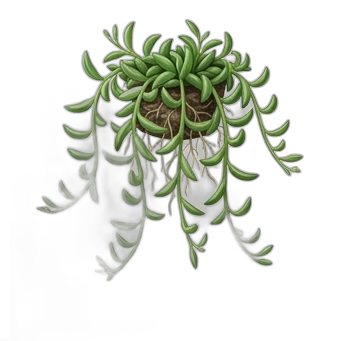
I stood on a gardener's second-story balcony in downtown Seattle last spring, untangling three yards of trailing, banana-shaped leaves that had somehow fused into a stubborn, living knot during transit. The Senecio radicans—better known as the String of Bananas—was bone-dry in its nursery pot, yet the tips were actively searching for soil, storing every drop of moisture they possessed inside those fleshy, translucent windows. That resilience is what I love most about them. They are architectural, forgiving, and deeply satisfying to grow once you understand their native African roots.
1. Botanical Overview & Natural Habitat

The plant's signature "bananas" are actually modified leaves known as specialized storage organs. Each leaf features a translucent longitudinal line called an epidermal window. This adaptation allows sunlight to penetrate the interior of the leaf for photosynthesis while minimizing moisture loss through evaporation—a brilliant evolutionary trick for surviving prolonged droughts.
Stems can easily reach lengths of 3 feet (90 cm) to 5 feet (150 cm) indoors, rooting passively wherever a node makes contact with the soil. Small, cinnamon-scented, white-to-off-white tubular flowers appear during the shorter days of late winter or early spring, releasing a subtle, clove-like fragrance that often surprises indoor gardeners. For further taxonomic validation and structural classification, you can consult the Royal Botanic Gardens Kew Plants of the World Online.
2. Essential Environmental & Care Requirements
Replicating a South African cliffside in a modern living room comes down to managing light, substrate, and thermal boundaries. Getting these baselines right prevents the leggy, stretched growth that plagues so many indoor succulent collections.
| Parameter | Optimal Condition | Common Mistake | Why It Matters |
|---|---|---|---|
| Light | 6+ hours bright, indirect light; 2-4 hours direct morning sun | Placing in dark interior corners or harsh afternoon sun | Insufficient light causes sparse node spacing; intense afternoon sun scorches epidermal windows. |
| Temperature | 65°F to 80°F (18°C to 27°C) | Exposing to drafts below 35°F (1.5°C) | Frost destroys cell walls instantly, turning fleshy leaves to mush. |
| Soil Mix | 50% cactus/succulent mix, 50% perlite/pumice | Using heavy, peat-dense potting soil | Dense soil retains moisture too long, suffocating roots and inviting fungal pathogens. |
| Watering | Soak-and-dry method (100% dry down to 2 inches depth) | Watering on a strict calendar schedule | Overwatering bursts the delicate water-storage cells, leading to stem rot. |
| Humidity | 30% to 50% relative humidity | Mist-spraying indoors | Misting provides zero hydration benefits and encourages foliar fungal spore germination. |
💡 Pro-Tip: Look closely at the windows on the top of the banana leaves. If they look plump and slightly convex, step away from the watering can. If those windows begin to pucker or pings of concave wrinkling appear along the side of the banana, your plant is signaling an immediate thirst.
3. Step-by-Step Cultivation, Feeding & Propagation
Propagation is where Senecio radicans truly shines. Because every single leaf node holds dormant root initials, multiplying your collection requires little more than patience and clean snips. Here is my exact field-tested protocol for taking cuttings and establishing a lush, full pot.
- Select and Sanitize: Sterilize a pair of sharp pruning shears with 70% isopropyl alcohol. Locate a healthy, vibrant vine on the mother plant and snip a length measuring at least 4 inches (10 cm) to 6 inches (15 cm) long.
- Strip the Lower Leaves: Carefully pluck away the bottom 2 inches (5 cm) of banana leaves from the stem. This exposes bare nodes, which is precisely where new roots will emerge.
- Callous the Wound: Lay your freshly cut stems out on a clean paper towel in a shaded, well-ventilated room for 48 to 72 hours. This allows the cut ends to dry and form a protective callous, preventing soil-borne bacteria from entering the vascular tissue.
- Prepare the Propagation Vessel: Fill a shallow terra-cotta pot with a pre-moistened mix of 60% perlite and 40% standard succulent soil. Terra-cotta is ideal because its porous clay walls wick away excess moisture from the root zone.
- Lay and Anchor: Instead of burying the stems vertically, coil the calloused cuttings horizontally across the surface of the soil. Pin them down gently using bent floral wire or clean paperclips so that the bare nodes make direct contact with the potting mix.
- Provide Bright, Indirect Light: Place the tray or pot in a spot receiving bright, indirect light between 70°F (21°C) and 75°F (24°C). Avoid direct scorching sunlight while roots are developing.
- Initiate Mist Watering: Mist the soil surface lightly every 3 to 4 days just to keep the top layer slightly damp, but never soggy. Within 14 to 21 days, tiny white roots will anchor into the mix, and miniature banana leaves will begin pointing skyward from the nodes.
When it comes to feeding, restraint is key. Apply a balanced, water-soluble liquid cactus fertilizer diluted to one-quarter strength precisely once a month during the active growing season (spring through summer). Cease fertilization entirely from late autumn through winter when the plant enters semi-dormancy. For broader botanical context on succulent cultivation standards, reference the University of Florida IFAS Extension.
4. Common Problems, Pests & Troubleshooting
Even resilient succulents fall victim to environmental stress. Recognizing the early warning signs saves you from losing an established trailing specimen.
- Mushy, Yellowing Stems and Leaves: This is the classic signature of root rot driven by overwatering or dense, poorly draining soil. Immediately cut away any healthy green tips above the rot line, discard the affected root ball and soil, and propagate fresh cuttings.
- Long, Leggy Stems with Wide Gaps: If the spaces between your banana leaves stretch past 1 inch (2.5 cm), your plant is starving for photons. Relocate it closer to an east- or unblocked west-facing window, and trim back the leggy growth to encourage bushier branching.
- Crispy, Brown, Shriveled Tips: Caused by intense, unshielded afternoon sun combined with extreme underwatering. Move the plant slightly back from the glass or provide sheer curtain filtration.
- Mealybugs: These cottony, white, sap-sucking pests love hiding in the tight crevices where the leaf meets the main stem. Dip a cotton swab in 70% isopropyl alcohol and dab it directly onto every visible pest, repeating weekly until the infestation is entirely eradicated.
⚠️ Important Caution: Like many members of the Senecio genus, String of Bananas contains pyrrolizidine alkaloids. These chemical compounds are toxic if ingested by cats, dogs, or humans, causing severe liver distress and gastrointestinal upset. Always hang your trailing pots well out of reach of curious pets and toddlers.

5. Frequently Asked Questions
Why is my String of Bananas turning mushy?
Your plant is experiencing cellular collapse from overwatering or a lack of proper drainage. When roots sit in stagnant, saturated soil for too long, they drown and rot, rendering them unable to transport water up to the leaves. This causes the bananas to swell past their structural limit, turn translucent yellow, and liquefy. Stop watering immediately, check the drainage hole for clogs, and inspect the root ball for brown, foul-smelling roots.
How much direct sun does a String of Bananas need?
String of Bananas thrives with 4 to 6 hours of bright light daily, ideally including gentle direct morning sun. While they can survive in lower-light indoor spaces, their growth slows down, and stems become thin and weak. However, sudden exposure to harsh, unacclimated afternoon sun will instantly sunburn the delicate epidermal windows, leaving permanent white or brown scarred patches on the leaves.
Can I propagate String of Bananas in water?
Yes, water propagation is entirely possible and fascinating to watch. Take a 4-inch (10 cm) stem cutting, remove the lower leaves, let the wound callous for 24 hours, and suspend the bare nodes just above or lightly touching clean water in a glass jar. Place the jar in bright, indirect light, and change the water every 5 days to prevent bacterial buildup. Robust water roots will emerge within 10 to 14 days, after which you can gently transition the cutting into a well-draining soil mix.
Why are the bananas on my plant flattening out?
If your banana-shaped leaves are losing their plump, cylindrical profile and turning flat or narrow, the plant is likely receiving inconsistent hydration or insufficient light. When a plant lacks the energy from proper light exposure, it cannot efficiently process water or manufacture new food reserves, resulting in distorted, stunted, or flattened leaf morphology. Assess your lighting conditions and ensure you are providing a thorough soak whenever the soil dries out completely.
📋 Table of Contents ▼ Click to expand
Tags: