

Star Window Plant
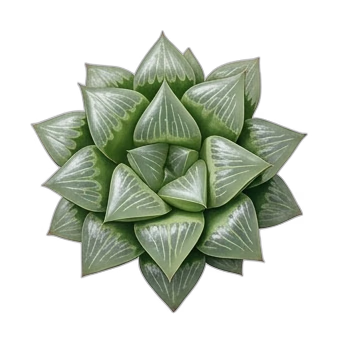
Haworthia cuspidata
1. Botanical Overview & Natural Habitat

What sets Haworthia cuspidata apart is its distinct leaf anatomy. The fleshy, triangular leaves feature translucent, window-like tips. In its native habitat, these epidermal windows allow sunlight to penetrate deep into the leaf interior where specialized photosynthetic tissue resides, protecting the plant from intense, damaging ultraviolet radiation while maximizing light capture beneath rocky outcrops or companion shrubs.
The root system consists of thick, contractile roots that actively pull the rosette flush against or slightly below the soil surface during severe dry spells, protecting the meristematic tissue from desiccating winds and herbivores. Because its root architecture requires both vertical drainage and lateral stability, understanding soil depth is just as critical here as it is when calculating How Deep Do Pepper Plant Roots Go? Pot Size & Substrate Depth Guide for container vegetables. Haworthia cuspidata produces insignificant, tubular white flowers on slender racemes reaching 6 to 8 inches (15.2 to 20.3 cm) in height, typically blooming in spring.
2. Essential Environmental & Care Requirements
Replicating a South African semi-arid environment indoors demands a firm grasp of specific climatic thresholds.
Light
Star Window Plants thrive in bright, indirect light. In nature, they grow in the dappled shade of rocks or larger scrub. Direct, unfiltered midday sun—especially in afternoon exposures—will scorch the translucent leaf tips, turning them a permanent, unsightly rust-brown. Aim for 3 to 4 hours of gentle morning sun, or place the plant 2 to 3 feet (60 to 90 cm) away from an east- or west-facing window. If you notice the rosettes stretching or losing their compact form, they are crying out for higher light intensity.
Temperature & Humidity
Temperature ranges mirror its native Mediterranean climate. Keep ambient temperatures between 65°F and 80°F (18°C to 27°C) during the active growing season. While they can tolerate brief dips down to 40°F (4°C) if kept completely dry, frost will rapidly rupture their water-dense cell walls. Indoor humidity should remain low, ideally between 30% and 40%. High humidity paired with stagnant air is a guaranteed recipe for fungal rot.
Watering Protocol
The golden rule of Haworthia care is the "soak and dry" method. Allow the potting medium to dry out 100% of the way down to the bottom of the container before applying water again. Depending on your indoor humidity and container size, this interval typically spans 14 to 21 days in summer and 30 to 45 days in winter. When you do water, drench the soil thoroughly until water runs freely through the drainage holes, then empty the saucer immediately. Never let the pot sit in standing water.
| Parameter | Optimal Condition | Common Mistake | Why It Matters |
|---|---|---|---|
| Light | Bright, indirect (East window or shaded South) | Direct afternoon sun | Intense UV rays scorch and blister the delicate translucent leaf windows. |
| Soil pH | 6.0 to 7.5 (Slightly acidic to neutral) | Heavy, moisture-retaining organic compost | Compacted soils suffocate thick roots and retain moisture too long, causing rot. |
| Watering | Complete dry-out between deep waterings | Frequent, shallow sips | Shallow watering encourages weak root development and leaves lower roots dry. |
| Pot Type | Unglazed terra cotta with a drainage hole | Non-porous plastic or glass without drainage | Terra cotta breathes, accelerating soil drying and preventing root asphyxiation. |
💡 Pro-Tip: If you want to study the root health of your Star Window Plant without uprooting it, gently poke a plain wooden chopstick 2 inches (5 cm) deep into the center of the pot. If it comes out cool, dark, or slightly damp, step away from the watering can. Only water when the wood emerges completely dry and clean.
3. Step-by-Step Cultivation, Feeding & Propagation
Cultivating Haworthia cuspidata successfully requires precise physical execution, from the substrate mix to the propagation bench.
Soil Formulation
Standard potting soil retains far too much moisture. Mix your own substrate using 40% high-quality cactus/succulent soil, 40% inorganic grit (such as pumice, perlite, or poultry grit), and 20% horticultural sand or akadama. This guarantees rapid drainage and structural aeration, a principle heavily emphasized by horticultural authorities like the Royal Horticultural Society when discussing arid-climate container subjects.
Feeding Schedule
Star Window Plants are light feeders. Fertilize only during their active growth phases in spring and autumn. Apply a balanced, water-soluble cactus fertilizer diluted to 1/4 strength once every 30 days. Cease all fertilization entirely during the dormant heat of mid-summer and the dark depths of winter to prevent mineral salt burn.
Step-by-Step Propagation via Offsets (pups)
Propagating your Star Window Plant is best done during routine repotting in early spring.
- Unpot and Clean: Gently slide the plant out of its container and massage the root ball to remove old, spent soil. Brush away debris to expose the junction where the offsets attach to the mother plant.
- Inspect and Select: Look for offsets (pups) that have developed at least 3 to 4 independent leaves and a distinct set of tiny roots measuring at least 0.5 inches (1.3 cm) long.
- Separate: Using a sterilized, razor-sharp blade or pruning shears, cut the offset away from the primary stem, ensuring you preserve as many attached roots as possible on the pup.
- Callus: Dust the fresh cuts with sulfur powder or ground cinnamon (a natural antifungal) and place the pups in a shaded, dry location for 3 to 5 days to allow the wounds to seal completely.
- Pot Up: Plant the callused offsets into individual 2-inch (5 cm) terra cotta pots filled with dry succulent mix. Keep them in bright, indirect light and withhold water entirely for 14 days to encourage the plant to push out new roots in search of moisture.
4. Common Problems, Pests & Troubleshooting
Even experienced growers encounter environmental hurdles with window succulents. Here is how to diagnose and correct them before permanent damage sets in.
Root Rot
- Symptoms: Leaves turn translucent-yellow, feel mushy to the touch, and easily detach from the base with a gentle tug. The base of the stem may turn black and soft.
- Cause: Overwatering combined with dense, poorly draining soil and inadequate airflow.
- Solution: Unpot the plant immediately. Use a sterilized blade to slice away all black, decaying roots until you hit firm, white tissue. Dust the remaining healthy roots with a fungicide, let the plant dry bare-root for 48 hours, and repot into fresh, dry, gritty substrate.
Etiolation
- Symptoms: The tight, symmetrical rosette begins to stretch upward, leaves turn pale green, thin, and point outward at unnatural angles.
- Cause: Insufficient light exposure.
- Solution: Gradually move the plant to a brighter location over the course of 7 to 10 days to prevent sunburn shock. Note that stretched leaves will not revert to their compact form; you must wait for new, compact growth to emerge from the center, after which you can propagate the top rosette if desired.
Mealybugs
- Symptoms: Small, cotton-like white masses hiding deep in the tight crevices between leaf bases and along the root crown.
- Cause: Low humidity, poor ventilation, or bringing home an infested companion plant.
- Solution: Dip a cotton swab in 70% isopropyl alcohol and dab every visible bug to dissolve their protective waxy coating. For severe infestations, spray the entire plant with horticultural insecticidal soap, ensuring it penetrates deep into the rosette crown. For further reading on managing tricky greenhouse pests, consult resources provided by institutions like the University of California Agriculture and Natural Resources.
⚠️ Important Caution: Never use commercial leaf shine products or heavy mineral oils on the translucent leaf tips of Haworthia cuspidata. These products clog the stomata and coat the epidermal window cells, completely blocking the light transmission necessary for photosynthesis and inevitably causing the plant to suffocate and decline.

5. Frequently Asked Questions
Why are the leaf tips on my Star Window Plant turning brown and crispy?
This is typically caused by one of two factors: direct, harsh afternoon sun scorching the delicate window tissue, or underwatering over an extended period. Assess your lighting placement and check your watering frequency to determine which environmental stressor is at play.
Should I cut off the flower stalk of my Star Window Plant?
You do not have to, but you can. Blooming consumes a moderate amount of energy. If your plant is small, recovering from root rot, or struggling, snipping off the flower stalk early allows the plant to redirect its energy back into root and leaf development.
Can Star Window Plants live happily inside a sealed glass terrarium?
Generally, no. Closed terrariums trap ambient humidity far above the 40% threshold these South African succulents require, leading rapidly to fatal fungal rot and root suffocation. If you use glass containers, ensure they are open-topped vessels with proper drainage holes drilled at the base.
How often do I need to repot a mature Star Window Plant?
Mature plants typically require repotting every 2 to 3 years in early spring. Repotting refreshes depleted mineral nutrients in the soil and provides extra room for the plant to expand its offset cluster into a slightly larger container, usually sizing up the pot by just 1 inch (2.5 cm) in diameter.
📋 Table of Contents ▼ Click to expand
Tags:





