
Rex Begonia
Begonia rex
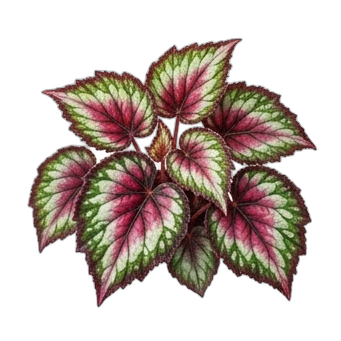
The morning light was barely grazing the edge of my propagation bench when I noticed the leaf collapse. It was a 'Escargot' Rex begonia, its signature spiral whorl resting limply against the rim of its terra cotta pot, betrayed by a single drop of water that had lingered too long in its central fold. I have grown thousands of houseplants across horticultural practice yet Rex begonias still demand my absolute attention. They are not plants you neglect for a week; they are botanical sculptures that respond instantly to the micro-climate of your indoor space.
1. Botanical Overview & Natural Habitat

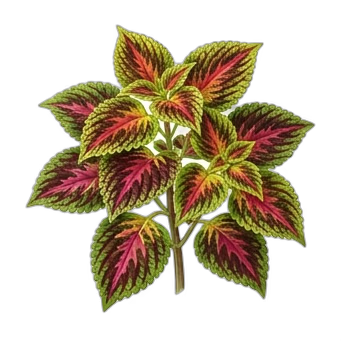
Botanically, Begonia rex is characterized by its thick, creeping surface rhizomes that store water and nutrients, allowing the plant to survive intermittent dry spells in its native leaf litter. The leaves are asymmetrical—a defining trait of the Begoniaceae family—and display an astonishing array of metallic sheaths, silver bands, deep purples, burgundies, and iridescent emerald greens. They feature a velvety or metallic pubescence (fine hairs) across the leaf lamina that protects the stomata from rapid moisture loss in high-humidity environments.
Understanding this natural habitat is the key to mastering their cultivation indoors. We are not simply potting a tropical plant; we are recreating a sheltered, highly humid, low-light understory ecosystem inside a modern home or greenhouse.
2. Essential Environmental & Care Requirements
To keep a Rex begonia thriving, you must balance four critical environmental parameters: light, water, humidity, and temperature. Deviate too far from these tolerances, and the foliage will rapidly show distress via tip burn, stem rot, or leaf drop.
| Parameter | Optimal Condition | Common Mistake | Why It Matters |
|---|---|---|---|
| Light | Bright, indirect light (10,000–15,000 lux) | Direct midday sun | Intense light scorches the delicate anthocyanin pigments, bleaching the leaves and causing crispy brown margins. |
| Watering | Allow top 0.5 to 1 inch (1.3 to 2.5 cm) to dry | Keeping soil soggy or letting it bone-dry | Over-saturation rots the delicate surface rhizome; extreme drought triggers irreversible leaf drop and crispy edges. |
| Humidity | 50% to 70% relative humidity | Ambient home air (often 30%) | Low humidity causes brown, crispy leaf tips and curls the edges of the asymmetrical foliage. |
| Temperature | 65°F to 75°F (18°C to 24°C) | Drafts below 55°F (13°C) | Cold drafts shock the plant, stalling root development and encouraging fungal pathogens like powdery mildew. |
Soil composition is equally vital. Rex begonias require an exceptionally airy, fast-draining substrate. I formulate my own mix using 40% high-grade peat moss or coco coir, 30% perlite or pumice for aeration, and 30% horticultural-grade orchid bark. The target pH should sit between 5.5 and 6.5, which optimizes nutrient availability.
When watering, always use room-temperature water that has been filtered or left out overnight to allow chlorine and fluoride to dissipate. Pour water directly onto the soil matrix rather than over the leaves, as trapped moisture in the asymmetrical leaf pockets is an open invitation for Botrytis blight.
💡 Pro-Tip: Never water a Rex begonia right in the center where the leaves emerge from the rhizome. Always tilt the pot slightly and water the perimeter of the container to protect the crown from rot.
3. Step-by-Step Cultivation, Feeding & Propagation
Cultivating Rex begonias successfully requires precision timing, particularly when repotting or propagating through leaf cuttings. Because their root systems are relatively shallow and compact, they prefer to be slightly root-bound in wide, shallow pots rather than deep containers.
Step-by-Step Leaf Wedge Propagation Sequence
- Select the Specimen: Choose a mature, healthy, and unblemished leaf from the parent plant using a sterile razor blade or scalpel.
- Section the Blade: Lay the leaf abaxial (underside) up on a clean cutting board. Cut the leaf into triangular wedges, ensuring that each wedge contains a major vein junction, as new plantlets emerge directly from the vascular tissue.
- Prepare the Tray: Fill a shallow propagation flat or humidity dome with a pre-moistened, sterile 50/50 mix of perlite and peat moss.
- Plant the Wedges: Insert the pointed end of each wedge vertically or at a 45-degree angle into the medium, burying about 0.5 inches (1.3 cm) of the base so the major vein makes firm contact with the soil.
- Enclose and Illuminate: Cover the tray with a clear humidity dome or plastic wrap to maintain 90% humidity. Place under bright, indirect fluorescent or LED grow lights for 12 to 14 hours daily.
- Maintain Moisture: Mist the interior of the dome as needed. Roots and tiny micro-plantlets will emerge from the cut veins within 30 to 45 days.
- Acclimate and Pot: Once the plantlets develop 3 to 4 true leaves and reach 2 inches (5 cm) in height, gradually open the dome over 7 days to lower humidity, then pot them individually into 2-inch (5-cm) containers using standard Rex soil mix.
Feeding should be approached with a light hand. Rex begonias are light feeders; heavy chemical fertilizers will quickly burn their sensitive root systems. During the active growing season (spring through summer), apply a balanced, water-soluble fertilizer diluted to one-quarter strength once every 3 weeks. Cease fertilization entirely from late autumn through winter when the plant enters a period of semi-dormancy.
For further botanical insights on managing indoor tropical understory species, consult the Royal Horticultural Society.
4. Common Problems, Pests & Troubleshooting
Even under optimal conditions, Rex begonias can encounter health hurdles. Recognizing symptoms early prevents minor issues from becoming fatal structural collapses.
Powdery Mildew (Oidium begoniae)
Appears as white, talcum-powder-like patches on the upper and lower leaf surfaces. It thrives in stagnant air with high humidity and cool temperatures.
- Remediation: Immediately isolate the plant. Increase horizontal air circulation with a small oscillating fan. Spray all foliage thoroughly with a mixture of 1 tablespoon of baking soda, a few drops of liquid castile soap, and 1 gallon (3.8 liters) of water, or apply a commercial copper-based fungicide.
Stem and Rhizome Rot (Pythium or Rhizoctonia)
Triggered by overwatering and heavy, poorly drained soil. The stems turn translucent, mushy, and black at the soil line, and the plant collapses suddenly.
- Remediation: If the rot has reached the main rhizome, the plant cannot be saved. However, you can salvage healthy leaves for propagation. Discard the contaminated soil and sterilize the pot with a 10% bleach solution before reusing.
Spider Mites (Tetranychus urticae)
Tiny, sap-sucking arachnids that thrive in the warm, dry air of heated indoor homes during winter. Symptoms include fine webbing across the undersides of leaves and a stippled, yellowed, or bronze appearance on the upper leaf surface.
- Remediation: Wipe down every leaf manually with a damp microfiber cloth to physically remove adults and eggs. Follow up with a thorough spraying of insecticidal soap or horticultural oil, making sure to coat the leaf undersides.
⚠️ Important Caution: Never use standard shine sprays or heavy leaf-shine oils on Rex begonias. The fine hairs (pubescence) on their leaves trap these oily substances, clogging the stomata and causing rapid tissue death.

5. Frequently Asked Questions
Why are my Rex begonia leaves turning brown and crispy at the edges?
Crispy edges are almost always a symptom of insufficient atmospheric humidity or erratic watering habits. Rex begonias require humidity levels between 50% and 70%. If your indoor air drops below this threshold, place the pot on a pebble tray filled with water, or run a dedicated cool-mist humidifier nearby. Ensure you are watering consistently whenever the top 0.5 inches (1.3 cm) of soil dries out.
How do I save a Rex begonia that has lost all its leaves?
Do not throw the pot away immediately. If the underground rhizome remains firm and plump to the touch, the plant is likely resting in a state of dormancy or shock. Cut back any completely rotted stems, move the pot to a warm location maintaining 70°F (21°C), and reduce watering to a bare minimum until new shoots break through the surface of the rhizome in spring.
Can Rex begonias survive outdoors during the summer?
Yes, you can safely move Rex begonias outdoors once all danger of frost has passed and night temperatures reliably stay above 60°F (15°C). They must be placed in a heavily shaded, protected spot—such as a covered porch or under a dense tree canopy—where they are completely shielded from direct sunlight and heavy pounding rain. Bring them back indoors well before autumn temperatures dip below 55°F (13°C).
Should I mist my Rex begonia to increase humidity?
Misting is generally discouraged for Rex begonias. While it raises humidity for a fleeting minute, the water droplets that remain pooled on the asymmetrical leaf surfaces create a breeding ground for fungal pathogens like Botrytis. Instead of misting, use a room humidifier, group your plants closely together to create a localized micro-climate, or place them on a water-filled pebble tray.
For additional academic research on plant microclimates and pathology, visit the University of Florida IFAS Extension.
📋 Table of Contents ▼ Click to expand
Tags: