
Golden Pothos
Epipremnum aureum
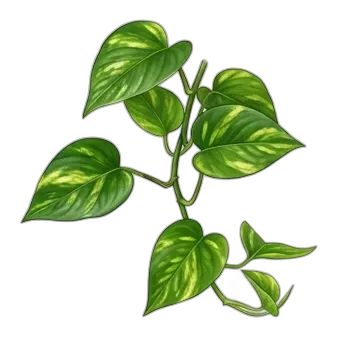
Standing in my conservatory last Tuesday, I watched a stray aerial root of an Epipremnum aureum grip the rough mortar of a brick accent wall, anchor itself with microscopic tenacity, and begin pulling the entire 12-foot vine upward toward a skylight. That raw, unstoppable drive to climb is why I always tell gardeners that growing a Golden Pothos isn't just about keeping a houseplant alive; it’s about managing a living piece of tropical architecture.
1. Botanical Overview & Natural Habitat

As the vine ascends toward the canopy, the leaves undergo a dramatic metamorphosis known as heteroblastic development. They grow significantly larger—often reaching 30 inches (76 cm) in length—and develop deep fenestrations (splits) and perforations remarkably similar to those of a Monstera deliciosa. This structural shift prevents tropical storm winds from ripping the foliage off the vine.
Understanding this wild pedigree dictates how we cultivate it indoors. While housebound specimens rarely reach their adult, fenestrated phase due to container constraints and lower light levels, they retain their innate climbing and trailing instincts. For further taxonomic and structural classification details, you can consult the Missouri Botanical Garden Plant Finder.
2. Essential Environmental & Care Requirements
Replicating a tropical understory in a domestic space requires balancing light, water, and substrate metrics precisely.
| Parameter | Optimal Condition | Common Mistake | Why It Matters |
|---|---|---|---|
| Light | Bright, indirect light (750–1,500 foot-candles) | Direct, scorching midday sun or pitch-dark corners | Direct sun burns leaf epidermis; deep shade reverts variegation to solid green. |
| Watering | Top 2 to 3 inches (5 to 7.5 cm) dry completely before watering | Keeping soil perpetually damp or following a strict 7-day calendar | Saturated root zones starve roots of oxygen, leading to Pythium and Rhizoctonia root rot. |
| Temperature | 65°F to 85°F (18°C to 29°C) | Exposing vines to drafts below 50°F (10°C) or AC vents | Cold stress halts metabolic processes and causes rapid cell wall collapse. |
| Humidity | 50% to 70% relative humidity | Placing plants in arid spaces below 30% humidity | Low humidity causes crispy leaf tips and stunts overall leaf expansion. |
Substrate composition is equally vital. Pothos roots suffocate in dense, moisture-retaining garden soil. I formulate an airy arum mix combining 40% high-grade coco coir, 30% chunky perlite (0.25 to 0.5 inches / 0.6 to 1.2 cm in diameter), and 30% orchid bark. This coarse matrix guarantees rapid drainage and maintains essential air pockets around the thick root systems.
💡 Pro-Tip: If your Golden Pothos is losing its brilliant yellow splashes and turning a dull, uniform green, don't just reach for fertilizer. Variegation is genetically tied to photosynthesis efficiency; without at least 4 hours of bright, indirect light daily, the plant sheds its costly gold pigments to maximize chlorophyll production. Move it two feet closer to an east- or unblocked north-facing window.
3. Step-by-Step Cultivation, Feeding & Propagation
Propagating and maintaining a Golden Pothos is straightforward when executed with botanical precision. Here is my proven methodology for generating robust, multi-branched specimens through stem cuttings.
- Select the Mother Vine: Inspect a healthy, mature Golden Pothos vine and identify a vibrant section with at least three visible, swollen brown bumps along the stem. These are your dormant nodes.
- Execute the Cut: Using a razor blade sterilized in isopropyl alcohol (70% concentration), slice the stem cleanly at a 45-degree angle approximately 0.5 inches (1.2 cm) below the lowest node. This angle increases the surface area for water and nutrient absorption while preventing water pooling on the cut site.
- Strip Lower Foliage: Remove the bottom leaf closest to the cut. Submerging leaves in water introduces organic rot, which quickly decimates the cutting.
- Initiate Rooting: Place the cutting into a vessel of clean, filtered room-temperature water (ranging from 68°F to 72°F / 20°C to 22°C), ensuring the bare node is completely submerged while the remaining upper leaves stay entirely dry.
- Monitor and Refresh: Position the container in bright, indirect light. Empty and refill the vessel with fresh water every 5 to 7 days to maintain high dissolved oxygen levels.
- Transplant to Soil: Once the secondary root system reaches 2 inches (5 cm) in length—typically occurring within 14 to 21 days—transplant the cutting directly into your pre-moistened chunky potting mix. Keep the soil evenly damp for the first 10 days to help the water roots transition to a terrestrial environment.
When it comes to feeding established plants during the active growing season (March through September), apply a balanced liquid foliage fertilizer (such as a 3-1-2 or 10-10-10 NPK formulation) diluted to half-strength every 4 weeks. Cease all fertilization entirely between November and February when natural photoperiods drop and winter dormancy takes hold.
4. Common Problems, Pests & Troubleshooting
Even resilient species flash distress signals when environmental parameters drift. Diagnosing these symptoms early saves the plant from structural failure.
- Yellowing Lower Leaves: When older leaves at the base of the vine turn a bright, uniform yellow and feel limp, you are dealing with overwatering. The root cortex has become anoxic, preventing water transport upward. Immediately halt watering, inspect the root ball for brown, mushy decay, and repot into dry, sterile substrate if necessary.
- Brown, Crispy Leaf Tips: This points directly to low ambient humidity or fluoride/chlorine toxicity from municipal tap water. Flush the potting medium thoroughly with distilled water once a month to wash away accumulated mineral salts, and run a cool-mist humidifier nearby.
- Leggy, Sparse Growth: Stems with long, naked gaps between tiny leaves indicate severe light starvation. The plant is desperately stretching to find photons. Prune the leggy vines back by half to force dormant lateral buds to activate, and relocate the pot to a brighter exposure.
- Pest Infestations: Spider mites (Tetranychus urticae) and mealybugs (Pseudococcus) occasionally target indoor specimens kept in dry, stagnant air. Spider mites reveal themselves via fine webbing and stippled, pale foliage, while mealybugs resemble small tufts of cotton nestled in leaf axils. For comprehensive plant pest identification and management guidelines, reference the University of Florida IFAS Extension.
⚠️ Important Caution: Golden Pothos leaves and stems contain needle-like calcium oxalate crystals known as raphides. When chewed or bitten by household pets (cats and dogs) or small children, these microscopic crystals pierce mucous membranes, causing immediate oral irritation, intense burning, excessive drooling, and difficulty swallowing. Always keep trailing vines elevated well out of reach of curious animals.

5. Frequently Asked Questions
Why are the leaves on my Golden Pothos turning completely yellow?
Uniform yellowing of multiple leaves is almost always a symptom of root suffocation caused by overwatering or dense, compacted soil. When roots sit in stagnant moisture for too long, they rot and can no longer deliver nutrients to the foliage. Let the soil dry out significantly, and adjust your watering schedule so the top 3 inches (7.5 cm) are completely dry before you water again.
Can I grow a Golden Pothos in water permanently?
Yes, you can grow a Golden Pothos hydroponically in water indefinitely, provided you supply nutrients. Because water lacks the trace minerals and macronutrients found in soil, you must add a weak, water-soluble hydroponic fertilizer at one-quarter strength every month. Keep in mind that water-grown roots are adapted to an aquatic environment and will struggle if you eventually try to transplant the vine into soil.
How do I get my Pothos to grow larger leaves with splits?
To trigger the adult phase and produce large, fenestrated leaves, you must provide the plant with a vertical structure to climb, such as a wooden plank, a sphagnum moss pole, or a textured wall. As aerial roots grip the vertical surface, the plant receives a hormonal signal that it has successfully escaped the forest floor, prompting it to scale upward and dramatically increase its leaf size.
Why is my Pothos crying water droplets from its leaves?
That droplet formation is a completely normal botanical process called guttation. When your potting soil is thoroughly saturated and relative humidity is high, root pressure forces liquid water out of specialized marginal leaf pores known as hydathodes. It is simply a sign that your plant is well-hydrated and actively transpiring, though you can reduce it slightly by backing off on watering by a day or two.
📋 Table of Contents ▼ Click to expand
Tags: