Pink Princess Philodendron
Philodendron erubescens
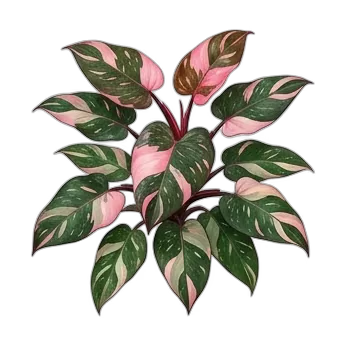
The midnight oil was burning in a greenhouse three winters ago when I first noticed the mutation I had been praying for. A single node on my mother Philodendron erubescens 'Pink Princess' had split open to reveal a shock of bubblegum pink tissue—not the sickly cream-white of a variegated sport doomed to wither from lack of chlorophyll, but a vibrant, stable sectoral splash. I spent the next four months nursing that single cutting through winter drafts and low light, learning the hard way that this plant demands a precise balance of pampering and neglect. I have watched this cultivar transition from a collector's secret to a mainstream obsession. Below is the master blueprint for keeping your Pink Princess thriving, radiant, and true to type.
1. Botanical Overview & Natural Habitat

Taxonomically, the species name erubescens translates from Latin to "blushing," a nod to the deep reddish-purple undersides of the leaves and the maroon-tinted petioles. The "Pink Princess" mutation introduces amelanistic variegation—patches of tissue lacking green chlorophyll, replaced instead by brilliant pink carotenoid and anthocyanin expressions.
Understanding this natural heritage dictates how we grow it indoors. Because it originates in equatorial rainforests, it is adapted to high ambient humidity (60% to 80%), dappled tropical light, and warm, steady temperatures. It does not experience true winter dormancy, though its metabolic rate slows significantly when indoor temperatures drop below 60°F (15.5°C) or when day length decreases in northern latitudes.
Mature plants feature semi-woody stems that can reach heights of 4 feet (1.2 meters) indoors and up to 10 feet (3 meters) in a conservatory setting. The leaves emerge tightly rolled in a protective sheath called a cataphyll, unfurling to display a distinctive oblong-cordate shape measuring up to 9 inches (22.8 cm) long and 5 inches (12.7 cm) wide. The juxtaposition of dark, near-black forest green foliage against bubblegum pink variegation makes it an unmistakable specimen in any interior landscape design.
2. Essential Environmental & Care Requirements
Replicating a Colombian rainforest inside a climate-controlled home requires meticulous attention to four core environmental parameters: light, water, temperature, and substrate composition.
| Parameter | Optimal Condition | Common Mistake | Why It Matters |
|---|---|---|---|
| Light | 3,000 to 5,000 foot-candles of bright, indirect light | Placing in direct, unfiltered midday sun | Direct sun scorches delicate pink tissue into crisp brown patches; too little light causes variegation to revert to solid green. |
| Watering | Water thoroughly when the top 2 inches (5 cm) of soil are dry | Keeping soil constantly soggy or letting it bone-dry | Excess water rots delicate aerial root systems; drought causes crispy tips and aborted leaf unfurling. |
| Temperature | 65°F to 85°F (18°C to 29°C) | Exposing to drafts below 55°F (13°C) | Cold shock halts metabolic activity, causes root necrosis, and induces yellowing lower leaves. |
| Substrate | Chunky, highly aerated aroid mix (pH 5.5 to 6.5) | Using dense, heavy potting soil | Heavy soil suffocates roots and retains excess moisture, directly causing fungal root rot. |
Light management is the single most critical factor for maintaining variegation. If a Pink Princess receives insufficient light, the plant triggers a survival mechanism, producing more chlorophyll to maximize energy capture, resulting in the loss of pink variegation (reversion). Conversely, placing it within reach of scorching afternoon sun will burn the unpigmented pink cells, leaving unsightly necrosis. Position your plant within 3 to 5 feet (0.9 to 1.5 meters) of an east-facing window, or use a full-spectrum LED grow light positioned 12 to 18 inches (30 to 45 cm) above the canopy for 12 to 14 hours daily.
Watering must be approached with a botanical eye rather than a rigid calendar schedule. The root system of Philodendron erubescens is designed to cycle rapidly between soaking rainstorms and fast drainage. Stick your finger a full 2 inches (5 cm) into the soil blend. If it feels cool and damp, withhold water. When you do water, saturate the pot until liquid runs freely from the drainage holes, ensuring salt and mineral build-up is flushed out of the root zone.
Humidity is equally paramount. While standard household humidity sits between 30% and 40%, your Pink Princess will display crippled, stuck leaves that tear upon emerging if ambient humidity dips below 50%. Utilize an ultrasonic humidifier to keep local relative humidity locked between 60% and 70%.
💡 Pro-Tip: To instantly boost local humidity without risking fungal leaf spot from stagnant mist, place your potted Pink Princess on a wide pebble tray filled with water, ensuring the bottom of the nursery pot sits above the waterline on elevated stones.
3. Step-by-Step Cultivation, Feeding & Propagation
Designing a striking interior landscape with your Pink Princess often requires propagation to maintain bushiness or to salvage a leggy specimen. Because this is a climbing vine, stem cuttings are the most reliable and genetically stable method of reproduction.
Step-by-Step Propagation and Pruning Sequence
- Select the Stem Node: Inspect your mature Pink Princess for a healthy, actively growing vine. Locate a section of stem featuring at least two to three nodes (the swollen brown rings where leaves and aerial roots emerge) and crisp, vibrant pink-and-green variegation.
- Sanitize Your Tools: Sterilize a sharp pruning shear or razor blade using isopropyl alcohol (70% concentration or higher) to prevent introducing bacterial or fungal pathogens into the open plant tissue.
- Make the Cut: Snip the stem cleanly about 0.5 inches (1.2 cm) below the lowest targeted node. Ensure the cutting includes at least one undamaged leaf and one viable aerial root bud.
- Apply Rooting Hormone: Dip the freshly cut node into a powdered or gel rooting hormone containing indole-3-butyric acid (IBA) to accelerate callus formation and root initiation.
- Establish the Propagation Medium: Plant the cutting into a pre-moistened, sterile medium consisting of 50% perlite and 50% sphagnum moss, inserting the node securely beneath the surface while keeping the primary leaf above the medium. Alternatively, submerge the node in a vessel of clean, filtered water, ensuring the leaf stays completely dry.
- Provide Bottom Heat and Humidity: Place the propagation setup in a bright, indirect location with a consistent ambient temperature of 75°F to 80°F (24°C to 27°C). Tent the cutting with a clear plastic bag to lock in 80% humidity, venting the enclosure for 10 minutes every 48 hours to prevent mold.
- Monitor Root Development: Expect root initials to emerge from the node within 14 to 28 days. Allow secondary roots to reach at least 2 inches (5 cm) in length before transplanting the rooted cutting into a permanent, chunky aroid potting mix.
Feeding your established Pink Princess requires a balanced, water-soluble fertilizer formulated for foliage plants, administered at half-strength every two weeks during the active growing season (spring through early autumn). Dilute a balanced 20-20-20 or nitrogen-rich 3-1-2 formula to prevent fertilizer burn. Cease all fertilization entirely during late autumn and winter when natural photoperiods shorten and growth naturally pauses. For deeper scientific insights into tropical plant nutrition and tissue management, consult the Royal Horticultural Society.
⚠️ Important Caution: Never over-fertilize your Pink Princess in an attempt to force faster growth. Excess nitrogen triggers rapid green tissue proliferation, which permanently overwhelms and masks the slower-growing pink chimeric cells, causing irreversible reversion to a solid green state.
4. Common Problems, Pests & Troubleshooting
Even experienced indoor gardeners encounter hiccups with tropical aroids. Diagnosing issues early saves the specimen from rapid decline.
Reversion to Solid Green When a variegated plant loses its color signature, it is reverting. This is almost always caused by insufficient light intensity or an overabundance of soil nitrogen. Prune the vine back aggressively to a healthy node below the reversion point—one that displays strong, balanced sectoral pink striping on the stem itself. Upgrade your lighting setup immediately.
Brown, Crispy Leaf Edges Crisp, brown margins indicate environmental dehydration. This is typically triggered by chronic low humidity (under 40%), irregular watering schedules, or excessive fertilizer salt accumulation in the root zone. Flush the soil thoroughly with distilled water and calibrate your room humidifier.
Yellowing Lower Leaves If older leaves at the base of the plant turn pale yellow and drop off, you are likely dealing with overwatering and subsequent root hypoxia. Allow the potting medium to dry out significantly, and check the drainage holes to ensure they are not blocked. For comprehensive plant pathology guidance and pest identification, refer to the University of Florida Extension Service.
Common Pests: Thrips and Mealybugs The tender, sugary sap of the Pink Princess makes it an attractive target for sap-sucking insects.
- Thrips: Look for silvery stippling on the leaves and tiny black insect debris. Treat immediately with insecticidal soap or horticultural oil, wiping down every leaf surface.
- Mealybugs: These appear as white, cottony masses in the leaf axils and stem joints. Dab them individually with a cotton swab soaked in 70% isopropyl alcohol, followed by a systemic or contact insecticide spray.

5. Frequently Asked Questions
Why are the new leaves on my Pink Princess stuck and tearing?
Stuck leaves are almost universally caused by low ambient relative humidity during the emergence phase. When the air is too dry, the protective cataphyll dries out and acts like a vise, gripping the unfurling leaf tightly. Boost your room humidity to 60%-70%. If a leaf is severely trapped, you can gently mist it with lukewarm water or use a damp cotton ball to soften the binding tissue, allowing it to slip free without ripping the delicate blade.
Can I propagate a Pink Princess cutting that has no pink variegation on the stem?
No. The variegation in a Pink Princess is chimeric, meaning it originates from genetic mutations within specific cell layers of the stem tissue (the meristem). If a stem cutting is entirely green, it lacks the genetic blueprint to produce pink cells, and any new growth it produces will be solid green. Always inspect the stem for vertical pink stripes before taking a cutting.
How do I make my Pink Princess climb instead of trailing?
In its natural habitat, the Pink Princess is an epiphyte that scales vertical tree trunks using strong aerial roots. To replicate this indoors, provide a vertical support structure such as a sphagnum-filled moss pole, a cedar plank, or a sturdy trellis. Tie the main stem loosely to the support using soft plant velcro or twine. As the aerial roots encounter the damp moss or rough wood, they will naturally latch on, anchoring the plant and triggering larger, more mature leaf sizes.
Why are the pink parts of my leaves turning brown and crispy?
The pink sections of a variegated leaf lack chlorophyll entirely, making them fragile and highly sensitive to environmental stress. They burn easily under direct sunlight, react poorly to chemical salt build-up from tap water, and scorch when exposed to dry, forced-air heating vents. Move your plant away from direct sun and heat sources, and water exclusively with filtered, distilled, or rainwater to prevent mineral leaf burn.
📋 Table of Contents ▼ Click to expand
Tags: