

Heartleaf Philodendron
Philodendron hederaceum
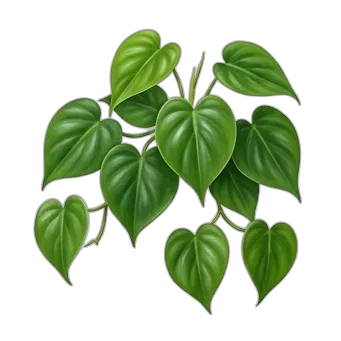
The rain was coming down in sheets against the glass of my conservatory when I first brought home a scraggly, clearance-rack Philodendron hederaceum with just three yellowing leaves. That was fourteen years ago. Today, that single salvage-project vine drapes six feet down a mahogany bookshelf in my office, its glossy, heart-shaped blades catching the afternoon sun. Few houseplants command such unwavering loyalty with so little demand, yet I still field more questions about this resilient native of the tropical Americas than almost any other aroid in the trade.

1. Botanical Overview & Natural Habitat
The Heartleaf Philodendron belongs to the Araceae family, native to the tropical rainforests of Central America, the Caribbean, and South America. In its natural understory habitat, Philodendron hederaceum is a hemiepiphytic climber. It crawls along the forest floor before encountering a host tree, anchoring itself with aerial roots and scrambling upward toward filtered sunlight, shedding its juvenile foliage size in favor of much larger, mature leaves as it climbs.
Taxonomically, this species exhibits significant foliar plasticity, which is why you may occasionally see it confused with Philodendron micans (which is actually a velvety subspecies, Philodendron hederaceum var. micans). The juvenile leaves are cordate (heart-shaped), measuring anywhere from 2 to 5 inches (5 to 12.5 cm) long, emerging with a delicate bronze tint before hardening into a rich, deep emerald green.
Unlike many cultivated hybrids that demand sterile, highly specialized laboratory conditions, the wild-type heartleaf retains the rugged survival mechanisms of a rainforest pioneer. Its stems contain calcium oxalate crystals—a defense mechanism against herbivores—and nodes that readily activate dormant meristematic tissue when damaged or cut. Understanding this natural ancestry explains precisely why it adapts so brilliantly to the dry air and lower light levels typical of modern residential and office interiors.
2. Essential Environmental & Care Requirements
Replicating a tropical rainforest understory indoors does not require a glass terrarium. It requires balance. Let us examine the precise parameters that keep Philodendron hederaceum growing vigorously year-round.
| Parameter | Optimal Condition | Common Mistake | Why It Matters |
|---|---|---|---|
| Light | Bright, indirect light (75–150 foot-candles) | Direct, scorching midday sun | Direct rays scorch the delicate foliar epidermis, causing crisp, brown bleached patches. |
| Watering | Allow top 2 to 3 inches (5 to 7.5 cm) to dry | Keeping soil perpetually soggy | Saturated media starves roots of oxygen, triggering anaerobic bacteria and root rot. |
| Temperature | 65°F to 80°F (18°C to 27°C) | Exposing to drafts below 50°F (10°C) | Cold stress halts cellular metabolism and causes systemic tissue collapse. |
| Humidity | 50% to 70% relative humidity | Dry indoor air below 30% | Extremely dry air causes leaf tips to crisp and inhibits unfurling new growth. |
| Soil Mix | Chunky, well-aerated aroid blend (pH 6.0–6.5) | Heavy, dense potting compost | Compacted soil retains excess water and suffocates the fine root hairs. |
Light is the engine of plant growth. While heartleaf philodendrons tolerate low-light conditions—such as a windowless office lit solely by fluorescent tubes—their internodal spacing will stretch, resulting in a sparse, leggy vine. Aim for an east-facing windowsill or set the plant 3 to 5 feet (0.9 to 1.5 m) back from a south- or west-facing window.
💡 Pro-Tip: Never rely solely on visual estimates for watering. Push your index finger 2 inches (5 cm) deep into the potting mix. If soil particles cling to your skin and feel damp, withhold water for another 48 hours. If it feels dry and crumbly, it is time for a thorough soaking until water runs freely through the container's drainage holes.
Temperature fluctuations are a hidden killer. Keep your philodendron away from air-conditioning vents, uninsulated winter windows, and heat registers. For further reading on foundational houseplant maintenance, consult the University of Florida IFAS Extension care resources for tropical ornamentals.
3. Step-by-Step Cultivation, Feeding & Propagation
Propagating Philodendron hederaceum is one of the most rewarding gardening rituals because success rates approach 100% when proper technique is applied. Because each node possesses the genetic blueprint to generate both roots and shoots, stem cuttings take root rapidly.
Step-by-Step Propagation and Repotting Sequence
- Select a Healthy Mother Stem: Inspect your mature vine and locate a vigorous section of stem with at least three healthy leaves and visible, brown root bumps (nodes) along the lower stem.
- Sterilize Your Cutting Tool: Wipe a pair of sharp pruning shears or a razor blade with 70% isopropyl alcohol to prevent transferring pathogens to the open plant wounds.
- Execute the Cut: Slice cleanly through the stem approximately 0.5 inches (1.25 cm) below the lowest node, ensuring you leave at least two leaves attached to the upper section of the cutting.
- Rooting Medium Preparation: Prepare your propagation vessel. You can root cuttings in pure water, damp perlite, or a 50/50 mix of sphagnum peat moss and coarse perlite.
- Water or Soil Placement: Submerge the node(s) while keeping the leaves completely above the waterline or medium. If rooting in water, change the liquid every 5 to 7 days to maintain high dissolved oxygen levels.
- Provide Optimal Environment: Place the cutting in a bright location with indirect light and ambient temperatures maintained between 72°F and 78°F (22°C to 26°C).
- Monitor Root Development: Root initials will emerge from the nodes within 10 to 14 days. Allow the root system to reach a length of 1.5 to 2 inches (3.8 to 5 cm) before transplanting water-grown cuttings into a chunky aroid soil blend.
When repotting an established plant, select a container only 1 to 2 inches (2.5 to 5 cm) larger in diameter than the current root ball. Philodendrons actually prefer being slightly root-bound; placing a small plant in an oversized pot guarantees that excess soil will retain moisture far too long, inviting root rot. For detailed botanical classification history, visit the Royal Botanic Gardens, Kew.
⚠️ Important Caution: All parts of Philodendron hederaceum contain insoluble calcium oxalate crystals. If ingested by curious cats, dogs, or young children, these needle-like crystals cause immediate oral irritation, intense burning, excessive drooling, and difficulty swallowing. Always keep hanging vines elevated well out of reach of household pets.
4. Common Problems, Pests & Troubleshooting
Even the most attentive plant parents encounter minor hiccups. Diagnosing them early saves the plant from severe setback.
- Yellow Lower Leaves: If older leaves near the base of the plant turn uniformly yellow and drop off, you are likely overwatering or the pot lacks adequate drainage. If the yellowing leaves are accompanied by a foul, earthy smell from the soil, tip the plant out immediately and inspect the roots for brown, mushy decay.
- Brown, Crispy Leaf Tips: This is almost universally a symptom of low relative humidity, inconsistent watering (allowing the plant to go bone-dry for too long), or a buildup of mineral salts from tap water fertilizers. Flush the soil monthly with distilled water to leach out excess salts.
- Leggy Stems with Tiny Leaves: If the distance between leaves (internodes) expands to several inches and new leaves emerge small and pale, the plant is starving for light. Move it closer to a natural light source or supplement with a full-spectrum LED grow light for 12 hours a day.
- Pest Infestations: Spider mites and mealybugs occasionally target stressed indoor aroids. Spider mites thrive in hot, dry air, weaving fine webbing under leaves and causing stippling (tiny white dots). Mealybugs look like tiny white cotton tufts tucked into leaf axils. Eradicate both by wiping down foliage with insecticidal soap or neem oil diluted in warm water, repeating every 7 days for a 21-day cycle to break the pest reproductive timeline.

5. Frequently Asked Questions
Why are the leaves on my Heartleaf Philodendron turning yellow?
Uniform yellowing of older lower leaves typically points to overwatering or compacted soil suffocating the roots. If the yellow leaves feel soft and water-soaked, reduce your watering frequency and ensure your potting mix drains freely. Occasionally, natural aging causes the oldest leaf at the base of a vine to yellow and drop; if new growth at the tip remains vibrant, there is no cause for concern.
Can I grow a Heartleaf Philodendron in water permanently?
Yes, Philodendron hederaceum adapts exceptionally well to semi-hydroponics and long-term water culture. While cuttings root readily in water, keeping a mature plant in water long-term requires adding a weak, water-soluble hydroponic nutrient solution every time you refresh the water (every 2 to 3 weeks) to supply essential macronutrients that plain tap water lacks.
How do I make my Heartleaf Philodendron bushy instead of long and vining?
Heartleaf philodendrons naturally exhibit a trailing growth habit, but you can encourage a bushier appearance by regularly pinching or pruning the growing tips back to a node. This activates dormant lateral buds lower down on the stem. Additionally, planting multiple rooted cuttings together in a single pot creates a much denser, fuller presentation.
Should I let my Heartleaf Philodendron climb or trail?
Both methods mimic aspects of its natural life cycle. Allowing the plant to trail downward from a hanging basket or high shelf highlights its cascading vines. However, if you train it upward onto a moss pole or wooden plank, the plant will anchor its aerial roots into the support, resulting in significantly larger, more robust adult leaves that closely mirror its wild rainforest form.
📋 Table of Contents ▼ Click to expand
Tags:





