

Peperomia Hope
Peperomia tetraphylla 'Hope'
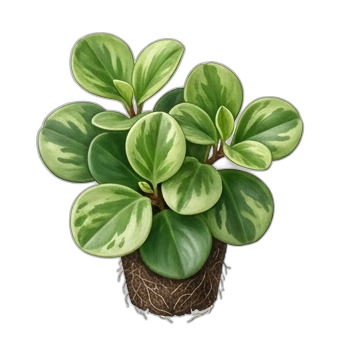
A dehydrated trailing stem of Peperomia tetraphylla 'Hope' with puckered, accordion-pleated coin-like leaves can be revived by tucking it into a 4-inch terracotta pot filled with a gritty cactus mix and moving it two feet away from a west-facing window. Shriveled leaves plump into jade-green succulents, spilling over the pot's rim like a cascade of miniature buttons, making Peperomia 'Hope' one of the most rewarding low-maintenance epiphytes for both novice and seasoned indoor gardeners.
1. Botanical Overview & Natural Habitat

In its natural rainforest habitats across Central and South America, as well as parts of tropical Africa and Asia, Peperomia tetraphylla is predominantly an epiphyte or lithophyte. It does not grow in heavy garden soil. Instead, it scrambles up tree trunks, hugs mossy branches, or drapes over damp rock faces. Its roots cling to bark crevices, drawing moisture and organic debris from the humid air and filtered canopy light.
Morphologically, 'Hope' features semi-succulent, succulent-like leaves arranged in whorls of three to four along creeping, reddish-green stems. Each leaf measures roughly 0.5 inches to 1.0 inch (1.2 cm to 2.5 cm) across, sporting distinct, subtle parallel veins that mimic miniature water storage reservoirs. Because it is an epiphyte, its root system is remarkably diminutive. A mature plant cascading 24 inches (60 cm) will often survive quite happily in a pot no larger than 5 inches (12 cm) in diameter. For deeper taxonomic reading and structural classification, consult the Royal Horticultural Society Plant Finder.
2. Essential Environmental & Care Requirements
Recreating a tropical tree canopy in a modern living room requires dialing in four environmental pillars: light, water, temperature, and substrate composition. Get these right, and the plant practically takes care of itself.
| Parameter | Optimal Condition | Common Mistake | Why It Matters |
|---|---|---|---|
| Light | Bright, indirect light (3,000–5,000 lux) | Direct afternoon sun or deep shade | Too much sun bleaches and scorches leaves; too little causes elongated stems (etiolation) and leaf drop. |
| Watering | Allow top 2 inches (5 cm) to dry fully | Keeping soil constantly damp like a fern | Excess moisture suffocates the fine epiphytic roots, rapidly triggering Pythium and Phytophthora root rot. |
| Temperature | 65°F to 75°F (18°C to 24°C) | Exposure below 50°F (10°C) or cold drafts | Chilly drafts induce shock, leaf drop, and cellular collapse in tropical succulent tissues. |
| Substrate | Chunky, highly aerated orchid/succulent mix | Dense, peat-heavy potting soil | Heavy soils retain water too long, depriving roots of the oxygen they evolved to absorb from the air. |
Light is the primary engine for this plant. Place your 'Hope' within 3 feet (1 meter) of an east-facing window or slightly set back from a bright south- or west-facing window behind a sheer curtain. If you notice the space between the leaves (the internodes) stretching past 1 inch (2.5 cm), the plant is starving for photons.
Watering frequency changes drastically across seasons. During the active growing period from spring through late summer, water thoroughly until it runs out of the drainage holes, then wait until the top 2 inches (5 cm) of the medium are completely dry. During the dormant winter months when daylight hours shrink, stretch watering intervals by an extra 7 to 10 days. Always empty the saucers within 10 minutes; standing water is a death sentence for peperomias.
Humidity should ideally hover between 40% and 60%. While 'Hope' tolerates standard household humidity better than true ferns, dry indoor heating in winter can cause crisp leaf margins. Avoid misting the leaves directly, as trapped water droplets on dense whorls can encourage fungal leaf spot. Instead, group plants together or use a pebble tray filled with water to raise ambient humidity.
3. Step-by-Step Cultivation, Feeding & Propagation
Repotting and propagating Peperomia 'Hope' should be done with a gentle touch. Because their root systems are shallow and delicate, aggressive root-tearing will set the plant back by months.
Soil Formulation and Repotting Sequence
- Prepare the custom epiphyte blend: Combine 40% high-quality coco coir or fine peat, 30% horticultural perlite or pumice, and 30% orchid bark (ranging from 0.25 to 0.5 inches / 0.6 to 1.2 cm in size). This ensures rapid drainage and high air porosity.
- Select the correct container: Choose a pot only 1 inch (2.5 cm) wider than the current root ball. Terracotta is ideal because its porous walls allow the soil to breathe and dry out evenly.
- Unpot the plant: Gently massage the existing nursery pot, invert it, and slide the plant out. Inspect the roots; healthy roots are firm and pale, while rotting roots are brown, mushy, and slip off their central string.
- Prune dead tissue: Use sterilized pruning shears (wiped with 70% isopropyl alcohol) to snip away any damaged or rotting roots.
- Position at the correct depth: Place fresh substrate at the base of a new pot. Position the plant so the crown sits precisely at the same soil level it was at previously—burying the stems too deep invites stem rot.
- Settle the medium: Fill in the sides with your custom mix, tapping the pot gently on the table to settle the chunks around the roots. Do not pack the soil down hard.
- Post-potting care: Wait 48 hours before giving the plant its first post-repotting drink to let any microscopic root tears callous over.
Feeding Protocol
Feed sparingly. Peperomia 'Hope' is a light feeder compared to heavy-foliage tropicals like monsteras. Dilute a balanced, water-soluble houseplant fertilizer (such as a 10-10-10 or 20-20-20 formula) to one-quarter strength. Apply this once every 4 weeks strictly during the active growing season (April through August). Flush the pot with plain water every 3 months to prevent mineral salt accumulation in the bark and perlite.
Propagation Protocol
Propagation is remarkably high-success because every single node on the trailing vine possesses the biological capacity to strike roots.
- Stem Cuttings: Snip a 4-inch (10 cm) section of vine containing at least 3 to 4 leaf nodes. Remove the bottom set of leaves. Insert the naked node directly into a moist 50/50 mix of perlite and peat, or suspend the cutting in a jar of clean water, ensuring only the bare node is submerged. Roots will emerge in 14 to 21 days at 72°F (22°C).
- Leaf Cuttings: Alternatively, snip individual leaves with a tiny 0.5-inch (1.2 cm) petiole (stem) attached. Press the petiole vertically into propagation sand. Tiny plantlets will form at the base of the petiole within 30 to 45 days.
💡 Pro-Tip: When propagating stem cuttings in water, add a single piece of horticultural activated charcoal to the jar. This prevents anaerobic bacteria from multiplying, keeping the water crystal clear and dramatically boosting root strike rates.
4. Common Problems, Pests & Troubleshooting
Even with meticulous care, indoor environments can shift, presenting diagnostic challenges. Here is how to read your plant's physical symptoms:
- Lower leaves turning yellow and dropping off: This is the classic symptom of overwatering or soil that stays wet for too long. Check the root ball immediately. If roots are black and mushy, cut away the rot, treat with a hydrogen peroxide rinse (1 part 3% H2O2 to 3 parts water), and repot into dry, chunky mix.
- Leaves curling inward or developing dry, crispy edges: Caused by underwatering combined with low humidity or excessive direct heat exposure. Adjust your watering schedule so the top 2 inches dry out, but never let the entire pot turn bone-dry for weeks on end.
- Stems becoming long, spindly, and pale: A clear indicator of insufficient light. Move the plant closer to a natural light source or supplement with a full-spectrum LED grow light positioned 12 inches (30 cm) above the canopy for 12 hours a day.
- Cottony white masses in leaf axils or under leaves: Infestation by mealybugs. These sap-sucking pests thrive in dry indoor air. Dab them individually with a cotton swab soaked in 70% isopropyl alcohol, then treat the entire plant with horticultural neem oil spray every 7 days for three cycles.
⚠️ Important Caution: Never use heavy petroleum-based leaf shine products on Peperomia 'Hope'. Because their leaves are semi-succulent and possess a natural waxy cuticle, commercial leaf shine clogs their stomata (gas exchange pores), suffocating the foliage and causing rapid leaf drop.

5. Frequently Asked Questions
Is Peperomia Hope safe for cats and dogs?
Yes. According to the ASPCA, Peperomia tetraphylla 'Hope' is entirely non-toxic to cats, dogs, and horses. If your curious pet decides to nibble on a trailing vine, it will not cause systemic poisoning or digestive upset, though it may ruin the look of your display.
Why are the leaves on my Peperomia Hope turning pale and losing their dark green color?
This is almost always caused by too much direct sunlight. While they enjoy bright conditions, harsh midday sun bleaches the chlorophyll in their leaves, turning them a washed-out, yellowish-green. Move the plant slightly further away from the window or filter the light with a translucent curtain.
Should I mist my Peperomia Hope to increase humidity?
No. Misting is generally discouraged for this species. Because the leaves grow in tight whorls and feature semi-succulent textures, pooling water trapped in the leaf joints creates an ideal breeding ground for fungal pathogens like Botrytis. Instead, use a mechanical humidifier placed nearby or a water-filled pebble tray.
How often should I water my Peperomia Hope in the winter?
In winter, the plant enters a semi-dormant resting phase due to reduced daylight and cooler indoor temperatures. You should typically extend your watering intervals to every 14 to 21 days, or whenever the soil is completely dry down to the bottom of the pot. Always test the soil weight by lifting the pot before reaching for your watering can.
📋 Table of Contents ▼ Click to expand
Tags:





