

Peperomia Ginny
Peperomia clusiifolia 'Ginny'
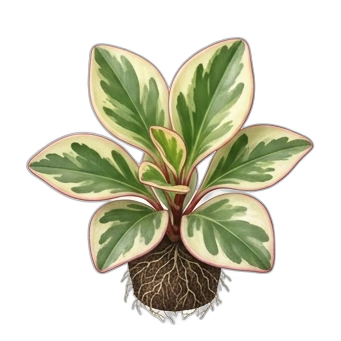
Peperomia clusiifolia 'Ginny' specimens sitting in glazed cachepots without drainage holes often suffer from stems turning to mush at the soil line while the crown clings to life with vibrant, creamy-pink leaves. That resilience—the plant's stubborn refusal to quit even when subjected to horticultural negligence—makes the Tricolor Peperomia a top tropical recommendation for indoor spaces.

1. Botanical Overview & Natural Habitat
Peperomia clusiifolia 'Ginny'—frequently traded under the names 'Tricolor', 'Jelly', or Red-Edge Peperomia—is a cultivar derived from a species native to the tropical and subtropical regions of the Caribbean and South America. Botanically classified within the sprawling Piperaceae (pepper) family, it is a succulent-like perennial herb with a semi-succulent, upright-to-mounding growth habit.
In the wild, these plants grow as understory epiphytes or lithophytes, clinging to mossy tree trunks or tucked into rock crevices where organic debris accumulates. This evolutionary background explains much of its indoor behavior. It is adapted to dappled, high-altitude light filtered through a dense forest canopy and experiences cyclical moisture followed by rapid drainage.
Morphologically, Peperomia Ginny boasts thick, fleshy, obovate leaves that alternate along succulent stems. The leaf margins are painted in a striking palette of emerald green, creamy chartreuse, and a vibrant, hot-pink border that intensifies under optimal light exposure. Unlike true succulents in the Crassulaceae family, Peperomia Ginny stores water within both its leaves and its semi-woody stems, functioning as a botanical reservoir during dry spells.
Mature indoor specimens typically reach a height and spread of 10 to 15 inches (25 to 38 cm), making them exceptionally well-suited for desktop displays, terrariums, or narrow plant shelves where vertical space is at a premium.
2. Essential Environmental & Care Requirements
Mastering the Peperomia Ginny requires balancing its tropical heritage with the artificial microclimates of modern homes. Because its leaves are semi-succulent, growers often make the mistake of treating it like a cactus, or conversely, like a moisture-loving fern. Let us look at the exact parameters required for optimal physiological function.
| Parameter | Optimal Condition | Common Mistake | Why It Matters |
|---|---|---|---|
| Light | Bright, indirect light (10,000 to 20,000 lux) | Low light in dark corners | Fading of pink/cream variegation; stretching (etiolation) of stems |
| Watering | Dry completely through the top 2 inches (5 cm) | Keeping soil constantly damp | Suffocation of fine roots leading to stem rot and tissue collapse |
| Temperature | 65°F to 75°F (18°C to 24°C) | Exposure to drafts below 50°F (10°C) | Chilling injury causing leaf drop and cellular degradation |
| Humidity | 40% to 60% relative humidity | Placing directly over heating vents (<20% humidity) | Crisp, brown leaf tips and slowed transpirational uptake |
| Soil pH | Slightly acidic to neutral (6.0 to 6.8) | Heavy, compacted clay-based potting soil | Waterlogging and nutrient lockout at the root zone |
Light intensity is the primary driver of variegation. Without a minimum of 4 to 6 hours of bright, indirect sunlight daily, the plant reverts to a dull, flat green, losing the signature magenta margins that define the cultivar.
When it comes to watering, your finger is the best diagnostic tool. Insert your index finger 2 inches (5 cm) into the potting medium. If it feels cool or damp, withhold the watering can. When watering, apply room-temperature water until it runs freely through the container's drainage holes, then empty the saucer within 10 minutes to prevent root rot.
For a deeper dive into the broader taxonomy and physiological traits of this fascinating genus, you can reference the Royal Botanic Gardens, Kew database on Piperaceae.
💡 Pro-Tip: To instantly judge if your Peperomia Ginny is receiving enough light, look at the stem internodes. If the gaps between the leaves exceed 1 inch (2.5 cm), the plant is stretching for light. Move it 12 inches closer to an east- or west-facing window immediately.
3. Step-by-Step Cultivation, Feeding & Propagation
Propagating Peperomia Ginny is one of the most rewarding gardening tasks because the plant roots readily from single leaf cuttings. Follow this step-by-step protocol to multiply your collection successfully during the active growing season (spring or early summer).
- Select Stock Material: Choose a healthy, vibrant stem free of blemishes. Using a pair of sterilized shears wiped down with isopropyl alcohol, cut a 4-inch (10 cm) terminal stem section just below a leaf node. Ensure the cutting has at least 3 to 4 fully formed leaves.
- Prepare the Cutting: Gently prune away the lowest pair of leaves to expose 1 inch (2.5 cm) of bare stem. This node is where your new roots will emerge. Allow the cut surface to callus over in open air for 2 to 4 hours to prevent fungal entry.
- Mix the Propagation Medium: Combine equal parts coarse horticultural perlite and high-grade peat-free potting soil. This creates an aerated, free-draining substrate with a high oxygen diffusion rate, which is critical for root initiation.
- Planting: Insert the exposed stem node 1 inch (2.5 cm) deep into the medium. Firm the soil lightly around the base to ensure good physical contact between the cutting and the substrate.
- Create a High-Humidity Environment: Mist the cutting lightly and cover the container with a clear plastic bag or propagation dome to trap ambient moisture, ensuring you leave a small gap for air circulation.
- Provide Optimal Rooting Conditions: Place the container in a warm spot receiving bright, indirect light at 70°F to 75°F (21°C to 24°C). Keep the medium barely moist. Root systems typically develop within 21 to 30 days. You can test for resistance by gently tugging on the base of the stem.
When fertilizing established plants, feed them strictly during the spring and summer months using a balanced, water-soluble houseplant fertilizer diluted to half-strength (e.g., 10-10-10 N-P-K). Apply this nutrient solution once every 4 weeks. Cease all fertilization entirely between October and February when natural light levels drop and the plant enters a semi-dormant metabolic rest phase.
4. Common Problems, Pests & Troubleshooting
Even experienced indoor gardeners run into hurdles with semi-succulent tropicals. Diagnosing problems early saves the plant from irreversible decline.
Stem Rot and Mushy Bases
- Symptom: The lower stems turn translucent brown, soft, and watery. Leaves may drop off while still green.
- Diagnosis: Advanced root or stem rot caused by overwatering, poor soil drainage, or low ambient temperatures combined with damp soil.
- Correction: Unpot the plant immediately. Use sterile scissors to cut away all soft, rotting brown roots and stems until you hit crisp, firm, white tissue. Repot into fresh, dry, fast-draining media and withhold water for 7 days to let remaining wounds heal.
Edema and Leaf Blisters
- Symptom: Small, corky, wart-like bumps or water-soaked blisters appear on the undersides of the leaves.
- Diagnosis: Edema occurs when the roots take up water faster than the leaves can transpire it, causing individual plant cells to rupture and scar. This is typically triggered by erratic watering cycles (prolonged drought followed by heavy saturation) in high humidity.
- Correction: Standardize your watering schedule. Ensure the plant is placed in a well-ventilated room with gentle air movement to encourage healthy leaf transpiration.
Pests: Mealybugs and Spider Mites
- Symptom: White, cottony masses tucked into leaf axils (mealybugs) or fine, dusty webbing across the growing tips accompanied by stippled, pale foliage (spider mites).
- Diagnosis: Pests thrive in stagnant indoor air and low-humidity environments.
- Correction: Quarantine the affected plant immediately. Wipe down all leaves and stems with a cotton swab dipped in 70% isopropyl alcohol to dissolve mealybug exoskeletons. For persistent infestations, thoroughly spray all plant surfaces with insecticidal soap or horticultural neem oil every 7 days for a 3-week cycle to break the pest generation window.
⚠️ Important Caution: Never apply horticultural oils or insecticidal soaps to your Peperomia Ginny while the plant is exposed to direct sunlight or when ambient temperatures exceed 85°F (29°C). The combination of oil and intense light acts as a magnifying glass, instantly scorching and burning the succulent leaf tissue.

5. Frequently Asked Questions
Why are the leaves on my Peperomia Ginny turning yellow?
Yellowing leaves are almost always a symptom of overwatering or poor soil drainage. When the soil stays wet for too long, oxygen is squeezed out of the root zone, causing the roots to suffocate and rot. Without a functional root system, the plant cannot transport water and nutrients to its leaves, resulting in generalized chlorosis (yellowing) and dropping foliage. Allow the soil to dry out completely between watering sessions.
Can I propagate Peperomia Ginny from a single leaf cutting?
Yes, absolutely. Unlike many plants that require a stem node, Peperomia Ginny can be propagated using leaf cuttings. Slice a healthy leaf off with a 0.5-inch (1.3 cm) petiole (stem) attached. Push the petiole into a moist perlite-and-peat mix at a 45-degree angle. Tiny plantlets with their own mini root systems will emerge directly from the base of the petiole within 45 to 60 days.
Why is my Peperomia Ginny losing its pink color?
The loss of pink and cream variegation is directly tied to light levels. If your plant is placed too far from a window or in a dim room, it lacks the photosynthetic stimulus required to maintain its secondary pigments. To restore the vibrant coloration, gradually move the plant closer to a bright, indirect light source over the course of two weeks to prevent leaf scorch.
Is Peperomia Ginny toxic to cats and dogs?
No, Peperomia clusiifolia 'Ginny' is entirely non-toxic to household pets, including cats, dogs, and horses. According to the ASPCA, it is classified as a safe, pet-friendly houseplant. However, while ingestion will not poison your pets, chewing on the tough, succulent leaves may cause mild gastrointestinal upset simply due to physical irritation.
📋 Table of Contents ▼ Click to expand
Tags:





