

Olive Tree
Olea europaea
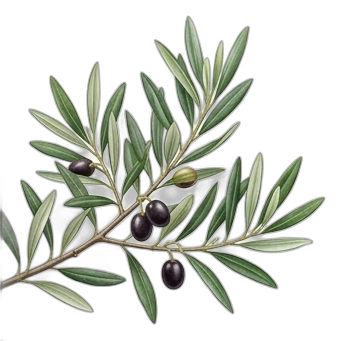
The heavy scent of sun-baked dust and cooling terra cotta always brings me back to the terrace in Provence where I first met a centuries-old Olea europaea. It was a gnarled, twisting veteran of the mistral winds, yet its silvery-green canopy filtered the Mediterranean afternoon light with absolute grace. When I pressed my palm against its deeply furrowed, silvery-gray bark, I realized why civilizations have revered this tree for millennia: it is an absolute survivor, balancing rugged resilience with quiet elegance. Over many seasons I have planted hundreds of olive trees across diverse microclimates. While they are remarkably forgiving once established, understanding their precise evolutionary adaptations is the difference between a thriving architectural statement and a dropping, yellowing disappointment in your garden.
1. Botanical Overview & Natural Habitat

Morphologically, Olea europaea is engineered for survival against drought and intense solar radiation. Its leaves are lanceolate, measuring 1.5 to 3 inches (4 to 8 cm) in length, featuring a leathery texture and a dense covering of microscopic, silvery-gray trichomes (hairs) on the underside. These trichomes reflect harsh sunlight and drastically reduce transpirational water loss. The root system is predominantly shallow and spreading, though it can send taproots down several feet into fractured rock to hunt for deep moisture in arid soils.
In its natural habitat, the olive experiences hot, bone-dry summers with temperatures routinely exceeding 95°F (35°C), and mild, wet winters where temperatures rarely drop below 30°F (-1°C) for extended periods. As the tree ages, its trunk develops a characteristic twisting, hollowed, and deeply furrowed character, a natural adaptation that helps distribute the heavy weight of the canopy while maximizing nutrient transport efficiency through living veins of bark.
For further deep dives into the taxonomy and historical distribution of this species, you can consult the Royal Botanic Gardens, Kew.
2. Essential Environmental & Care Requirements
Translating the Mediterranean climate into your own landscape or indoor space requires strict adherence to a few non-negotiable environmental parameters. Olives do not tolerate guesswork.
Light
Olive trees are obligate sun-worshipers. They require a minimum of 6 to 8 hours of direct, uninhibited sunlight daily. Planting them in partial shade results in weak, leggy growth, sparse foliage, and a complete failure to flower and set fruit. If growing indoors, place the container directly in front of a south-facing window or supplement with high-intensity grow lights for 12 hours a day.
Temperature and Hardiness
While Olea europaea thrives in USDA Hardiness Zones 8 through 11, certain cultivars can withstand brief drops down to 15°F (-9.4°C) once fully dormant and established. However, sudden freezes in autumn or late spring frosts below 25°F (-3.9°C) can severely split bark and kill young cambium layers.
Soil and Drainage
This is the single most critical factor in olive cultivation. In the wild, they grow in rocky, calcium-rich, highly porous soils. Heavy clay is their kryptonite. The ideal soil pH ranges from 6.5 to 8.5. If your native soil retains moisture, you must amend it heavily with coarse horticultural sand, pumice, and decomposed granite to achieve rapid drainage.
⚠️ Important Caution: Never plant an olive tree in unamended heavy clay or a container lacking bottom drainage holes. Standing water around the root zone for even 48 hours will trigger Phytophthora root rot, which is almost universally fatal to Olea europaea.
| Parameter | Optimal Condition | Common Mistake | Why It Matters |
|---|---|---|---|
| Light | 6–8+ hours of direct sun daily | Placing in indoor corners or shadier garden spots | Reduces photosynthesis, halts flower bud formation, and weakens structural integrity. |
| Soil Drainage | Rapidly draining, gritty, sandy-loam (pH 6.5–8.5) | Planting in dense, water-retentive clay | Prevents fatal root rots and allows essential oxygen exchange in the rhizosphere. |
| Watering | Deep, infrequent soaking; allow top 3–4 inches (7–10 cm) to dry | Frequent, shallow watering | Encourages shallow root systems and invites fungal pathogens. |
| Winter Temp | Mild winters (30°F to 50°F / -1°C to 10°C) | Exposing young trees to hard freezes below 20°F (-6.6°C) | Splits bark, damages vascular tissue, and kills developing branch tips. |
3. Step-by-Step Cultivation, Feeding & Propagation
Whether you are establishing a specimen tree in a Mediterranean-style landscape or managing a containerized patio plant, success relies on methodical execution.
Planting and Cultivation Steps
- Select and Prep the Site: Choose a location with full sun and excellent drainage. Dig a hole 2 times wider than the root ball, but no deeper. The top of the root ball must sit 1 inch (2.5 cm) above the surrounding soil grade to account for settling.
- Unwind the Roots: Gently tease out any circling roots on the outer edge of the root ball to prevent girdling.
- Backfill with Native Soil: Fill the hole with the unamended native soil (avoid heavy organic fertilizers in the hole, which can burn tender roots). Tamp down gently to remove large air pockets.
- Water Deeply: Apply 5 to 10 gallons (19 to 38 liters) of water immediately after planting to settle the soil tightly around the roots.
- Apply Mulch: Spread a 2-inch (5 cm) layer of coarse gravel or bark mulch around the base to suppress weeds and retain moisture, keeping the mulch at least 3 inches (7.5 cm) away from direct contact with the trunk to prevent collar rot.
Feeding and Fertilization
Olive trees are light feeders compared to heavy-fruiting citrus. Over-fertilization leads to excessive, weak vegetative shoot growth at the expense of fruit production and increases susceptibility to pests. Apply a balanced, slow-release organic fertilizer with a formulation such as 10-10-10 or an olive-specific citrus blend once in early spring as new growth emerges, and a second light application in mid-summer. Stop all fertilization by late summer (August) to allow new shoots to harden off before winter frost.
Propagation Protocol
While olives can be grown from seed, seedlings are genetically variable and rarely reproduce the characteristics of the parent tree. Professional landscape designers and nurseries rely on semi-hardwood cuttings.
Take cuttings in mid-summer when current-season growth is partially mature. Cut 4 to 6-inch (10 to 15 cm) sections from healthy, disease-free lateral shoots. Strip the leaves off the bottom half of the cutting, dip the wounded base in rooting hormone powder (0.3% IBA), and insert them into a sterile propagation medium consisting of a 50/50 mix of perlite and peat moss. Maintain a high humidity environment using a clear plastic dome and bottom heat of 75°F (24°C). Rooting typically occurs within 45 to 60 days, after which they can be potted up into individual containers.
💡 Pro-Tip: When pruning your olive tree in late winter, remember the golden rule of olive architecture: "A bird should be able to fly straight through the center." Open up the canopy center to maximize light penetration and air circulation, which naturally deters scale insects and fungal leaf spot.
For comprehensive regional guidelines on agricultural care and regional cultivar selection, refer to the University of California Agriculture and Natural Resources.
4. Common Problems, Pests & Troubleshooting
Even tough Mediterranean natives run into trouble when environmental conditions drift out of balance. Here is how to diagnose and correct the most common issues.
Olive Leaf Spot (Peacock Spot)
Caused by the fungus Spilocaea oleagina, this disease manifests as dark, circular spots with concentric rings on the leaves, resembling a peacock’s feather, followed by heavy premature leaf drop.
- Cause: Extended periods of leaf wetness combined with cool, humid spring weather.
- Solution: Prune the canopy to improve air circulation and keep foliage dry. Apply a copper-based fungicide in late autumn before heavy winter rains begin, and clear away all fallen infected leaves from the base of the tree.
Scale Insects (Black Scale and Oleander Scale)
These small, immobile insects attach themselves to stems and the undersides of leaves, sucking sap and excreting sticky honeydew that fosters unsightly black sooty mold.
- Cause: Stressed trees, lack of predatory beneficial insects, or dense, unpruned canopies.
- Solution: For minor infestations, scrub branches with a soft brush and horticultural soap. For heavy outbreaks, apply horticultural oil in late winter while the tree is dormant to smother overwintering scales and their eggs.
Yellowing Leaves and Leaf Drop
- Cause 1 (Underwatering): Leaves curl inward lengthwise, become brittle, and drop off. Solution: Deep, slow watering sessions spaced out to allow dry-down phases.
- Cause 2 (Overwatering/Poor Drainage): Leaves turn a pale, chlorotic yellow and drop while still pliable. Solution: Cease watering immediately, inspect soil drainage, and evaluate for root rot.

5. Frequently Asked Questions
Can I grow an olive tree indoors year-round?
Yes, you can grow an olive tree indoors, provided you can place it directly in front of a south-facing window that receives at least 6 to 8 hours of direct sunlight. Keep in mind that indoor environments lack the intense light and seasonal temperature shifts required for heavy fruit production, so indoor olives are primarily grown for their ornamental foliage and architectural form. Ensure you use a fast-draining gritty potting mix and water only when the top 3 inches (7 cm) of soil are completely dry.
How long does it take for an olive tree to produce fruit?
Olive trees grown from cuttings typically begin producing a small crop of fruit within 3 to 4 years. Trees grown from seed can take anywhere from 8 to 12 years to reach sexual maturity and set fruit. Keep in mind that many olive cultivars require cross-pollination from a second, different compatible variety to set a heavy crop, though some cultivars are partially self-fertile.
Do olive tree roots damage foundations or pipes?
Olive tree root systems are spreading and aggressive when searching for water, but they are generally less invasive than trees like weeping willows or maples. However, to be safe, plant standard-sized olive trees at least 15 to 20 feet (4.5 to 6 meters) away from permanent structural foundations, swimming pools, and fragile underground utility lines. For smaller yards, dwarf or patio cultivars have significantly smaller, more manageable root footprints.
How often should I water a potted olive tree?
A potted olive tree requires more frequent watering than one planted in the ground, but it still demands a dry-down period. During the active growing season (spring through summer), water deeply until it runs out of the drainage holes, then let the top 3 to 4 inches (7 to 10 cm) dry completely before watering again. In winter, reduce watering frequency by half as the tree enters a semi-dormant state and metabolic activity slows down.
📋 Table of Contents ▼ Click to expand
Tags:





