Moon Valley Pilea
Pilea involucrata 'Moon Valley'
1. Botanical Overview & Natural Habitat

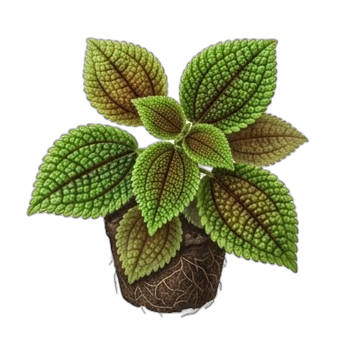
Its defining characteristic is the intense, deeply puckered leaf texture—botanically termed rugose—which resembles the craters of the moon, inspiring its cultivar name. The leaves feature a chartreuse to bright lime-green center outlined by dark brown or bronze depressions along the major vein tracts, backed by pale, reddish-green undersides. Tiny, insignificant pink or white flowers occasionally appear in clusters on upright stems during the spring and summer, though cultivation of this species focuses almost entirely on its striking foliage.
Because it originates from tropical rainforest floors, its entire morphology is an adaptation to dappled light, high humidity, and a rich, constantly moist root run. Understanding this evolutionary background is the single most important step in keeping your Moon Valley Pilea thriving indoors.
2. Essential Environmental & Care Requirements
Translating the rainforest floor to a modern living room requires dialing in a specific set of environmental parameters. Deviate too far, and the plant will quickly signal its distress through leaf drop or crispy margins.
| Parameter | Optimal Condition | Common Mistake | Why It Matters |
|---|---|---|---|
| Light | Bright, indirect light (10,000 to 20,000 lux) | Direct afternoon sun | Intense sun burns the delicate leaf tissue and fades the dark bronze contrast. |
| Temperature | 65°F to 75°F (18°C to 24°C) | Placing near drafty AC units or below 50°F (10°C) | Cold drafts cause sudden defoliation and shock the tropical root system. |
| Humidity | 50% to 70% relative humidity | Ambient home humidity below 30% | Low humidity leads to crisp, brown leaf tips and stunted puckering. |
| Watering | Evenly moist, watering when top 0.5 inches (1.3 cm) dries | Allowing the root ball to dry out completely | Extreme dryness causes irreversible stem collapse and wilting. |
To achieve these conditions, place your Pilea near an east-facing window or a few feet back from a south- or west-facing window shielded by a sheer curtain. For more detailed insights on indoor tropical plant care and light measurement, you can consult the Royal Horticultural Society.
💡 Pro-Tip: If your Moon Valley Pilea starts stretching out and losing its compact, bushy shape, it is begging for more light. Move it just 12 inches (30 cm) closer to its light source, and pinch back the leggy growing tips to encourage lateral branching.
3. Step-by-Step Cultivation, Feeding & Propagation
Propagating and repotting the Moon Valley Pilea is straightforward if you mimic its natural rooting environment. Because of its shallow root system, it does not require deep containers.
- Select the Right Container and Soil: Choose a nursery pot with adequate drainage holes that is only 1 to 2 inches (2.5 to 5 cm) wider than the current root ball. Mix a potting substrate composed of 50% high-quality peat-based potting soil, 25% perlite or pumice for aeration, and 25% orchid bark or coco coir to retain moisture while preventing compaction.
- Repotting Technique: Gently remove the plant from its container, teasing apart any tightly wound roots at the base. Position the plant at the exact same soil depth it was growing at previously—burying the stem too deeply can cause stem rot. Firm the soil lightly and water thoroughly until it runs freely from the drainage holes.
- Fertilization Schedule: Feed your Pilea monthly during the active growing season (spring through late summer) using a balanced, water-soluble houseplant fertilizer diluted to half-strength (roughly 1/2 teaspoon per gallon of water). Cease all fertilization entirely from November through February when natural light levels drop and growth slows.
- Propagation via Stem Cuttings: Locate a healthy, non-flowering stem at least 3 to 4 inches (7.5 to 10 cm) long. Using sterilized pruning shears, make a clean cut just below a leaf node. Strip away the lower leaves, leaving only the top two or three pairs.
- Rooting: Dip the cut end in rooting hormone powder (optional) and insert the cutting into a small pot filled with pre-moistened perlite or a 50/50 peat and perlite mix, inserting it to a depth of 1 inch (2.5 cm). Enclose the entire pot and cutting in a clear plastic bag to trap humidity, placing it in bright, indirect light. Roots will typically form within 14 to 21 days.
⚠️ Important Caution: Never let your Moon Valley Pilea sit in standing water in a saucer. While it loves a moist root run, waterlogged soil suffocates the roots within 48 hours, rapidly leading to fatal root rot.
4. Common Problems, Pests & Troubleshooting
Even with meticulous care, indoor environments fluctuate. Knowing how to diagnose early symptom distress saves plants from total decline.
- Lower Leaves Turning Yellow and Dropping: This is almost always a sign of overwatering or soil that remains soggy for too long. Allow the top inch (2.5 cm) of soil to dry out between watering sessions, and ensure your pot drains freely. For additional guidance on diagnosing plant pathogens and watering stress, check the resources at the University of Florida Extension.
- Brown, Crispy Leaf Margins: Triggered by dry indoor air or underwatering. If your home humidity drops below 40%, group your Pilea with other tropical plants, place it on a pebble tray filled with water, or run a small room humidifier nearby.
- Fungus Gnats: Small black flies hovering around the soil surface indicate that the topsoil is staying too wet. Let the top 1 inch (2.5 cm) dry out completely, and apply a deringing treatment of mosquito dunks (Bacillus thuringiensis israelensis) to your watering can.
- Mealybugs: These cottony white pests love hiding in the deep crevices of the puckered leaf joints. Dip a cotton swab in 70% isopropyl alcohol and dab them individually, followed by a thorough spray of insecticidal soap.

5. Frequently Asked Questions
Is Moon Valley Pilea safe for cats and dogs?
Yes, Pilea involucrata 'Moon Valley' is completely non-toxic to cats, dogs, and horses. You can safely place it within reach of curious pets without worrying about poisoning if ingested.
Why are the leaves on my Moon Valley Pilea turning flat and losing their texture?
Loss of texture and stretched, pale growth is a direct indicator of insufficient lighting. The deep puckering requires bright, indirect light to develop fully. Move the plant closer to an unobstructed window or supplement with a dedicated LED grow light.
How often should I water my Moon Valley Pilea?
In typical indoor conditions (68°F to 72°F / 20°C to 22°C), you will generally need to water every 7 to 10 days. Always check the soil moisture manually by inserting your finger 0.5 inches (1.3 cm) deep; if it feels dry, it is time to water.
Should I mist my Moon Valley Pilea to raise humidity?
Misting is generally discouraged because the water droplets trapped in the deeply textured leaves can linger too long and invite fungal leaf spot diseases. Instead, use a room humidifier or place the pot on a water-filled pebble tray to elevate ambient humidity safely.
📋 Table of Contents ▼ Click to expand
Tags: