
Living Stones
Lithops pseudotruncatella
Seventeen years ago, on a blistering July afternoon in a greenhouse, I nearly murdered my first tray of Lithops pseudotruncatella. I had treated them like standard echeverias, watering them every Wednesday out of sheer habit. Within a fortnight, three dozen remarkable little windows into the plant kingdom had literally burst open at the seams, gorged to death on unneeded moisture. That expensive mistake forced me to unlearn everything I thought I knew about succulent culture. Today, these masterclasses in evolutionary disguise remain my absolute favorite plants to design with, provided we honor their hyper-specific rules of engagement.
1. Botanical Overview & Natural Habitat

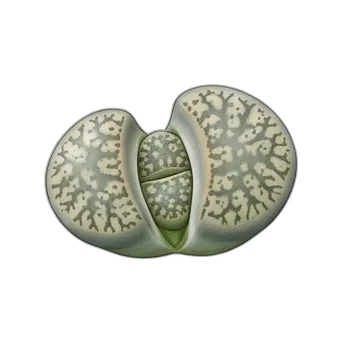
Morphologically, a mature plant consists of a single, deeply bifurcated pair of succulent leaves fused into an inverted cone. There is virtually no true stem; the plant grows almost entirely underground to escape intense solar radiation. The top surface of each leaf—known as the "window"—is translucent or semi-translucent, featuring intricate reddish-brown reticulations, dots, and lines. These windows allow filtered sunlight to reach photosynthetic cells buried deep within the subterranean body.
In their native habitat, annual rainfall rarely exceeds 2 to 6 inches (5 to 15 cm), arriving mostly during specific seasonal windows. Temperatures fluctuate wildly, dropping to freezing 32°F (0°C) during winter nights and scorching up to 104°F (40°C) in summer days. To survive, Lithops pseudotruncatella synchronizes its lifecycle with these brutal meteorological extremes. They bloom in autumn, pushing up a brilliant, daisy-like yellow flower from the central fissure that can span 1.5 inches (3.8 cm) across, before undergoing a dramatic subterranean leaf-renewal cycle in late winter.
For further scientific classification and structural breakdowns, you can consult the Royal Botanic Gardens, Kew Plants of the World Online database.
2. Essential Environmental & Care Requirements
Replicating an arid Namibian quartz plain on your sunny windowsill or in a modern landscape design requires strict adherence to environmental parameters.
Light is your primary variable. Lithops pseudotruncatella demands a minimum of 5 to 6 hours of direct, unhindered sunlight daily. South-facing windows are ideal; east-facing windows are acceptable if unobstructed. If grown indoors under artificial light, provide a high-output LED grow light delivering at least 2,500 to 3,000 foot-candles for 12 to 14 hours daily. Insufficient light results in etiolation, where the plant stretches upward, ruining its flat, stone-like mimicry.
Temperature tolerances are wider than most expect, but the extremes matter. During their active growth phase in autumn and spring, daytime temperatures between 65°F to 80°F (18°C to 27°C) with nighttime drops to 50°F to 55°F (10°C to 13°C) trigger optimal metabolic activity. They can handle brief dips down to 28°F (-2°C) if kept completely bone dry, but freezing wet soil guarantees root rot.
Soil composition is where most growers fail. Standard potting soil retains moisture far too long, suffocating the taproot. You need an inorganic, ultra-gritty matrix consisting of 80% to 90% mineral components and no more than 10% organic matter.
| Parameter | Optimal Condition | Common Mistake | Why It Matters |
|---|---|---|---|
| Soil Mix | 90% mineral (pumice, perlite, coarse sand) / 10% organic | Using standard cactus soil or peat-heavy mixes | Retains moisture too long, causing the plant to burst or rot |
| Light | 6+ hours of direct, unfiltered sun | Keeping them on a dim interior shelf | Causes stretching (etiolation) and loss of camouflage color |
| Container Depth | Minimum 4 to 6 inches (10 to 15 cm) | Using shallow succulent dishes | Constricts the deep taproot, stunting overall plant longevity |
| Air Circulation | Moderate to high cross-breeze | Stagnant, humid indoor environments | Promotes fungal infections and attracts sap-sucking pests |
3. Step-by-Step Cultivation, Feeding & Propagation
Growing Lithops pseudotruncatella successfully is an exercise in rhythmic restraint. Unlike leafy houseplants, your watering schedule must directly mirror the plant's natural seasonal cycle of dormancy and growth.
💡 Pro-Tip: Never water a Lithops while it is shedding its old leaf pair for a new one. The old leaves must papery-dry up completely, transferring their water and nutrients to the emerging pair. Watering during this phase short-circuits the process, resulting in "stacked" leaves that eventually rot the core.
Here is the precise cultivation protocol for establishing and maintaining healthy specimens:
- Select and Prepare the Container: Choose a terra-cotta pot at least 4 inches (10 cm) deep to accommodate the taproot. Terra-cotta is mandatory because its porous clay walls wick away excess ambient moisture from the root zone.
- Mix the Substrate: Combine 4 parts horticultural pumice, 3 parts coarse poultry grit, 2 parts akadama or Turface, and 1 part sifted organic cactus compost. Ensure the blend contains zero fine peat dust.
- Potting the Specimen: Gently brush away old nursery soil from the thick taproot. Position the plant so the base of the leaf fissure sits level with or slightly below the surface of the top-dressing.
- Apply Top-Dressing: Layer 0.5 inches (1.3 cm) of non-calcareous aquarium gravel or crushed granite around the base of the plant. This keeps the delicate lower leaves elevated away from damp soil and mimics their native quartz flats.
- Establish the Watering Rhythm: In late spring and summer (their summer dormancy), withhold water almost entirely, giving only a teaspoon around the rim every 30 days if the leaves pucker severely. In autumn, when temperatures moderate and the flower bud emerges, water thoroughly until it runs out the drainage hole, but only when the top leaves feel flat or slightly soft.
- Fertilization Strategy: Feed precisely once a year—just as autumn growth commences—using a balanced, low-nitrogen liquid cactus fertilizer (such as a 5-10-10 formulation) diluted to one-quarter strength. Never fertilize during winter or summer dormancy.
Propagation is primarily achieved via seed, as mature specimens rarely offset to form multi-headed clumps early in life. Sow seeds in autumn across the surface of a fine, pre-sterilized grit mix, maintaining a constant ambient temperature of 65°F to 72°F (18°C to 22°C) under a clear humidity dome for the first 14 days. Once germination occurs around day 7 to 10, gradually increase ventilation to prevent damping-off fungi.
⚠️ Important Caution: Never mist established Lithops plants. Their epidermal tissue absorbs water directly, and lingering droplets under intense sunlight will scorch and rupture the cell walls instantly.
For deeper academic insights into succulent propagation techniques and arid-zone adaptations, explore the resources provided by the University of California Botanical Garden at Berkeley.
4. Common Problems, Pests & Troubleshooting
Even with meticulous care, environmental shifts or stray moisture can trigger distress signals in Lithops pseudotruncatella. Reading these physical symptoms is the hallmark of an expert designer.
Splitting Leaves: If the outer skin splits vertically down the sides rather than through the top fissure, the plant has taken up too much water too quickly. While minor splits often heal into a callous without killing the plant, it ruins the structural symmetry. Immediately halt all watering and increase air circulation to dry out the substrate.
Mushy, Translucent Base: This is the terminal stage of root rot or stem rot, caused by anaerobic soil conditions. Once the plant turns translucent and watery at the soil line, it cannot be saved. Discard the affected plant and sterilize the surrounding media with a 10% bleach solution before replanting the container.
Pest Infestations: Root mealybugs are the stealthiest enemy of Lithops. They live entirely underground, weaving white, waxy webs along the taproot. If your plant looks mysteriously dehydrated despite dry soil, unpot it immediately. Wash the roots clean under warm water, trim away necrotic tissue, dip the root system in a 70% isopropyl alcohol solution, and repot into completely fresh, sterile media.

5. Frequently Asked Questions
Why are my Living Stones getting tall and wrinkly?
When a Lithops pseudotruncatella gets tall, cylindrical, and loses its flat, stone-like profile, it is etiolated from a severe lack of light. It is stretching upward to capture more photons. Concurrently, if the sides are wrinkling horizontally while the top remains firm, the plant is simply consuming its stored water reserves during a natural growth phase and requires no immediate intervention unless it is severely underwatered outside of dormancy.
How do I know when it's safe to water Lithops?
Check the firmness of the top leaf surface. A well-hydrated Lithops feels rock-hard and the top window is plump or slightly convex. When it is ready for water, the top surface will feel spongy, soft to the touch, and develop fine concave wrinkles or puckers. If you can still feel internal firmness, do not water—even if it has been months since the last drink.
Can I grow Lithops pseudotruncatella outdoors year-round?
Only if you live in USDA Hardiness Zones 9b through 11, where winter temperatures rarely drop below 30°F (-1°C) and annual rainfall is exceptionally low. In these regions, they must still be planted in specialized raised beds or alpine houses outfitted with overhead rain protection roofs. In all other climates, they must be kept in containers and brought indoors or under protective cover during freezing or excessively wet seasons.
What should I do when my Living Stones split open?
Do absolutely nothing except withhold water completely. The splitting process is entirely normal and represents the annual leaf-renewal cycle, where the old pair of leaves sacrifices its moisture and nutrients to feed a brand-new pair forming inside. Introducing water during this phase will confuse the plant, causing it to retain the old leaves and rupture the new ones. Let the outer leaves turn into dry, brown paper husks before offering even a drop of water.
📋 Table of Contents ▼ Click to expand
Tags: