
Hobbit Jade
Crassula ovata 'Hobbit'
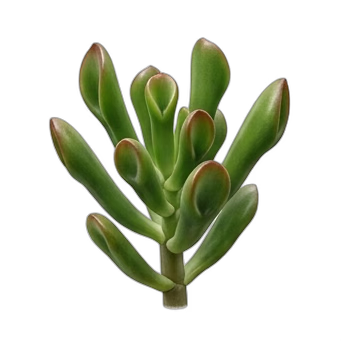
When a stressed, drought-hardened Crassula ovata 'Hobbit' is exposed to the right stress thresholds, soil compositions, and pruning regimens, the leaves become tubular, curled, finger-like spoons tipped in a vibrant, sun-baked magenta rather than remaining flat green succulent paddles. A three-inch branch can be snipped and the lower leaves stripped to propagate this strange mutant of the classic jade plant.
1. Botanical Overview & Natural Habitat

In structural habit, it is an evergreen, arborescent succulent that develops a thick, woody trunk and stout branches over time, eventually maturing into a miniature bonsai-like tree. In ideal conditions, it reaches heights of 2 to 3 feet (60 to 90 cm) indoors, and up to 4 feet (1.2 m) in favorable outdoor container settings.
Native primarily to the Eastern Cape and KwaZulu-Natal provinces of South Africa, Crassula ovata evolved in rocky, well-draining soils under intense sunlight and seasonal, irregular rainfall. As a CAM (Crassulacean Acid Metabolism) plant, 'Hobbit Jade' keeps its stomata closed during the scorching daylight hours to minimize water loss, opening them only at night to fix carbon dioxide. This evolutionary adaptation makes it exceptionally drought-tolerant but uniquely sensitive to overwatering and poorly aerated root zones.
2. Essential Environmental & Care Requirements
Mastering the cultivation of 'Hobbit Jade' requires mimicking its native South African scrubland environment. Below is a detailed breakdown of the exact parameters required to keep this cultivar thriving.
| Parameter | Optimal Condition | Common Mistake | Why It Matters |
|---|---|---|---|
| Light Exposure | 4 to 6 hours of direct sun daily; bright indirect light otherwise. | Keeping it in a dim interior room or north-facing window. | Insufficient light causes weak, etiolated stems, loss of leaf curl, and fading of the red margin pigmentation. |
| Temperature Range | 65°F to 85°F (18°C to 29°C) active; tolerates down to 40°F (4°C) briefly. | Exposing the plant to a sudden frost or freezing conditions below 32°F (0°C). | High water content in succulent tissues causes cell walls to rupture when frozen, turning the plant to mush. |
| Soil Composition | Gritty, fast-draining mix (50% inorganic grit, 50% organic compost). | Planting in standard, heavy, moisture-retentive potting soil. | Dense soils hold moisture too long, suffocating roots and inviting Phytophthora and root rot. |
| Watering Frequency | "Soak and dry" method; allow soil to dry completely for 2 to 3 inches (5 to 7 cm) deep. | Watering on a rigid calendar schedule regardless of soil dryness. | Constant moisture deprives roots of oxygen and triggers systemic stem rot. |
| Humidity Levels | 30% to 50% relative humidity; high air circulation. | Stagnant, humid terrariums or unventilated spaces. | High humidity combined with moisture stagnation encourages fungal leaf spot and mealybug infestations. |
For further reading on succulent adaptations and care strategies, consult the Royal Horticultural Society.
3. Step-by-Step Cultivation, Feeding & Propagation
Propagating and maintaining 'Hobbit Jade' is immensely rewarding, but it demands strict adherence to physical steps, particularly when handling its fleshy stems and roots.
Step-by-Step Propagation via Stem Cuttings
- Select a healthy parent stem: Choose a firm, disease-free branch at least 3 to 4 inches (7 to 10 cm) long, featuring several sets of tubular leaves.
- Make a clean cut: Using sterilized pruning shears or a razor blade wiped down with isopropyl alcohol, cut cleanly just below a leaf node.
- Allow callusing: Place the cutting in a dry, shaded area indoors for 4 to 7 days. This allows the wound to form a hard, protective callous, which prevents soil pathogens from entering the stem.
- Prepare the rooting substrate: Fill a small, 4-inch (10 cm) terracotta pot with a dry mixture of 60% perlite or pumice and 40% cactus-specific potting soil.
- Plant the cutting: Insert the callused end roughly 1 inch (2.5 cm) deep into the dry medium. Prop the stem up with small stones if it wobbles.
- Withhold water: Do not water the cutting for the first 14 days. Without roots, it cannot absorb moisture, and introduction of water will rot the stem.
- Initiate moisture: After 2 weeks, mist the topsoil lightly every 3 days until you feel resistance when gently tugging on the cutting, indicating root development. Transition to standard deep watering after 30 days.
💡 Pro-Tip: When fertilizing your established 'Hobbit Jade', switch to a low-nitrogen, high-phosphorus liquid fertilizer (such as a 5-10-10 or 2-7-7 formulation) diluted to half strength. Apply it only once every 6 weeks during the active spring and summer growing season. High nitrogen triggers rapid, weak stem elongation that ruins the compact, bonsai-like character of the plant.
4. Common Problems, Pests & Troubleshooting
Even resilient succulents fall victim to environmental stress and opportunistic pests. Diagnosing symptoms early prevents minor setbacks from becoming fatal.
- Stem Rot and Mushy Base: If the lower trunk turns translucent, dark brown, or squishy, you are dealing with advanced stem rot caused by overwatering and compacted soil. Immediately slice off the healthy upper portions above the rot line, let them callus for 7 days, and restart them as fresh cuttings. Discard the rotted root ball and soil.
- Leaf Drop: Sudden shedding of green, plump leaves usually points to a drastic environmental shift, such as moving a plant from a dark indoor shelf into scorching outdoor midday sun without hardening it off. If the dropped leaves are yellow and mushy, overwatering is the culprit.
- Mealybugs: These sap-sucking insects look like tiny tufts of white cotton, hiding tightly within the narrow joints where the tubular leaves meet the stem. Dab them individually with a cotton swab soaked in 70% isopropyl alcohol, or spray the entire plant with horticultural insecticidal soap, ensuring you reach all leaf crevices.
- Etiolation: If your 'Hobbit Jade' is stretching out with wide internodes, pale green coloring, and losing its signature spoon-like leaf curls, it is starving for light. Move the plant progressively closer to a south- or west-facing window, or supplement with a full-spectrum LED grow light positioned 6 to 8 inches (15 to 20 cm) above the canopy for 12 to 14 hours daily.
⚠️ Important Caution: Never use standard petroleum-based horticultural oils or heavy chemical insecticidal sprays on 'Hobbit Jade' during peak daylight hours. The combination of oil-based residue and intense direct sunlight will act like a magnifying glass, instantly scorching and blistering the succulent's delicate leaf tissues. Always treat pests in the evening or in deep shade, and let the plant dry completely before returning it to direct light.

5. Frequently Asked Questions
Why are the leaves on my Hobbit Jade turning flat and losing their curl?
The distinct tubular, curled shape of 'Hobbit Jade' leaves is directly dependent on light intensity. When a plant receives insufficient light, new growth reverts to a flatter, wider, more standard jade-like appearance. Move your plant to a sunnier location where it receives at least 4 hours of direct sunlight daily to encourage the compact, curled morphology to return.
How often should I water a Hobbit Jade in the winter?
During the winter dormancy period (typically November through February), interior temperatures drop and light levels decrease, slowing the plant's metabolic rate significantly. You should reduce watering frequency to roughly once every 4 to 6 weeks, only moistening the soil after confirming that the root ball has dried out completely all the way to the bottom of the container.
Can Hobbit Jade be grown successfully outdoors year-round?
'Hobbit Jade' can only be grown outdoors year-round in USDA Hardiness Zones 10 through 11, where temperatures do not drop below 30°F (-1°C) for extended periods. In colder climates, keep the plant in a movable container so it can spend summers on a bright patio and be brought indoors before the first autumn frost threatens.
Is Hobbit Jade toxic to cats and dogs?
According to the ASPCA, Crassula ovata and its cultivars are classified as toxic to domestic pets, including cats, dogs, and horses. Ingestion typically results in mild to moderate symptoms such as vomiting, lethargy, and incoordination. Keep your 'Hobbit Jade' positioned out of reach on high shelves or plant stands if you share your living space with curious pets.
📋 Table of Contents ▼ Click to expand
Tags: