

Haworthia
Haworthia fasciata
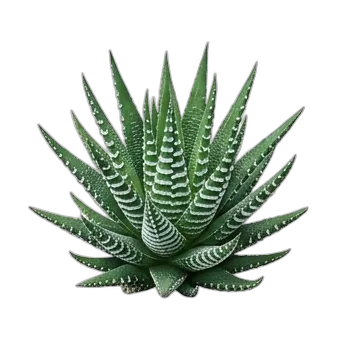
Traditional, high-water bedding annuals planted in a searingly hot, south-facing courtyard in zone 9b will fry within a week. Instead, a 3.5-inch pot holding a single, architectural rosette of dark green leaves striped with chalk-white, bumpy ridges—Haworthia fasciata—can be used. This South African native thrives on utter neglect, eventually multiplying into a dense cluster of offsets, proving why the plant deserves a permanent spot in every modern interior and arid landscape.

1. Botanical Overview & Natural Habitat
Haworthia fasciata—commonly known as the zebra plant—belongs to the Asphodelaceae family (subfamily Asphodeloideae), making it a close evolutionary cousin to Aloe and Gasteria. Native exclusively to the Eastern Cape province of South Africa, this miniature succulent forms compact, stemless rosettes typically reaching 3 to 5 inches (7.6 to 12.7 cm) in height and up to 6 inches (15 cm) in width.
The most defining morphological feature of H. Fasciata is the pattern of white, fibrous tubercles (wart-like ridges) on the exterior surfaces of its stiff, triangular, dark green leaves. A common point of botanical confusion exists between Haworthia fasciata and Haworthiopsis attenuata (formerly Haworthia attenuata). You can easily distinguish true H. Fasciata by one distinct trait: the upper, inner surfaces of its leaves are entirely smooth, whereas H. Attenuata features tubercles on both the upper and lower leaf surfaces.
In its native habitat, H. Fasciata grows beneath the protective canopy of larger shrubs and rocks, a habit that dictates its entire physiological makeup. It is adapted to survive under partial shade, enduring intense solar radiation only when filtered. The root system consists of thick, contractile roots that actively pull the plant deeper into the gritty, mineral-rich soil during periods of extreme drought, protecting the crown from thermal extremes.
2. Essential Environmental & Care Requirements
Translating the wild conditions of the Eastern Cape to an indoor or container environment requires mimicking its natural extremes: intense, well-draining dry periods punctuated by deep, infrequent moisture.
| Parameter | Optimal Condition | Common Mistake | Why It Matters |
|---|---|---|---|
| Light | Bright, indirect light (2,000–3,000 foot-candles) | Direct afternoon sun in summer | Intense, unfiltered midday light scorches the fleshy leaves, turning them an unrecoverable reddish-brown or bleached white. |
| Soil | Highly inorganic grit mix (60% pumice/perlite, 40% organic compost) | Standard peat-based potting soil | Dense soils retain moisture too long, suffocating the contractile roots and triggering fatal root rot. |
| Watering | Soak-and-dry method (soil completely dry 2–3 inches deep) | Frequent, shallow sips of water | Shallow watering encourages weak surface roots rather than deep, drought-resistant structural root systems. |
| Temperature | 65°F to 80°F (18°C to 27°C) active; 50°F to 55°F (10°F to 13°C) winter rest | Exposure below 35°F (1.7°C) | Freezing temperatures cause water inside the cellular walls to expand and rupture, turning the plant to mush. |
Air circulation is another critical, yet frequently overlooked, environmental variable. In nature, constant wind prevents fungal spores from establishing on microscopic leaf blemishes. Indoors, place your Haworthia in a spot with gentle, passive air movement—never in a stagnant corner or a sealed terrarium.
3. Step-by-Step Cultivation, Feeding & Propagation
Propagation of Haworthia fasciata is delightfully straightforward because the plant naturally produces basal offsets, or "pups," around its perimeter. For authoritative background on succulent propagation methods, you can reference resources provided by institutions like the Royal Botanic Gardens, Kew.
Step-by-Step Propagation and Repotting Sequence
- Select a Healthy Mother Plant: Choose a mature specimen that has produced at least one offset measuring a minimum of 1 to 1.5 inches (2.5 to 3.8 cm) in diameter, ideally equipped with its own nascent root nubs.
- Unpot and Clean: Gently invert the pot, tap the sides to loosen the root ball, and brush away old, exhausted soil from the root network using a soft-bristled brush or your fingers.
- Separate the Offsets: Using a sterile, sharp scalpel or razor blade, slice the offset away from the primary stem. Ensure you retain a clean cut close to the mother plant without tearing the central flesh of either specimen.
- Cure the Wounds: Place the separated offsets in a warm, dry, shaded location for 3 to 7 days to allow the cut meristematic tissue to callous over completely, preventing soil pathogens from entering.
- Prepare the Container: Select a unglazed terracotta pot featuring a single, large drainage hole. Fill it with a professional succulent and cactus soil blend amended with an extra 30% coarse horticultural pumice.
- Plant at the Correct Depth: Set the offset atop the dry soil mix, positioning the base so the root crown sits level with or slightly above the rim of the pot. Never bury the leaves below the soil line.
- Initiate the Rooting Phase: Keep the newly potted offset completely dry for the first 14 days to stimulate root hunting. After two weeks, administer your first light watering around the perimeter of the pot, and place it in bright, indirect light.
💡 Pro-Tip: Never feed your Haworthia with high-nitrogen commercial houseplant fertilizers. Instead, apply a balanced, water-soluble cactus fertilizer (such as a 2-7-7 formula) diluted to one-quarter strength only twice a year: once in early spring (April) and once in mid-summer (July). Excess nitrogen causes rapid, bloated tissue growth that splits the structural leaves and destroys the plant's natural, compact aesthetic.
4. Common Problems, Pests & Troubleshooting
Even the toughest succulents experience stress when indoor environments deviate too far from their evolutionary blueprints.
- Etiolation (Stretching): If the tight, radial rosette begins to open up, lengthen, and turn a pale, sickly green, your plant is starving for light. Move it closer to an east- or unobstructed west-facing window, or supplement with a full-spectrum LED grow light positioned 8 inches (20 cm) above the crown for 12 hours a day.
- Root Rot (Pythium/Phytophthora): Indicated by translucent, yellowing lower leaves that turn brown and mushy at the base, root rot is the direct result of overwatering combined with poor drainage. To save the plant, unpot it immediately, slice away all black, rotting roots with a sterilized blade down to healthy white tissue, dust the cuts with powdered sulfur or cinnamon, and let it dry out bare-root for 7 days before replanting in fresh, dry grit.
- Mealybugs: These sap-sucking pests look like tiny cotton balls hiding deep within the tight crevices between leaf bases. Spot-treat infestations immediately using a cotton swab dipped in 70% isopropyl alcohol, ensuring you penetrate every fold to dissolve their protective waxy coatings.
⚠️ Important Caution: Never use standard petroleum-based horticultural oils or heavy insecticidal soaps on Haworthia fasciata. The delicate, chalk-white tubercles on the leaves can trap these heavy oils, blocking the stomata and causing severe chemical burns that permanently disfigure the plant. Stick exclusively to targeted isopropyl alcohol treatments for pest management.

5. Frequently Asked Questions
Why are the tips of my Haworthia leaves turning brown and crispy?
Crisp, brown leaf tips are almost always caused by underwatering combined with extremely low ambient humidity, or an accumulation of mineral salts from hard tap water. If you water on too strict of an extended schedule—such as every 30 days regardless of conditions—the root tips die back from drought, failing to pull moisture to the extremities of the leaves. Flush the soil thoroughly with distilled water or rainwater every few months to wash away built-up fertilizer salts, and adjust your watering frequency so that you soak the medium thoroughly whenever it dries out entirely.
Does Haworthia fasciata need direct sunlight?
No. Unlike desert cacti that bake in all-day baking sun, Haworthia fasciata evolved as an understory plant shielded by shrubs and rocks. Direct, unfiltered midday sunlight—especially through glass windows—will quickly sunburn the leaves, turning them a stressed purple-brown or scorching them white. Provide bright, indirect light or soft morning sun for 3 to 4 hours daily, which is more than enough to maintain vibrant green color and crisp white striping.
How often should I water my zebra plant?
There is no fixed calendar day that dictates when to water. Instead, use the weight test and the finger test: lift the pot to gauge its weight, and insert your finger 2 inches (5 cm) deep into the soil. If the soil is completely dry from top to bottom, water the plant thoroughly until water runs freely out of the container's drainage hole. In a typical indoor environment with normal ambient temperatures, this usually translates to every 10 to 14 days in the summer growing season, and every 3 to 4 weeks during the winter dormancy period. For further botanical insights on succulent water management, consult guidelines published by the University of California Agriculture and Natural Resources extension services.
Can I grow Haworthia successfully in a container without a drainage hole?
Technically yes, but practically no—unless you are an exceptionally disciplined grower with a moisture meter and a feather-light touch. Growing a sensitive succulent in a closed container creates a high-risk trap for perched water tables at the bottom of the pot. Without drainage, excess irrigation salts accumulate rapidly, and anaerobic bacteria thrive in the stagnant base, leading directly to root suffocation and rot. Always use a pot with at least one functional drainage hole.
📋 Table of Contents ▼ Click to expand
Tags:





