Easter Cactus
Hatiora gaertneri
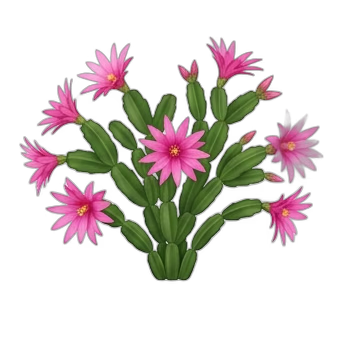
Every spring, a chorus of worried emails arrives asking why a beloved plant is dropping its buds just as they swell to the size of a marble. When a ten-year-old Hatiora gaertneri drops three dozen coral-red starbursts into the soil in a single morning, the culprit is rarely pests or root rot; nudging the ceramic pot even two inches to the left can shock the plant during its critical setting phase.

1. Botanical Overview & Natural Habitat
The Easter Cactus (Hatiora gaertneri, formerly classified as Schlumbergera gaertneri or Rhipsalidopsis gaertneri) belongs to the Cactaceae family, but you will find zero scorching desert sand in its native lineage. Endemic to the cloud forests of southeastern Brazil, specifically states like Paraná and São Paulo, this plant is an epiphyte and occasional lithophyte.
In the wild, Hatiora gaertneri does not root in the earth. Instead, it anchors itself high up in the crotches of forest canopy trees or clings to damp, mossy granite rock faces. Here, it receives bright, filtered light piercing through dense tropical foliage and drinks moisture straight from warm equatorial downpours and thick, rolling mists.
Morphologically, the plant features segmented, flattened, lance-shaped stem joints (cladodes) with purplish, slightly scalloped margins and minute bristles along the areoles rather than aggressive thorns. Unlike its cousin the Thanksgiving Cactus (Schlumbergera truncata), which sports claw-like teeth on its leaf margins, the Easter Cactus has smooth, rounded edges.
The flowers are another definitive taxonomic marker. While Thanksgiving and Christmas cacti produce zygomorphic (bilaterally symmetrical) tubular flowers that droop downwards, the Easter Cactus produces radiant, star-shaped, actinomorphic (radically symmetrical) blossoms that open completely flat in response to full daytime sun, measuring up to 2 inches (5 cm) across.
To understand its ecological adaptations deeply, consult the comprehensive profiles maintained by the Royal Botanic Gardens, Kew.
2. Essential Environmental & Care Requirements
Replicating a Brazilian cloud forest inside a modern home requires balancing humidity, light intensity, and thermal fluctuations. Get these variables wrong, and your plant will signal distress through limp cladodes or premature bud drop.
| Parameter | Optimal Condition | Common Mistake | Why It Matters |
|---|---|---|---|
| Light | Bright, indirect light (10,000 to 20,000 lux); morning sun only. | Direct midday summer sun. | Scorches the delicate green cladodes, turning them a bleached yellow-red and killing epidermal cells. |
| Temperature | 60°F to 75°F (15°C to 24°C) active; 50°F to 55°F (10°C to 13°C) for budding. | Exposing to drafts below 45°F (7°C) or heat registers above 80°F (27°C). | Sudden thermal shifts trigger severe bud blast and drop within 48 hours. |
| Watering | Water thoroughly when the top 1.5 inches (3.8 cm) of soil is dry. | Keeping soil soggy or letting it dry out completely for weeks. | Causes root suffocation or shriveling of the epiphyte's specialized water-storing tissues. |
| Soil pH & Mix | Acidic (pH 5.5–6.5); fast-draining orchid bark and peat blend. | Dense, heavy potting soil with high clay content. | Compacted soil starves roots of oxygen and breeds fungal pathogens like Phytophthora. |
Light is the primary driver of floral initiation. From November through January, your Easter Cactus requires short days (fewer than 12 hours of light) and cool night temperatures between 50°F and 55°F (10°C to 13°C) to trigger the hormonal shift necessary for flower bud formation. If placed near a living room television or reading lamp that stays on past 10 PM, the plant will experience light pollution, halting bud development entirely.
Humidity is equally critical. Indoor environments during winter often drop below 30% relative humidity. Aim for 50% to 60% humidity by grouping plants together or utilizing a cool-mist humidifier. Avoid daily misting if your indoor air circulation is poor, as trapped water droplets on dense cladodes invite fungal leaf spot.
💡 Pro-Tip: To accurately test your Easter Cactus's moisture needs without guessing, insert a wooden chopstick 3 inches (7.6 cm) into the potting mix. Leave it for 10 seconds. If any damp soil clings to the wood or if the wood has darkened significantly from moisture, hold off on watering for another 3 to 5 days.
3. Step-by-Step Cultivation, Feeding & Propagation
Growing Hatiora gaertneri from a single cutting to a cascading specimen requires patience and precise timing. Follow this rigorous protocol for propagation and annual maintenance.
Propagation Protocol via Stem Cuttings
- Select Mother Material: In late spring (May or June, precisely 4 to 6 weeks after flowering finishes), select healthy, plump cladodes from the tips of the parent plant. Avoid woody, older stems at the base.
- Make the Cut: Using a razor blade sterilized in isopropyl alcohol, snap or slice a section consisting of 2 to 3 connected segments right at the node (the joint where they connect). Never pull or tear the segments, as bruised vascular tissue invites rot.
- Callus the Wound: Place the freshly cut segments flat on a dry paper towel in a shaded, well-ventilated room. Allow them to dry undisturbed for 4 to 7 days until a thick, corky callus forms over the cut surface.
- Prepare the Propagation Substrate: Mix equal parts fine orchid bark, perlite, and premium peat-based potting soil. Moisten the mix until it feels like a wrung-out sponge.
- Plant the Cuttings: Insert the callused base of the lowest segment approximately 0.5 inches (1.3 cm) deep into the medium. Anchor multiple cuttings in a single 4-inch (10 cm) nursery pot to ensure a full-looking plant later.
- Rooting Conditions: Place the container in bright, indirect light where temperatures remain consistently at 70°F (21°C). Mist the surrounding air lightly every 3 days, but keep the soil barely moist.
- Verify Root Development: Within 21 to 30 days, gently tug on the base of a cutting. If you feel firm resistance, healthy roots have formed. Transition the young plant to standard watering schedules.
Feeding and Fertilization
Feed your Easter Cactus only during its active growing season, which runs from post-flowering (May) through late summer (August). Apply a balanced, water-soluble fertilizer formulated for acid-loving plants (such as a 10-10-10 or 20-20-20 orchid or azalea formulation) diluted to one-quarter strength every 14 days.
Cease all fertilization entirely by September 1st. This nutrient withdrawal, combined with cooler autumn temperatures and shortening daylight hours, signals the plant to transition from vegetative growth to reproductive bud setting. Feeding during the autumn or winter dormancy period will burn delicate root hairs and cause leaf drop.
⚠️ Important Caution: Never repot your Easter Cactus while it is in bud or actively flowering. The physical disturbance to the root ball almost universally causes severe shock, resulting in the immediate abortion of every flower bud on the plant. Always wait until the bloom cycle finishes entirely and new vegetative growth begins.
For deep academic insights into epiphyte physiology and nutrient uptake, reference the research archives provided by the University of Florida IFAS Extension.
4. Common Problems, Pests & Troubleshooting
Even experienced growers encounter hiccups with cloud forest cacti. Because these plants lack the thick protective cuticle of desert species, their symptoms manifest rapidly.
Symptom: Cladodes Turning Limp, Wrinkled, or Shriveled
- Root Rot (Overwatering): If the soil smells sour and roots are brown, mushy, and sloughing off, your plant is drowning. Unpot immediately, trim away dead root tissue with sterilized shears, dust the remaining roots with cinnamon powder (a natural antifungal), and repot in fresh, dry, fast-draining mix. Water sparingly until new growth appears.
- Underwatering or Heat Stress: If the soil bone-dry, the plant has gone too long without water or has been placed near an active heating vent. Submerge the entire pot in a basin of tepid water for 20 minutes to rehydrate the desiccated tissues.
Symptom: Sudden Bud Drop (Blast)
- Environmental Instability: Moving the plant, exposing it to cold drafts from an opening door, or fluctuating temperatures outside the 50°F–65°F (10°C–18°C) window during bud development will cause flowers to drop before opening. Secure the plant in a permanent, draft-free location from January through April.
Symptom: Pests
- Mealybugs: These cottony, white, slow-moving insects hide in the tight joints between cladodes, sucking plant sap. Dab individual pests with a cotton swab soaked in 70% isopropyl alcohol. For heavy infestations, spray thoroughly with horticultural insecticidal soap, ensuring coverage in all leaf axils.
- Fungus Gnats: Tiny black flies hovering around the soil surface indicate your potting mix is staying too wet. Allow the top 2 inches (5 cm) of soil to dry out completely between waterings, and apply Bacillus thuringiensis israelensis (BTI) dunks to the water supply to eliminate larvae.

5. Frequently Asked Questions
How do I get my Easter Cactus to bloom?
To trigger blooming, your Easter Cactus requires a specific chilling and dark period. Beginning in late autumn (November), provide the plant with 12 to 14 hours of absolute darkness each night and keep nighttime temperatures between 50°F and 55°F (10°C and 13°C) with daytime highs around 65°F (18°C). Reduce watering by half during this 8-week rest period. Once tiny bud nubs appear at the tips of the cladodes in late winter, resume normal watering and return the plant to its display location, making sure never to move or rotate it while buds develop.
What is the difference between an Easter Cactus and a Christmas Cactus?
While both are epiphytic jungle cacti with segmented stems, their blooming times and physical traits differ. The Easter Cactus (Hatiora gaertneri) blooms in spring (April to May), features smooth, rounded leaf margins with tiny bristles, and produces flat, star-shaped, symmetrical flowers that open fully in the sun. The Christmas Cactus (Schlumbergera x buckleyi or Schlumbergera truncata) blooms from November through January, features pointed, claw-like teeth on its leaf margins, and produces tubular, drooping, asymmetrical flowers that do not open flat.
Can I put my Easter Cactus outside for the summer?
Yes. Once all danger of spring frost has passed and outdoor nighttime temperatures remain consistently above 55°F (13°C), you can transition your Easter Cactus outdoors. Hang it under a covered porch, patio, or beneath the canopy of a shade tree where it receives dappled morning sunlight and protection from heavy downpours and high winds. Bring the plant back indoors in September before nighttime temperatures dip below 50°F (10°C) to prevent cold stress.
How often should I repot an Easter Cactus?
Easter Cacti actually prefer to be slightly root-bound and do not require frequent repotting. Repot young plants every 2 to 3 years, and mature specimens every 4 to 5 years, always immediately after the flowering season concludes in late spring. Choose a new pot that is only 1 inch to 2 inches (2.5 cm to 5 cm) wider in diameter than the previous container. Using a pot that is too large traps excess moisture around the root zone, frequently leading to fatal root rot.
📋 Table of Contents ▼ Click to expand
Tags: