

Dwarf Cavendish Banana
Musa acuminata 'Dwarf Cavendish'
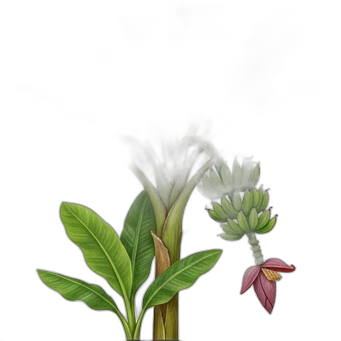
Standing on my patio last July, watching a massive, heavy-bellied bunch of thirty pristine bananas snap the pseudostem of my favorite Musa acuminata 'Dwarf Cavendish' right at the neck just two weeks before harvest, I learned my most expensive landscaping lesson: never underestimate the leverage of a fruiting banana tree. That heartbreak taught me everything I now teach gardeners who want a slice of the tropics in their backyard or sunroom: managing structural support is just as vital as getting your soil pH right.
1. Botanical Overview & Natural Habitat

Morphologically, it features broad, paddle-shaped leaves that can stretch up to 3 feet (91 cm) long and 18 inches (45 cm) wide. These leaves emerge tightly rolled as a "cigar leaf," unfurling with a brilliant chartreuse color that deepens to a rich, glossy green. In high-light environments, young leaves often display striking maroon or purple blotches, a charming juvenile trait that fades as the plant matures. The "trunk" is not a true woody stem, but rather a pseudostem formed by the tightly overlapping, spiral arrangement of heavy leaf sheaths.
Evolutionarily, Musa acuminata traces its lineage back to the humid tropical rainforests and lowland margins of Southeast Asia. In its native understory habitat, it evolved as a gap-colonizing species, adapted to burst upward through dappled jungle light into sudden, intense tropical sunbeams. This history dictates its current physiological needs: it craves high ambient humidity (above 60%), consistently moist and organically rich soils, and protection from shearing, high-velocity winds that can easily shred its massive, unreinforced foliage into ribbons.
2. Essential Environmental & Care Requirements
Growing a thriving Dwarf Cavendish requires matching its native tropical microclimate as closely as possible, whether you are cultivating it in USDA Hardiness Zones 9 through 11 or bringing it indoors for the winter in Zone 5.
| Parameter | Optimal Condition | Common Mistake | Why It Matters |
|---|---|---|---|
| Temperature | 75°F to 95°F (24°C to 35°C) | Exposing to temperatures below 50°F (10°C) without hardening off | Cold shock halts root uptake, turns leaves yellow, and invites stem rot. |
| Light | 6 to 8 hours of direct, unfiltered sun | Placing in dim interior corners or north-facing windows | Insufficient light causes weak, leggy stems that cannot support fruit weight. |
| Soil pH | 5.5 to 6.5 (Slightly acidic) | Planting in heavy, compacted, alkaline clay | Alkaline soils lock up essential iron and micronutrients, causing severe chlorosis. |
| Watering | Evenly moist; water when top 1 to 2 inches (2.5 to 5 cm) dry | Allowing the root ball to dry out completely between waterings | Drought causes rapid leaf desiccation, irreversible leaf edge burn, and fruit drop. |
Temperature is the primary driver of growth velocity. Dwarf Cavendish bananas stop growing entirely when temperatures dip below 50°F (10°C), and foliage suffers frost damage at 32°F (0°C). While the underground corm can survive a light frost in Zone 8 if heavily mulched, sustained freezes below 28°F (-2°宁) will kill unprotected plants to the ground.
Light intensity directly influences structural integrity. Indoors, place your plant directly in front of an unobstructed south- or west-facing window, or supplement with high-output LED grow lights for a minimum of 12 hours daily.
Water management requires a delicate balance. Because of their massive leaf surface area, these plants transpire vast quantities of water. During the peak summer growing season, deep watering every 2 to 3 days is standard. However, they despise "wet feet." Plant them in a medium that mimics a rich forest floor: equal parts coarse peat, perlite, and well-composted manure. For comprehensive guidance on managing soil moisture and fertility for tropical fruit crops, consult the University of Florida IFAS Extension.
3. Step-by-Step Cultivation, Feeding & Propagation
Cultivating a Dwarf Cavendish from a bare-root pup to a heavy-fruiting specimen is an immensely rewarding horticultural journey. Follow this precise protocol to ensure success.
- Select and Prepare the Vessel or Site: If planting in a container, choose a pot at least 20 inches (50 cm) wide and deep (roughly 15 to 20 gallons) with generous drainage holes. If planting in-ground, select a site protected from strong winds and amend a 3-foot (1 meter) circle with a 4-inch (10 cm) layer of compost and aged manure, tilled down to a depth of 12 inches (30 cm).
- Planting the Corm or Pup: Plant your banana pup or tissue-cultured starter so the top of the root ball sits exactly level with the surrounding soil line. Burying the pseudostem too deeply invites collar rot, while planting too shallowly leaves the stabilizing roots exposed.
- Establish Initial Irrigation: Immediately after planting, water deeply until moisture runs freely from the container's drainage holes. Apply a 3-inch (7.5 cm) layer of organic bark or leaf mulch around the base, keeping it 2 inches (5 cm) away from the pseudostem to prevent fungal trapping.
- Implement a Heavy Feeding Regime: Dwarf Cavendish bananas are heavy, aggressive feeders ("heavy hogs"). Apply a balanced, slow-release granular fertilizer with an N-P-K ratio of 10-10-10 or 15-5-30 (high potassium is critical for fruit development) every 4 weeks during the active spring and summer growth phase. Supplement weekly with a liquid kelp or fish emulsion spray to supply essential micronutrients.
- Manage Pups and Suckers: As the mother plant matures, it will send up side shoots called "pups" from the underground corm. Using a sharp, sterilized spade or hori-hori knife, slice away all but one or two strong, well-spaced follower pups to direct the plant's energy toward maximum vegetative growth and fruit production.
- Harvesting the Fruit: Watch for the massive, purple-red inflorescence to emerge from the heart of the leaves, typically after 12 to 18 months of optimal care. Once the female flowers pollinate and develop upward-curling fingers, the bunch will take 60 to 90 days to fill out. Cut the entire stalk down when the bananas reach a plump, angular stage but before they turn bright yellow on the tree.
💡 Pro-Tip: When your Dwarf Cavendish finally fruits, do not wait for the bananas to turn bright yellow on the plant. Birds, squirrels, and fruit bats will target them instantly. Harvest the entire hand or bunch when the individual fingers lose their distinct angular ridges and become nicely rounded, then hang the stalk in a cool, shady spot indoors to ripen uniformly.
⚠️ Important Caution: Never pull dead or dying lower leaves off your banana tree by ripping them downward against the grain of the pseudostem. This creates a gaping wound in the outer sheath layers, inviting bacterial pathogens and boring insects straight into the vascular system. Always use a sanitized razor knife or pruning shears to cut the petiole clean, leaving a 2-inch (5 cm) stub that will dry out and naturally flake off later.
4. Common Problems, Pests & Troubleshooting
Even with meticulous care, indoor and outdoor banana growers frequently encounter specific physiological and biotic challenges.
- Spider Mites (Tetranychus urticae): These microscopic arachnids thrive in the warm, dry indoor air typical of winter banana culture. You will notice fine stippling on the leaves, followed by delicate webbing on the undersides. Blast the foliage thoroughly with a strong stream of tepid water in the shower, then apply horticultural soap or neem oil every 7 days for three cycles to break the hatching continuum.
- Panama Disease (Fusarium Wilt): Caused by the soil-borne fungus Fusarium oxysporum f. Sp. cubense, this pathogen enters through the roots, blocking water-transporting xylem vessels. Symptoms include yellowing of the lower leaves that progress inward from the margins, followed by the complete collapse of the pseudostem at the base. While the Cavendish lineage has historically shown strong resistance to older strains, sterile soil practices are non-negotiable. For advanced disease identification protocols, refer to resources provided by the Royal Botanic Gardens, Kew.
- Leaf Shredding and Wind Damage: Strong gusts frequently shred the intercostal veins of the leaves. While aesthetically unappealing, minor shredding does not kill the plant. However, to prevent total structural collapse during tropical storms or heavy indoor drafts, tie the upper leaves loosely with soft burlap ribbon and ensure your container has a heavy base weight.
- Nutrient Deficiencies (Chlorosis): Interveinal chlorosis (yellowing between green veins) usually points to an iron or magnesium deficiency, often triggered by a soil pH that has crept above 7.0. Immediately flush the soil with acidified water (pH 5.8) and apply a chelated iron foliar spray for rapid recovery.

5. Frequently Asked Questions
Can I grow a Dwarf Cavendish banana indoors year-round?
Yes, absolutely. Provided you can supply a minimum of 6 hours of direct, unfiltered sunlight—ideally backed up by high-output LED horticultural lighting—and maintain indoor humidity above 50% using a cool-mist humidifier, a Dwarf Cavendish will thrive, grow, and even fruit successfully inside a bright sunroom or living room.
How long does it take for a Dwarf Cavendish to produce fruit?
From the time you plant a healthy, well-rooted tissue-culture starter or robust pup, it typically takes between 12 to 18 months of continuous, frost-free, heavy-feeding growth for the plant to reach maturity and push out its massive floral spike.
Why are the edges of my banana leaves turning brown and crispy?
Leaf edge browning is almost universally caused by insufficient ambient humidity or irregular watering. Banana leaves have massive surface areas that transpire moisture rapidly; when the surrounding air drops below 50% humidity or the root ball experiences even brief drought stress, the delicate marginal cells dry out and die faster than the roots can replace the water.
Do I need to cut down the main pseudostem after it produces bananas?
Yes. Unlike true woody trees, a single banana pseudostem is monocarpic—it fruits only once in its lifetime and then naturally dies. Once you harvest the fruit bunch, use a clean saw to cut the spent pseudostem down to ground level at a 45-degree angle, allowing the pre-established follower pup to take over as the primary trunk for the next generation.
📋 Table of Contents ▼ Click to expand
Tags:





