Dragon Tree
Dracaena marginata
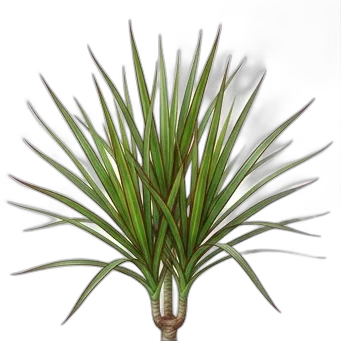
The first time I hauled a mature Dracaena marginata out of a gardener's dimly lit suburban basement—a seven-foot architectural specimen with a bare, curving trunk and a shock of burgundy-edged leaves clinging desperately to the top—I knew immediately what had happened. It wasn't root rot, and it wasn't a pest infestation. It was architectural starvation. The plant had spent four years existing in light levels hovering around 50 foot-candles, watered on a rigid, panic-driven schedule every Sunday morning.

1. Botanical Overview & Natural Habitat
The Dragon Tree, scientifically classified as Dracaena marginata (syn. Dracaena cinnabari in broader historical contexts, though marginata is the true Madagascar native we cultivate indoors), belongs to the family Asparagaceae. In its native habitat along the rocky, arid, and coastal scrublands of Madagascar, it grows as an evergreen shrub or small tree up to 15 feet (4.5 meters) tall.
Taxonomically, the plant is renowned for its slender, woody stems marked by old leaf scars, and its narrow, linear leaves that stretch 12 to 24 inches (30 to 60 cm) long and roughly 0.5 inches (1.3 cm) wide. The species epithet marginata refers to the striking deep red or purple pigmentation bordering the vibrant green leaves. Over time, as lower leaves naturally senescence and drop, the plant develops an exposed, twisting woody cane structure that gives it a distinctively prehistoric, palm-like silhouette.
For a deeper dive into the taxonomy and structural characteristics of the Dracaena genus, you can reference the Royal Botanic Gardens, Kew.
2. Essential Environmental & Care Requirements
Mastering the cultivation of Dracaena marginata requires replicating the fluctuating, well-draining conditions of its native environment within the controlled climate of a home or office.
Light is the primary driver of its structural integrity. While it tolerates lower light conditions—making it a staple of interior architectural design—too little light results in weak, spindly stems that cannot support the weight of the canopy. Aim for bright, indirect light, roughly 1,000 to 2,500 foot-candles. Direct midday sun will scorch the foliage, bleaching the green centers and burning the red margins.
Temperature parameters are straightforward. Because they hail from the tropics, keep ambient temperatures between 65°F and 80°F (18°C to 27°C). Never expose the plant to sustained temperatures below 50°F (10°C); cold drafts from poorly sealed winter windows will cause immediate cellular collapse, manifesting as water-soaked, black leaf tissue.
Soil composition must prioritize aeration and rapid drainage. Heavy garden loam will retain too much moisture, suffocating the delicate root system. A bespoke mix consisting of 40% high-grade potting soil, 30% coarse perlite or pumice, and 30% orchid bark or coco coir mimics the fast-draining, rocky soils of Madagascar.
| Parameter | Optimal Condition | Common Mistake | Why It Matters |
|---|---|---|---|
| Light | Bright, indirect (1,000–2,500 fc) | Placing in deep, windowless corners | Causes weak, etiolated stems and muted leaf coloration |
| Watering | Top 2 to 3 inches (5–7.5 cm) dry completely | Watering on a rigid calendar schedule | Leads to root asphyxiation and severe fungal root rot |
| Soil pH | 6.0 to 6.5 (Slightly acidic) | Using dense, unamended topsoil | Restricts nutrient uptake and causes severe drainage failure |
| Humidity | 40% to 50% relative humidity | Ignoring dry winter heating indoor air | Results in unsightly brown, necrotic leaf tips |
3. Step-by-Step Cultivation, Feeding & Propagation
Propagation of Dracaena marginata is remarkably straightforward due to the meristematic activity locked inside its woody stems. Whether you are dividing an overgrown specimen or starting fresh from stem cuttings, follow this reliable protocol.
- Select a Healthy Stem: Choose a mature, firm, disease-free stem at least 6 to 8 inches (15 to 20 cm) long during the active growing season (late spring or early summer).
- Make the Cut: Using a sterilized razor blade or bypass pruners cleaned with 70% isopropyl alcohol, make a clean, horizontal cut just below a node.
- Treat the Cutting: Dust the basal end of the cutting with rooting hormone powder containing IBA (Indole-3-butyric acid) to accelerate root initiation.
- Prepare the Propagation Medium: Fill a 4-inch (10 cm) container with a pre-moistened, sterile mix of equal parts perlite and peat moss.
- Insert the Stem: Push the cut end 2 inches (5 cm) deep into the medium, firming the soil gently around the base to ensure good contact.
- Create a Microclimate: Enclose the pot and cutting in a clear plastic bag to maintain 80%+ humidity, placing it in bright, indirect light at 72°F to 75°F (22°C to 24°C).
- Monitor and Transplant: Roots will typically form within 30 to 45 days. Once roots reach 1 inch (2.5 cm) in length, transplant the young plant into a standard container using the soil blend outlined in Section 2.
Feeding should be approached with restraint. Dracaena are light feeders. Apply a balanced, water-soluble houseplant fertilizer diluted to half-strength once every 4 weeks strictly during the active growing season (spring through summer). Cease all fertilization entirely from October through February when the plant enters semi-dormancy.
💡 Pro-Tip: Dracaena marginata is highly sensitive to the fluoride and chlorine commonly found in municipal tap water. Fluoride toxicity manifests as broad, necrotic brown patches with yellow halos along the leaf tips and margins. Always use rainwater, distilled water, or reverse-osmosis filtration to keep those dramatic red edges pristine.
4. Common Problems, Pests & Troubleshooting
Even with meticulous care, environmental shifts can trigger physiological responses in your Dragon Tree. Learning to read these symptoms early prevents minor issues from becoming terminal.
Leaf tip browning is the single most common complaint. If the tips are crisp and brown, the culprit is almost always low ambient humidity or fluoride accumulation from tap water. If the browning is accompanied by soft, yellowing foliage at the base of the plant, you are overwatering. Allow the soil profile to dry down completely to a depth of 3 inches (7.5 cm) before introducing moisture.
⚠️ Important Caution: Dracaena marginata contains saponins, which are toxic to domestic pets including cats and dogs. Ingestion can cause hypersalivation, vomiting, dilated pupils, and lethargy. Position your plant safely out of reach of curious animals or select a non-toxic alternative if you have aggressive chewers at home.
Pests are relatively rare thanks to the tough, fibrous nature of the leaves, but spider mites (Tetranychus urticae) can establish colonies during dry winter months. Look for fine webbing on the undersides of the leaves and a stippled, grey-green appearance on the foliage. Treat infestations immediately by wiping down the leaves with horticultural soap or neem oil diluted according to manufacturer specifications. Scale insects may also occasionally hide along the woody cane crevices; dab these with a cotton swab soaked in rubbing alcohol to dissolve their protective waxy shields.

5. Frequently Asked Questions
Can I cut the top off my tall Dragon Tree to make it shorter?
Yes, absolutely. Dracaena marginata tolerates heavy pruning exceptionally well. If your plant has grown too tall for your space, you can cut the main cane cleanly to your desired height using a sterilized saw or pruners. The plant will respond by activating dormant buds just below the cut, typically pushing out two to three new branch heads within 4 to 6 weeks, resulting in a bushier, multi-stemmed profile.
Why are the lower leaves of my Dracaena turning yellow and falling off?
This is a completely natural biological process. As the plant grows upward and produces new leaves at the apex of the canopy, the oldest lower leaves at the base of the cane naturally senescence, turn yellow, dry up, and drop off to fuel the plant's structural development. However, if multiple leaves are yellowing simultaneously and the stem feels soft or mushy, it indicates root rot caused by overwatering.
How often should I water my Dragon Tree?
Watering frequency depends entirely on your indoor environmental conditions, but as a rule of thumb, water thoroughly every 14 to 21 days during the spring and summer, and every 30 days during the winter. Always test the soil moisture manually: insert your finger a full 2 to 3 inches (5 to 7.5 cm) into the potting mix. If it feels completely dry, it is time to water until it runs freely through the drainage holes. If it feels damp, wait another week.
Can Dracaena marginata survive in low light offices?
Yes, it can survive, but it will not thrive. In low-light environments (under 100 foot-candles), the plant's metabolic rate slows dramatically. Growth will stall, the stem will stretch unhealthily toward the nearest light source, and the vibrant red leaf margins may fade to a dull green. If you must keep the plant in a low-light office, supplement its environment with a dedicated full-spectrum LED grow light positioned 12 to 18 inches (30 to 45 cm) above the canopy for 10 to 12 hours a day.
📋 Table of Contents ▼ Click to expand
Tags: