
Christmas Cactus
Schlumbergera bridgesii
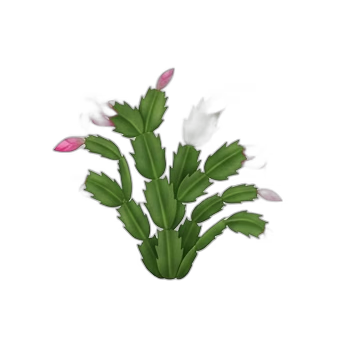
The ceramic pot tipped slightly on the potting bench, spilling a cascade of hot-pink blooms across the concrete. That specific plant—a Schlumbergera bridgesii—had spent the previous autumn sulking in a dark hallway before relocation to a spot receiving exactly fourteen hours of uninterrupted darkness each night. Watching those flattened, glossy stem segments erupt into symmetrical, tubular flowers proves why this tropical epiphyte remains the undisputed monarch of indoor winter horticulture. Unlike its desert-dwelling namesakes, this jungle native refuses to be treated like a standard houseplant, demanding instead a precise mimicking of its native canopy-dwelling life.
1. Botanical Overview & Natural Habitat

Morphologically, the plant lacks true leaves. What appear to be leaves are actually flattened, succulent stem segments known as cladodes. These segments feature softly scalloped or rounded margins, which instantly distinguishes the Christmas cactus from its close cousin, the Thanksgiving cactus (Schlumbergera truncata), whose cladodes feature distinct, claw-like teeth pointing forward. At the terminal ends of these cladodes, drooping blossoms emerge during the short-day months of late autumn and winter. The flowers are radially symmetrical, featuring vibrant layers of magenta, pink, red, or white petals that arch backward to reveal prominent, pendulous stamens adapted for pollination by hummingbirds and specialized insects.
In its natural habitat, the Christmas cactus experiences high humidity, filtered tropical sunlight, and constant air circulation. Temperatures rarely plummet to freezing, hovering comfortably between 60°F and 75°F (15°C to 24°C) year-round. Understanding this native microclimate is the singular key to mastering its cultivation in a domestic indoor environment.
2. Essential Environmental & Care Requirements
Replicating an epiphytic Brazilian rainforest canopy inside a modern heated home requires adherence to specific environmental metrics.
Light exposure must be bright, indirect, and filtered. Exposing a Christmas cactus to direct midday sun will quickly scorch its succulent cladodes, turning them a stressed, purplish-red and eventually bleaching them to a papery tan. An east-facing window providing gentle morning light for 3 to 4 hours, or a bright interior space shielded by a sheer curtain, is ideal.
Temperature management is equally critical, particularly during the transition from vegetative growth to floral initiation. During active summer growth, ambient temperatures between 65°F and 80°F (18°C to 26°C) are optimal. However, to trigger the chemical signaling required for blooming in autumn, night temperatures must drop to 50°F to 60°F (10°C to 15°C), paired with total darkness for 12 to 14 hours daily starting in September or October. For an exhaustive academic breakdown of photoperiodic management, consult the Clemson Cooperative Extension Home & Garden Information Center.
Watering practices separate thriving specimens from rotting casualties. Because they grow on tree trunks, their roots are accustomed to rapid drainage and immediate aeration. The golden rule is to allow the top 1.5 to 2 inches (3.8 to 5 cm) of the soil medium to dry completely before administering a thorough drenching. Never allow the pot to sit in a saucer of standing water for more than 15 minutes.
Humidity levels indoors often plummet below 30% during heating season, which causes bud drop and shriveled stems. Maintain a local relative humidity of 50% to 60% by placing the pot on a pebble tray filled with water, ensuring the base of the container remains elevated above the waterline.
| Parameter | Optimal Condition | Common Mistake | Why It Matters |
|---|---|---|---|
| Light | Bright, indirect (filtered morning sun) | Direct afternoon sun | Causes irreversible sunburn, bleaching, and chlorotic collapse of cladodes |
| Watering | Drench when top 1.5–2 inches (3.8–5 cm) are dry | Keeping soil constantly soggy | Suffocates epiphyte roots, leading to rapid Pythium and Phytophthora root rot |
| Temperature | 60°F–70°F (15°C–21°C) with cool autumn nights | Placement near heating vents or drafty doors | Sudden thermal fluctuations shock the plant, causing premature flower bud drop |
| Soil pH | Slightly acidic, 5.5 to 6.5 | Heavy, dense garden loam | Prevents adequate aeration and traps moisture around delicate root hairs |
💡 Pro-Tip: When your Christmas cactus finishes its winter flowering cycle, do not panic if it drops a few spent blossoms. Move the plant to a cooler, slightly drier location for 4 to 6 weeks to enforce a strict rest period. This dormant phase is physiologically mandatory; skipping it results in weak, spindly spring growth and zero flowers the following December.
3. Step-by-Step Cultivation, Feeding & Propagation
Cultivating a robust, long-lived Schlumbergera bridgesii requires a methodical approach to potting media, nutrient replenishment, and asexual reproduction.
Soil and Repotting
Christmas cacti prefer tight root systems and should only be repotted every 3 to 4 years, ideally in early spring immediately after the post-bloom rest period. Select a container only 1 to 2 inches (2.5 to 5 cm) larger in diameter than the previous pot, ensuring it features at least one unobstructed drainage hole.
Formulate a specialized epiphytic soil blend by combining:
- 40% high-quality organic peat moss or coco coir
- 30% coarse orchid bark (to guarantee internal air pockets)
- 20% perlite or pumice (for rapid moisture drainage)
- 10% horticultural charcoal (to maintain microbial freshness)
Feeding Protocol
Feed active plants monthly from early spring through late summer using a balanced, water-soluble houseplant fertilizer diluted to half-strength (e.g., 10-10-10). Cease all fertilization entirely by September 1st. Continuing to feed during the autumn bud-set phase forces vegetative growth at the expense of floral development, causing newly formed buds to turn yellow and abort.
Propagation via Stem Cuttings
Multiplying your collection is remarkably straightforward when executed with precision. Follow this exact numbered sequence:
- Select Material: In spring or early summer, target healthy, disease-free, mature stem sections featuring at least 3 to 4 connected cladodes.
- Execute the Cut: Using a razor blade sterilized with 70% isopropyl alcohol, twist or snap the joint cleanly between the target segment and the parent stem. Never use dull kitchen shears, which crush vascular tissue.
- Callus the Wound: Place the harvested cuttings flat on a clean paper towel in a shaded, well-ventilated room for 3 to 5 days. Allowing the basal cut to form a protective dry callus is non-negotiable; planting a raw, wet cut directly into damp media invites immediate fungal invasion.
- Planting: Insert the basal end of the cutting approximately 0.5 inches (1.3 cm) deep into a pre-moistened medium composed of equal parts perlite and peat moss.
- Rooting Conditions: Enclose the container in a clear plastic bag to lock in humidity, placing it in bright, indirect light at a steady 70°F (21°C). Roots will actively form at the basal nodes within 21 to 30 days, after which the young plant can be transitioned to standard care.
⚠️ Important Caution: Never let your Christmas cactus experience temperatures below 45°F (7°C). Because their succulent tissues hold a high volume of water, freezing temperatures cause internal cellular walls to rupture instantly, turning the cladodes into a translucent, mushy mess that cannot be saved.
For further botanical verification on plant classification and structural traits, explore the database managed by the Royal Botanic Gardens, Kew.
4. Common Problems, Pests & Troubleshooting
Even with meticulous environmental control, physiological stress and opportunistic pests can occasionally manifest. Early identification is your best defense.
Stem Drop and Bud Blast
When flower buds turn pale, drop prematurely, or whole stem segments detach, the culprit is almost universally environmental instability. Sudden drafts from opening exterior doors, proximity to hot forced-air vents, erratic watering schedules (swinging wildly from bone-dry to waterlogged), or moving the plant mid-bloom will shock the vascular system. Secure the plant in a permanent location once buds form, maintaining a stable ambient temperature and consistent soil moisture.
Shriveling and Limp Cladodes
If the segments lose their plump, glossy turgor pressure and look wrinkled, diagnose the root system immediately.
- Scenario A: The soil is bone-dry. The plant is simply thirsty; give it a thorough, deep watering, and it will plump back up within 48 hours.
- Scenario B: The soil is soaking wet, yet the cladodes are limp. This indicates advanced root rot (Pythium species). The roots have died and can no longer transport water upward. You must unpot the plant, slice away black, mushy roots with a sterile blade, dust the remaining healthy tissue with sulfur powder, and repot into fresh, dry soil.
Pests
- Fungus Gnats (Sciaridae): These tiny, black, flying insects thrive in constantly damp, organic-rich topsoils. While the adult gnats are merely annoying, their subterranean larvae feed on fine root hairs. Control them by letting the top 2 inches of soil dry completely between waterings, applying biological larvicides containing Bacillus thuringiensis israelensis (Bti), or top-dressing the soil with a 0.5-inch (1.3 cm) layer of horticultural sand.
- Mealybugs (Pseudococcus): Appearing as cottony, white, waxy masses tucked tightly into the crevices between cladodes, mealybugs pierce plant tissues to suck out sugary phloem sap. Eradicate localized outbreaks by dipping a cotton swab into 70% isopropyl alcohol and touching it directly to each insect. For severe infestations, apply a thorough spray of horticultural neem oil, ensuring coverage of all undersides and joints.

5. Frequently Asked Questions
How do I get my Christmas cactus to bloom for the holidays?
To force heavy flowering in December, you must replicate natural photoperiod triggers starting in late September. The plant requires 14 hours of absolute, uninterrupted darkness (no ambient reading lights, streetlamps, or television glare) and 10 hours of bright, indirect light every single day for roughly 6 to 8 weeks. Pair this lighting schedule with cool nighttime temperatures between 50°F and 60°F (10°C to 15°C) and reduced watering. Once tight flower buds form and reach the size of a small pea, you can return the plant to its normal display location.
Why are the leaves on my Christmas cactus turning purple?
A purplish or reddish-bronze flush across the cladodes is a physiological stress response, most frequently triggered by excessive light levels. While Christmas cacti love bright spaces, intense direct sunlight—especially through unfiltered southern or western window glass—causes anthocyanin pigments to accumulate as a natural sunscreen. Instantly relocate the container to a spot receiving softer, filtered morning light, and the cladodes will gradually revert to their standard rich green.
Should I cut off dead flowers on a Christmas cactus?
Yes. Once individual blossoms fade, turn brown, and dry up, gently pinch or twist the old flower base away from the terminal tip of the cladode. Removing spent flowers prevents the plant from expending metabolic energy on seed pod production (fruit set), keeping energy focused entirely on maintaining structural health and initiating future vegetative growth cycles.
Is the Christmas cactus toxic to cats and dogs?
No. Unlike true cacti (Cactaceae) that feature dangerous structural spines, and unlike many traditional holiday plants like poinsettias, lilies, or mistletoe, the true Christmas cactus (Schlumbergera bridgesii) is completely non-toxic to cats, dogs, and horses, according to the ASPCA database. However, ingestion of large quantities of fibrous plant material may still cause mild, temporary gastrointestinal upset or vomiting in curious pets due to the heavy fiber content.
📋 Table of Contents ▼ Click to expand
Tags: