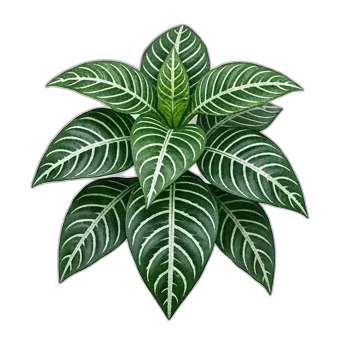
Chinese Evergreen
Aglaonema
1. Botanical Overview & Natural Habitat
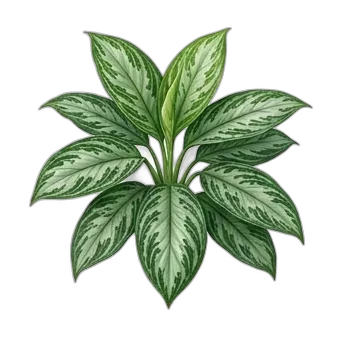
The Chinese Evergreen (Aglaonema) is native to the lowland rainforests of Southeast Asia, deep within a dense, humid canopy where direct sunlight rarely pierces the upper layers. Its lance-shaped leaves, patterned in stark silvers and deep jades, are adapted to low-light, high-humidity environments anchored in fast-draining, organic-rich soil.

Modern horticulture has transformed the wild species, which typically featured muted green and gray patterns, into a dazzling array of cultivars. Varieties such as 'Silver Queen', 'Crete', and 'Red Siam' introduce brilliant pinks, deep reds, and blazing whites to the leaf blades. Despite this colorful evolution, their underlying botanical mechanics remain unchanged. They are monocots with parallel or net-venation variations, and they occasionally produce spatial inflorescences consisting of a spadix wrapped in a modified green or white spathe, though this rarely occurs when grown indoors under standard domestic conditions.
2. Essential Environmental & Care Requirements
Replicating a Southeast Asian understory inside a modern living room requires precision. Because Aglaonema evolved beneath a thick jungle canopy, they detest intense, direct sunlight. Exposing an Aglaonema to harsh midday rays will scorch its leaves within 4 to 6 hours, leaving unsightly brown, papery patches. Instead, position your plants 3 to 6 feet (0.9 to 1.8 meters) away from an east- or north-facing window. Green-leafed cultivars tolerate lower light levels quite well, whereas the heavily variegated pink and red cultivars require brighter, indirect light to maintain their vibrant coloration.
Temperature is another critical factor. As tropical natives, Chinese Evergreens suffer when exposed to cold drafts or rapid temperature drops. The ideal ambient temperature range sits consistently between 65°F and 80°F (18°C to 27°C). Never allow the ambient temperature to drop below 55°F (13°C). If temperatures fall past this threshold for even 24 to 36 hours, you will notice water-soaked, black lesions developing on the stems—a clear sign of chilling injury.
Humidity and watering complete the environmental triangle. While Aglaonema is remarkably forgiving of typical household humidity (often around 30% to 40%), it thrives and produces glossier, larger foliage when relative humidity is maintained between 50% and 60%. When it comes to hydration, adopt a "soak and dry" methodology. Allow the top 2 to 3 inches (5 to 7.5 cm) of the soil mix to dry completely before applying water. Overwatering is the single fastest way to kill an Aglaonema, as their fleshy roots succumb rapidly to fungal pathogens when suffocated in waterlogged media.
| Parameter | Optimal Condition | Common Mistake | Why It Matters |
|---|---|---|---|
| Light | Bright, indirect light (500–1000 foot-candles) | Direct southern exposure | Causes leaf scorching, fading of variegation, and cellular dehydration. |
| Temperature | 65°F – 80°F (18°C – 27°C) | Placement near AC units or cold drafts below 55°F (13°C) | Triggers chilling injury, cell collapse, and terminal stem rot. |
| Soil Moisture | Dry top 2–3 inches (5–7.5 cm) before watering | Keeping soil perpetually damp | Deprives roots of oxygen, inviting Pythium and Phytophthora root rot. |
| Humidity | 50% – 60% relative humidity | Ignoring dry winter air entirely | Leads to crispy leaf tips, slowed growth, and increased susceptibility to spider mites. |
For deeper botanical insights on caring for tropical understory flora, consult the Royal Horticultural Society guidelines on indoor plants.
3. Step-by-Step Cultivation, Feeding & Propagation
Growing a specimen-quality Chinese Evergreen starts with proper potting mechanics. Because these plants prefer soil that sheds excess water instantly while retaining vital moisture, a standard peat-heavy potting mix straight from the bag will ultimately cause root suffocation. You need to construct a specialized, chunky substrate.
Step-by-Step Cultivation & Potting Sequence
- Formulate the Soil Mix: Combine 50% high-quality tropical potting soil, 25% perlite or pumice for aeration, and 25% orchid bark to ensure rapid drainage and oxygen flow around the root zone.
- Select the Container: Choose a pot with unobstructed drainage holes that is only 1 to 2 inches (2.5 to 5 cm) larger in diameter than the current root ball. Terracotta is ideal because its porous walls allow excess moisture to evaporate.
- Unpot and Inspect: Gently slide the Aglaonema from its nursery container. Tease apart the root mass to loosen circling roots, and use sterilized pruning shears to snip away any brown, mushy, or hollow roots.
- Establish the Base Layer: Add a 1-inch (2.5 cm) layer of your custom soil blend to the bottom of the new pot. Place the plant in the center, ensuring the top of the root ball sits about 1 inch (2.5 cm) below the rim of the pot to prevent overflow during watering.
- Fill and Settle: Backfill around the root system with the remaining soil blend, tapping the sides of the pot gently to settle the medium. Avoid pressing down too forcefully, which compacts the vital air pockets.
- Initial Watering: Water the newly potted plant thoroughly until water streams freely from the drainage holes. Allow it to drain completely for 30 minutes before returning it to its sauced saucer.
Fertilization should be measured and intentional. During the active growing season—typically spanning from early spring through late summer—feed your Aglaonema every 4 to 6 weeks using a balanced, water-soluble houseplant fertilizer diluted to half-strength (e.g., a 10-10-10 or 20-20-20 formulation). Cease fertilization entirely from October through February when natural light levels drop and the plant enters a state of semi-dormancy.
Propagation is remarkably straightforward through stem cuttings or division. When your Aglaonema matures, it often produces basal offsets (pups) directly from the soil line. To propagate via division, simply unpot the plant in spring, gently tease the root systems apart with your fingers, and pot the individual pups into their own 4-inch (10 cm) containers. Alternatively, you can take a 4-to-6-inch (10 to 15 cm) stem cutting containing at least two node sites, remove the lower leaves, and root it either in a vessel of clean water (changing the water every 5 days) or directly in moist perlite. Roots typically emerge within 14 to 21 days.
💡 Pro-Tip: When rooting Aglaonema stem cuttings in water, add a small piece of activated horticultural charcoal to the vessel. This prevents anaerobic bacteria from multiplying, keeping the water crystal clear and dramatically accelerating root initiation.
4. Common Problems, Pests & Troubleshooting
Even with meticulous care, indoor environments present variables that can stress your plants. Learning to diagnose visual symptoms early saves your Aglaonema from terminal decline.
Yellowing lower leaves are a classic diagnostic puzzle. If the oldest leaves at the very base of the plant turn uniformly yellow and eventually drop off while the upper growth remains firm and vibrant, this is a normal part of the plant's aging process. However, if multiple leaves turn yellow simultaneously, feel soft and limp, and are accompanied by a musty odor from the soil, you are dealing with active root rot caused by overwatering. Immediately unpot the plant, cut away all infected tissue, dust the remaining healthy roots with cinnamon (a natural antifungal), and repot into fresh, dry soil.
⚠️ Important Caution: All parts of the Aglaonema plant contain needle-like calcium oxalate crystals (raphides). If chewed or ingested by cats, dogs, or small children, these crystals pierce mucosal tissues, causing intense local irritation, severe burning, profuse drooling, and difficulty swallowing. Always place your Chinese Evergreens well out of reach of curious pets and toddlers.
Pests are relatively uncommon on healthy Chinese Evergreens due to the thick cuticle of their leaves, but low household humidity can invite mealybugs and spider mites. Mealybugs appear as small, cottony white masses tucked tightly in the leaf axils and beneath leaf stems. Spider mites are microscopic; look instead for fine, silken webbing across the undersides of leaves and a stippled, dusty appearance on the upper surface. Treat infestations immediately by wiping down every leaf with a 1:1 mixture of isopropyl alcohol and water, followed by a thorough spraying of horticultural insecticidal soap.

5. Frequently Asked Questions
Why are the tips of my Chinese Evergreen leaves turning brown and crispy?
Brown, crispy leaf tips are almost universally caused by low ambient relative humidity or a buildup of mineral salts from tap water. If your indoor humidity dips below 40%, the delicate leaf edges lose moisture faster than the roots can supply it. Alternatively, heavy mineral salts like fluoride and chlorine present in municipal tap water accumulate in the soil over time and burn the leaf tips. To remedy this, switch to distilled or rainwater, and increase humidity around the plant using a cool-mist humidifier.
Can a Chinese Evergreen survive in a room with zero natural sunlight?
No plant can survive indefinitely with absolute zero light, as light is the foundational energy source for photosynthesis. However, Aglaonema is exceptionally tolerant of low-light conditions compared to almost any other houseplant. If a room has no windows, your Chinese Evergreen can survive quite happily if placed directly beneath artificial full-spectrum LED or fluorescent office lighting turned on for 10 to 12 hours a day.
How often should I repot a growing Chinese Evergreen?
You should typically repot your Aglaonema every 2 to 3 years, preferably in early spring as the growing season commences. Signs that your plant has outgrown its current home include roots circling densely around the interior of the pot, roots emerging visibly from the bottom drainage holes, or water running straight through the potting mix without being absorbed because the soil has broken down and lost its structural integrity.
Why is my colorful pink or red Chinese Evergreen turning completely green?
If your brightly colored cultivar is losing its variegation and reverting to solid green, it is almost certainly receiving insufficient light. The vivid pink, red, and silver pigments in modern Aglaonema cultivars are produced by specialized plant cells that require moderate to bright indirect light to activate their coloration. When placed in deep shade, the plant maximizes its chlorophyll production to capture every available photon, causing the vibrant colors to fade away and be replaced by plain green. Move the plant closer to an unshaded window to restore its brilliant hues.
📋 Table of Contents ▼ Click to expand
Tags: