

Calathea Medallion
Goeppertia veitchiana
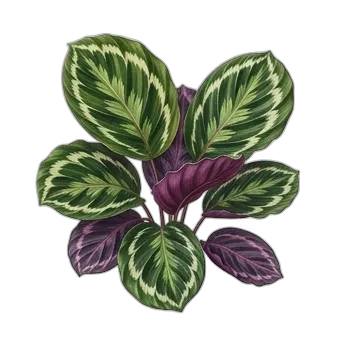
It was a humid Tuesday morning in my conservatory when I noticed the telltale crisping edges on my prized Goeppertia veitchiana 'Medallion'. I had missed my humidity tracking sheet by just four percentage points over the weekend, and the plant made its displeasure known with lightning speed. I have developed a deep respect for the dynamic nature of prayer plants. They are living barometers of their indoor ecosystems. When you treat them right, their foliage is nothing short of living art: deep emerald and silver concentric rings on the adaxial surface, contrasted with a rich, velvety burgundy on the abaxial side.
1. Botanical Overview & Natural Habitat

In its natural habitat, Goeppertia veitchiana grows in rich, organic, humus-heavy soil that remains consistently moist yet exceptionally well-drained. The temperature is uniformly warm, and the air is thick with moisture. A defining botanical feature of this species is its possession of a pulvinus—a specialized, node-like structure located at the base of the leaf petiole. This cellular hinge allows the plant to perform nyctinasty, meaning the leaves fold upward at dusk and flatten out again at dawn. This movement optimizes light capture during the day and reduces moisture loss or herbivory pressure at night, earning them the common moniker of "prayer plants."
Understanding this understory heritage dictates everything we do indoors. We are attempting to recreate a micro-climate characterized by filtered light, steady warmth, moist soil, and high ambient humidity without creating stagnant, anaerobic conditions at the root zone.
2. Essential Environmental & Care Requirements
Creating the ideal indoor environment for your Calathea Medallion requires precise control over four core pillars: light, water, humidity, and temperature. Let us look at the exact parameters required to keep your plant thriving.
| Parameter | Optimal Condition | Common Mistake | Why It Matters |
|---|---|---|---|
| Light | Bright, indirect light (75–80% shade, 10,000–15,000 lux) | Placing in direct sun or dark corners | Direct sun bleaches and burns delicate foliage; deep shade halts photosynthesis and causes leggy, weak growth. |
| Water | Rainwater, distilled water, or RO water; keep soil evenly moist | Using unfiltered tap water high in salts | Fluoride and chlorine accumulate in the leaf tips, causing severe necrosis and brown margins. |
| Humidity | 60% to 80% relative humidity | Letting ambient humidity drop below 40% | Low moisture levels trigger rapid transpiration, leading to curling leaves, crisp edges, and severe leaf stress. |
| Temperature | 65°F to 85°F (18°C to 29°C) | Exposing to drafts or temps below 55°F (13°C) | Cold drafts shock the root system, leading to rapid wilting, cellular collapse, and terminal decline. |
Light management is perhaps the most frequent stumbling block for indoor gardeners. Your Calathea Medallion needs bright indirect light. An east-facing window or a spot a few feet back from a west- or south-facing window filtered through a sheer curtain is ideal. If you are uncertain about light levels, consult resources like the Royal Horticultural Society for guidance on measuring indoor foot-candles.
Water quality is equally critical. These plants are exceptionally sensitive to the chemical additives found in municipal tap water. Fluoride, chlorine, and heavy mineral salts build up in the soil matrix and quickly scorch the delicate leaf margins. Always utilize water with a Total Dissolved Solids (TDS) reading of less than 50 parts per million (ppm).
💡 Pro-Tip: If you cannot maintain a permanent 60% humidity room, cluster your Calathea Medallion with other tropicals on a pebble tray filled with water, ensuring the bottom of the nursery pot sits above the waterline to prevent root rot while capturing localized evaporation.
3. Step-by-Step Cultivation, Feeding & Propagation
When it comes to potting mix, standard off-the-shelf potting soil is usually too dense and retains too much water, suffocating the delicate root systems. We must engineer a soil structure that mimics the loose, organic leaf litter of the South American rainforest floor.
A successful soil blend consists of 40% high-quality organic peat or coco coir, 30% perlite or pumice for aeration, and 30% orchid bark or horticultural charcoal to create macro-pores. This ensures that oxygen can easily reach the roots while moisture is retained uniformly.
Step-by-Step Repotting and Propagation Sequence
- Select the Right Vessel: Choose a nursery pot with generous drainage holes that is only 1 to 2 inches (2.5 to 5 cm) wider in diameter than the current root ball. Calatheas actually prefer a slightly snug root run.
- Prepare the Plant: Gently tip the plant sideways, squeeze the flexible nursery container, and slide the root ball out. Inspect the roots for any signs of mushiness or discoloration.
- Divide the Rhizomes: If you are propagating, gently tease apart the root mass using your fingers. Locate natural division points where multiple shoots (culms) emerge from the soil, ensuring each division retains at least 3 to 4 healthy leaves and an intact root system.
- Establish the Planting Depth: Place a 1-inch (2.5 cm) layer of your custom soil blend at the bottom of the new pot. Position the plant so that the crown sits precisely at the same soil level it did previously—burying the crown too deep invites stem rot.
- Backfill and Settle: Fill in the gaps around the root ball with your soil mix, gently tapping the sides of the pot to settle the medium without excessively compacting it.
- Initial Watering: Water the newly potted plant thoroughly with room-temperature distilled water until it runs freely from the drainage holes. Allow it to drain completely before returning it to its display location.
Feeding your Calathea Medallion requires a delicate hand. Because they are sensitive to mineral accumulation, use a balanced, water-soluble houseplant fertilizer diluted to one-quarter strength. Apply this only during the active growing season (from late spring through early autumn) once every 4 to 6 weeks. Never fertilize a dry plant, as concentrated salts will instantly burn the root hairs; always water the soil lightly beforehand. During the dormant winter months, withhold fertilization entirely.
⚠️ Important Caution: Never attempt to propagate your Calathea Medallion by cutting individual leaves off at the stem. Unlike some aroids, Calathea leaves do not possess nodes capable of generating roots; propagation must be done via root and rhizome division.
4. Common Problems, Pests & Troubleshooting
Even with the most attentive care, environmental fluctuations can manifest as physical symptoms on the foliage of your Calathea Medallion. Learning to read these botanical distress signals is the hallmark of an expert grower.
- Crisp, Brown Leaf Edges: This is almost universally caused by insufficient relative humidity or the presence of fluoride and chlorine in your irrigation water. Remedy this by shifting to distilled water and increasing humidity above 60%.
- Yellowing Lower Leaves: When older leaves turn completely yellow and drop, it is often a sign of overwatering or soil that remains soggy for too long. Check the roots; healthy roots are firm and light-colored, while rotting roots are brown, mushy, and foul-smelling.
- Foliage Losing Vibrancy: If the striking contrast between the silver rings and green background begins to wash out, your plant is likely receiving too much direct sunlight. Move it further away from the window or introduce a sheer filter.
- Pest Infestations (Spider Mites): Low humidity is an open invitation for two-spotted spider mites (Tetranychus urticae). These tiny arachnids spin fine webbing on the undersides of leaves and suck the sap, causing stippling and yellow speckling.

5. Frequently Asked Questions
Why are the leaves on my Calathea Medallion curling up?
Leaf curling is a primary defense mechanism against moisture loss. When the ambient humidity drops too low or the soil dries out past the critical threshold, the plant curls its leaves inward to minimize surface area exposed to dry air. Immediately check your soil moisture and evaluate your room's relative humidity. Give the plant a thorough watering if dry, and mist or group it to raise local humidity.
Can I use tap water if I let it sit out overnight?
No, letting tap water sit out overnight is ineffective for removing the most common chemical culprit affecting Calatheas: fluoride. While chlorine will dissipate into the gas phase over 24 hours, fluoride remains stubbornly in solution. To protect your plant's sensitive foliage, rely exclusively on rainwater, distilled water, or reverse osmosis water.
Why is my Calathea Medallion crying or dripping water?
This phenomenon is known as guttation. It occurs when root pressure forces water out of specialized pore-like structures called hydathodes at the leaf margins, usually overnight when transpiration slows down but water uptake continues. It is a completely natural biological process and a sign that your watering routine and root health are functioning well.
How do I save a Calathea Medallion that has lost all its leaves?
Do not throw it away immediately. As long as the underground rhizome and root system remain firm and healthy, the plant has a strong survival instinct. Cut away all dead, damaged top growth, ensure the potting mix is kept barely moist (not wet), enclose the pot in a clear plastic bag to create a high-humidity greenhouse effect, and place it in warm, bright indirect light. Given time, dormant buds on the rhizome will push out fresh new shoots.
📋 Table of Contents ▼ Click to expand
Tags:





