
Boston Fern
Nephrolepis exaltata
The fronds of my first large Boston fern Nephrolepis exaltata didn’t crisp up slowly; they collapsed in a dramatic, russet-colored avalanche across my living room floor within forty-eight hours of turning on the central heating system for the first winter. I was twenty-four, working my first nursery job, and convinced I had committed an unforgivable horticultural sin. In reality, I had simply failed to respect the physiological limits of a plant evolved for the dappled, humid understory of a subtropical swamp. That messy botanical disaster taught me more about the true environmental thresholds of the Boston fern than any textbook ever could. Today, I treat this species not as a disposable houseplant, but as a resilient, ancient woodland structure that demands specific parameters to thrive indoors or out.
1. Botanical Overview & Natural Habitat

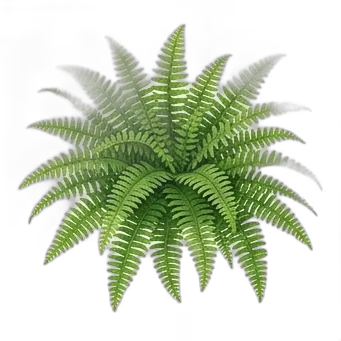
In its natural habitat—spanning humid tropical and subtropical regions worldwide, including Florida, Mexico, Central America, South America, the West Indies, and parts of Africa and Polynesia—Nephrolepis exaltata is primarily epiphytic or terrestrial. It thrives in deeply shaded hammocks, riverbanks, and swamp margins where it receives filtered, high-intensity indirect light through a dense forest canopy.
Morphologically, the Boston fern features arching, lance-shaped fronds that can grow from 16 to 35 inches (40 to 90 cm) in length, composed of numerous small, overlapping pinnae (leaflets). Unlike many other ferns, Nephrolepis exaltata spreads aggressively via underground stolons or runners, allowing it to form dense colonies across the forest floor or grip the rough bark of tropical trees. The root system is shallow, featuring fine, fibrous roots that require consistent moisture and high oxygenation. Understanding this wild origin is the single greatest key to mastering its cultivation: it expects constant humidity, damp roots that never sit in stagnant mud, and protection from scorching, direct sunlight.
2. Essential Environmental & Care Requirements
Recreating a tropical swamp microclimate inside a modern home requires precision. Let us look at the exact environmental parameters necessary to keep Nephrolepis exaltata pristine.
| Parameter | Optimal Condition | Common Mistake | Why It Matters |
|---|---|---|---|
| Light | Bright, indirect light (10,000 to 15,000 lux) | Placing in direct midday sun or deep dark corners | Direct sun scorches delicate frond tissues; too little light halts photosynthesis and stunts frond production. |
| Temperature | 65°F to 75°F (18°C to 24°C) | Exposure to drafts below 55°F (13°C) or AC vents | Sudden temperature shocks trigger massive frond drop and cellular collapse. |
| Humidity | 60% to 80% relative humidity | Placing near heating vents or dry indoor air | Low humidity causes rapid transpiration, resulting in crisp brown leaf tips and dry pinnae. |
| Watering | Evenly moist; water when top 0.5 inches (1.2 cm) dries | Allowing root ball to dry out completely or waterlogging | Boston ferns have zero drought tolerance; severe drying kills the fine root hairs permanently. |
| Soil Mix | Rich, organic, highly porous (peat, perlite, compost) | Heavy, compacted garden soil or pure sand | Roots require high air-filled porosity; compacted soil suffocates the root system and breeds pathogens. |
Beyond these environmental factors, feeding must be managed carefully. Because these ferns grow rapidly during spring and summer, they appreciate regular, diluted nutrition. Feed every 30 days during the active growing season (April through September) using a balanced, water-soluble liquid fertilizer formulated for foliage plants, diluted to half-strength (e.g., 10-10-10 N-P-K at 1/2 recommended dose). Never fertilize a dry fern or a dormant plant in winter, as excess mineral salts will rapidly burn the delicate, shallow root system.
For deeper reading on fern biology and regional adaptability, consult the University of Florida IFAS Extension publications on tropical foliage care.
3. Step-by-Step Cultivation, Feeding & Propagation
Propagating and repotting Nephrolepis exaltata is straightforward because the plant actively tells you when it is ready. Follow this strict protocol to successfully divide and repot an established Boston fern.
- Select the Optimal Window: Perform repotting and division in early spring (March to April) just as new fiddleheads (croziers) begin to emerge from the crown.
- Water the Plant Thoroughly: Water your fern deeply 24 hours before the operation to ensure the root tissues are fully turgid and minimize transplant shock.
- Extract and Inspect: Gently slide the fern out of its current container. Shake away excess, loose soil and examine the root ball. Locate the natural divisions where multiple crowns have formed alongside trailing stolons.
- Divide the Crown: Using a sterile, sharp knife or pruning shears, cut cleanly through the central rhizome mass, ensuring each divided section contains at least 3 to 4 healthy growing crowns and an intact root system.
- Prepare the Container and Medium: Select a pot only 1 to 2 inches (2.5 to 5 cm) wider than the root mass of the division. Use a sterile potting mix composed of 50% high-quality sphagnum peat moss, 25% perlite or coarse horticultural sand, and 25% organic leaf mold or compost.
- Plant at the Correct Depth: Set the division into the new pot so that the top of the root crown sits level with or slightly above the soil surface. Planting too deeply will cause the crown to rot.
- Post-Propagation Care: Water the newly potted division thoroughly to settle the soil. Place it in bright, indirect light with a humidity tent or clear plastic bag draped loosely over the top for 14 days to lock in moisture while new root hairs establish. Remove the plastic once active new frond growth is observed.
💡 Pro-Tip: When potting a Boston fern, mix a handful of horticultural charcoal into your soil blend. It sweetens the medium, prevents anaerobic souring from constant moisture, and absorbs excess mineral salts before they can burn the fern's sensitive roots.
4. Common Problems, Pests & Troubleshooting
Even experienced growers encounter issues with Boston ferns because their environmental tolerances are narrow. Here is how to diagnose and correct the most frequent problems.
- Massive Frond Drop & Crispy Brown Tips: This is almost always caused by a drop in relative humidity below 40%, combined with irregular watering. Correction: Move the plant away from drafty windows, forced-air heating vents, and air conditioners. Set the pot on a wide pebble tray filled with water, ensuring the bottom of the pot stays above the water line, or run a dedicated cool-mist humidifier nearby.
- Yellowing Fronds with Soft, Mushy Stems: This points directly to overwatering or poorly draining soil. If the roots sit in stagnant moisture, anaerobic bacteria take over, causing root rot. Correction: Cease watering immediately. Unpot the plant, trim away black, decaying roots with sterilized shears, and repot into fresh, highly porous, well-draining media.
- Pale, Stretched Fronds Lacking Vigor: Insufficient light is the culprit. Correction: Gradually transition the plant to a location receiving brighter, indirect light, such as an unobstructed east-facing window or a few feet back from a south-facing window.
- Pest Infestations (Spider Mites & Mealybugs): Dry indoor air during winter creates ideal breeding conditions for two-spotted spider mites (Tetranychus urticae), which spin fine webs under the pinnae. Mealybugs may hide deep within the dense central crown. Correction: Immediately isolate the plant. Wash the entire foliage thoroughly under a lukewarm shower or sink spray to physically dislodge pests. Follow up by spraying every surface with insecticidal soap or horticultural oil (Neem oil), repeating the treatment every 7 days for a 21-day cycle to disrupt the pest reproductive life cycle.
⚠️ Important Caution: Never use commercial leaf shine products or heavy chemical hydrocarbon sprays on Nephrolepis exaltata. Their frond tissues are exceptionally thin and porous; oil-based shines will clog the stomata, block gas exchange, and cause the entire frond to blacken and die within days.

5. Frequently Asked Questions
Why is my Boston fern turning brown and dropping leaves?
The primary driver of sudden browning and leaf drop is environmental shock, usually stemming from low humidity, underwatering, or exposure to cold drafts. Boston ferns transpire moisture rapidly through their dense fronds. When the ambient humidity drops below 50% or the root ball dries out completely even once, the plant sacrifices its oldest outer fronds to conserve moisture. Check your watering cadence and elevate local humidity immediately.
How do I revive a dying Boston fern that has lost all its fronds?
If the above-ground fronds have completely turned brown and died, check the central crown and root ball. As long as the root mass remains firm and white-to-tan (rather than black and mushy) and the central rhizomes are plump, the plant is still alive. Cut all dead fronds back to approximately 1 inch (2.5 cm) above the soil line using sterile shears. Move the pot to a warm, humid location with bright indirect light, water it sparingly until new growth emerges, and watch as fresh fiddleheads push through the soil within 14 to 30 days.
Are Boston ferns toxic to cats and dogs?
No. According to the ASPCA toxicity database, Nephrolepis exaltata is entirely non-toxic to cats, dogs, and horses. You can safely hang these ferns or place them on low plant stands without worrying about your pets developing gastrointestinal distress if they happen to nibble on the dangling fronds.
Can Boston ferns survive outdoors during the winter?
It depends entirely on your USDA Hardiness Zone. Boston ferns are reliably perennial only in USDA Zones 10 through 12, where temperatures never drop below 30°F (-1°C). In colder climates (Zones 3 through 9), they must be treated as patio annuals or brought indoors well before the first autumn frost, when nighttime temperatures consistently dip below 50°F (10°C).
📋 Table of Contents ▼ Click to expand
Tags: