

Birds Nest Fern
Asplenium nidus
The water was lukewarm and running slow through the kitchen sink nozzle when I first noticed the dark, scaly tunnels weaving through the organic matter at the base of my Asplenium nidus. I had brought the plant home from a nursery in downtown Seattle three months prior, captivated by its chartreuse fronds unfurling like glossy ribbons from a dark, velvety center. But in my dry, centrally heated apartment, I had let the crown stay too wet while ignoring the thirsty root ball beneath. That afternoon, I learned the most vital lesson of bird's nest fern cultivation: this epiphyte demands a delicate equilibrium between atmospheric moisture and pristine crown hygiene.

1. Botanical Overview & Natural Habitat
The bird's nest fern (Asplenium nidus) belongs to the family Aspleniaceae and is native to the warm, humid tropical rainforests of Southeast Asia, tropical Australia, Polynesia, and East Africa. In its native habitat, it is predominantly an epiphyte or lithophyte. This means it does not root into the forest floor soil; instead, it uses its short, woody rhizomes to anchor itself high up in the crotches of tree branches or upon mossy rock faces, where organic debris accumulates.
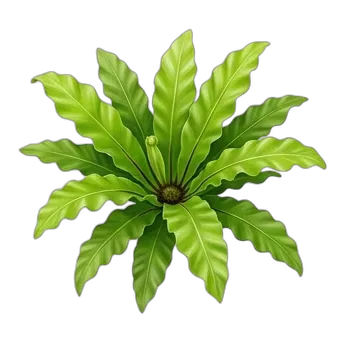
Morphologically, the bird's nest fern is unmistakable. It produces an upright, rigid rosette of simple, undivided fronds that emerge from a central, fuzzy crown—the feature that gives the plant its common name, as the entire structure resembles a giant bird's nest. These fronds are characteristically bright green, leathery in texture, and feature a prominent black or dark brown midrib that runs down the underside.
| Parameter | Optimal Condition | Common Mistake | Why It Matters |
|---|---|---|---|
| Light | Bright, indirect light (10,000 to 15,000 lux) | Direct, hot afternoon sun | Causes scorching, bleaching, and irreversible tissue necrosis on delicate fronds. |
| Temperature | 65°F to 80°F (18°C to 27°C) | Temperatures dropping below 50°F (10°C) | Induces severe chilling injury, metabolic shutdown, and eventual plant collapse. |
| Humidity | 60% to 80% relative humidity | Dry indoor air (< 40% humidity) | Results in brown, crispy frond margins and stunted, distorted new growth. |
| Soil pH | 5.5 to 6.5 (slightly acidic) | Highly alkaline or compacted soil | Locks out essential micronutrients like iron and suffocates epiphytic roots. |
In the wild, the upward-facing rosette acts as an ingenious funnel. It catches falling leaf litter, bird droppings, and rainwater, which decompose directly inside the "nest" to feed the plant. This evolutionary adaptation means your indoor specimen relies heavily on proper watering technique and a loose, highly aerated root zone that mimics a jungle canopy. For deeper reading on epiphytic plant physiology, consult the Royal Botanic Gardens, Kew.
2. Essential Environmental & Care Requirements
Replicating a tropical rainforest canopy inside a modern home or office requires a targeted approach to light, moisture, and airflow.
Light Requirements
Provide your bird's nest fern with bright, indirect light. An unobstructed east-facing window or a spot set 3 to 5 feet back from a south- or west-facing window is ideal. While they can tolerate lower-light environments (down to about 500 lux), growth will slow dramatically, and fronds will lose their vibrant, glossy sheen. Never expose Asplenium nidus to direct midday sun; the rays will scorch the tender, unfolding fronds within hours, leaving permanent brown patches.
Temperature and Air Circulation
Maintain ambient temperatures between 65°F and 80°F (18°C to 27°C) year-round. Protect the plant from sudden drafts, air conditioning vents, and heating grates, which cause rapid moisture loss in the foliage. Gentle, circulating air is beneficial as it prevents fungal spores from settling in the dense crown, but high-velocity wind from a fan will tear the delicate frond tips.
Watering and Humidity
Watering is where most growers fail. You must water the potting medium thoroughly whenever the top 1 to 2 inches (2.5 to 5 cm) feel dry to the touch. However, never pour water directly into the center of the crown. The tightly packed, overlapping bases of new fronds trap moisture, making the stagnant center a prime breeding ground for fungal and bacterial rots. Instead, water the soil directly around the perimeter of the pot until excess water drains freely from the bottom.
Relative humidity should remain above 60%. If your home dips below this threshold during winter heating seasons, run an ultrasonic humidifier within 3 feet (1 meter) of the plant. Grouping your Asplenium nidus with other tropical plants also creates a beneficial microclimate.
💡 Pro-Tip: When dealing with low indoor humidity, avoid misting the fronds of your bird's nest fern. Misting only provides temporary moisture and leaves water droplets trapped in the crown or on the leaf surfaces, which heavily encourages foliar diseases like Pseudomonas bacterial blight. Use a room humidifier instead.
3. Step-by-Step Cultivation, Feeding & Propagation
Repotting and propagating Asplenium nidus requires care to avoid damaging the sensitive root system and central growing point. Because these plants are slow-growing epiphytes, they only need repotting every 2 to 3 years, preferably in the spring as active seasonal growth resumes.
Step-by-Step Repotting Guide
- Select the container: Choose a pot that is only 1 to 2 inches (2.5 to 5 cm) wider in diameter than the current root ball. Bird's nest ferns prefer a slightly root-bound state and will suffer if placed in an oversized pot that holds excess moisture.
- Mix the substrate: Create an open, well-aerated epiphytic potting mix. Combine 40% high-quality peat-based potting soil, 30% coarse orchid bark (0.25 to 0.5 inches / 0.6 to 1.3 cm), and 30% perlite or horticultural charcoal. This ensures high porosity and prevents root suffocation.
- Unpot the plant: Gently ease the fern out of its current container. Use your fingers to lightly brush away old, compacted soil from the outer edges of the root mass, taking care not to tear the fine, hair-like roots.
- Position at the correct depth: Place fresh soil mix in the bottom of the new container. Position the fern so that the base of the crown sits slightly above the soil surface level. Burying the crown too deep is the leading cause of post-transplant rot.
- Fill and settle: Fill the surrounding gaps with your custom soil mix, pressing down gently with your fingers to eliminate large air pockets. Water the plant thoroughly with tepid water around the outer edges of the pot to settle the soil around the roots.
Fertilization Protocol
Feed your bird's nest fern sparingly. During the active growing season (spring through summer), apply a balanced, water-soluble foliage houseplant fertilizer diluted to one-quarter strength once every 4 weeks. Flush the soil thoroughly with plain water every 3 months to wash away built-up mineral salts that can burn the root tips. Cease all fertilization entirely from late autumn through winter when the plant enters dormancy.
⚠️ Important Caution: Never use chemical leaf shine products on the glossy fronds of an Asplenium nidus. These oily substances clog the stomata (breathing pores) on the leaf surface, suffocating the plant tissue and causing the fronds to yellow, turn brown, and die prematurely. Clean dust off fronds using only a soft, damp microfiber cloth.
4. Common Problems, Pests & Troubleshooting
Even with optimal care, indoor environments present challenges. Recognizing early warning signs saves plants from decline.
Environmental Issues
- Brown, crispy frond tips: Caused by chronically low relative humidity or under-watering. Increase ambient humidity immediately and ensure your watering schedule keeps the root zone consistently moist without becoming soggy.
- Yellowing fronds: Lower, older fronds naturally turn yellow and die as the plant ages—this is normal. However, if multiple fronds yellow simultaneously, it indicates overwatering, root rot, or severe nutrient deficiency. Inspect the roots; healthy roots are firm and pale, while rotting roots are black, mushy, and foul-smelling.
- Pale, bleached fronds with brown patches: Direct sun exposure has burned the tissue. Relocate the fern to a spot receiving softer, indirect illumination.
Pests and Diseases
- Scale Insects: These stationary pests appear as small, brown, bump-like shields along the prominent midribs on the undersides of the fronds. They feed on plant sap, secreting sticky honeydew. Wipe them off manually using a cotton swab dipped in 70% isopropyl alcohol, then treat the plant with horticultural insecticidal soap.
- Fungus Gnats: Tiny black flies hovering around the soil surface indicate that the topsoil is staying too wet. Allow the top 2 inches (5 cm) of the medium to dry out completely between waterings, and apply Bacillus thuringiensis israelensis (BTI) to eliminate the larvae.
- Rhizome and Crown Rot: Triggered by overwatering and poor drainage combined with water sitting in the crown. Affected tissue turns dark brown and mushy. Trim away all infected tissue with sterilized pruning shears, dust the cuts with cinnamon or powdered sulfur as a natural fungicide, and repot into fresh, sterile, dry-leaning media.

5. Frequently Asked Questions
Why are the new fronds on my bird's nest fern coming out deformed or crinkled?
Deformed or crinkled new growth is almost always a symptom of mechanical damage to the emerging fiddlehead while it was tightly wrapped in the crown, or severe underwatering during the frond's expansion phase. It can also indicate a mild thrips infestation feeding on the tender unfolding tissue. Check the emerging fronds closely with a magnifying glass for tiny, slender insects. If pests are absent, ensure consistent soil moisture and protect the fragile crown from physical bumps.
Can I propagate a bird's nest fern by dividing the crown?
Unlike many clumping houseplants, Asplenium nidus features a single central growing point (crown) and does not naturally produce offshoots or pups. Therefore, you cannot propagate it through simple root division without destroying the mother plant. In commercial settings, they are propagated via spores, which is an extremely technical, slow, and labor-intensive process requiring sterile laboratory conditions over many months. For home growers, it is best enjoyed as a single, magnificent specimen plant.
Why is my bird's nest fern dropping spores on my furniture?
If you notice fine, rusty-brown dust accumulating on the surfaces beneath your fern, these are spores, not dirt or pests. True to their botanical classification, mature ferns reproduce via spores rather than seeds. They develop in linear patterns (sori) along the veins on the undersides of older, mature fronds. This is a completely natural biological process and a sign of a healthy, mature plant. You can simply wipe them away with a damp cloth.
Is the bird's nest fern toxic to cats and dogs?
No, the bird's nest fern (Asplenium nidus) is completely non-toxic to cats, dogs, and horses, according to the ASPCA. This makes it an exceptional, worry-free choice for pet owners who want to introduce lush, tropical greenery into pet-accessible spaces in their homes.
📋 Table of Contents ▼ Click to expand
Tags:





