
Bird of Paradise
Strelitzia reginae
1. Botanical Overview & Natural Habitat

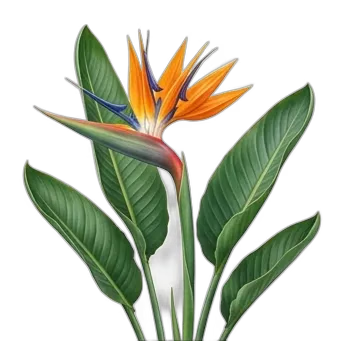
In its native habitat, the plant experiences warm, humid summers paired with cooler, drier winters—environmental nuances that directly trigger its reproductive cycle. Botanically, the plant lacks a true aerial woody stem; instead, it develops underground rhizomes and pseudostems formed by tightly overlapping leaf bases. The leaves are leathery, glaucous-green, oblong, and measure up to 18 inches (45 cm) in length and 6 inches (15 cm) in width, borne on sturdy petioles that can stretch up to 3 feet (90 cm) long.
The inflorescence is a masterpiece of co-evolution. It features a horizontal, boat-shaped green-and-red spathe (the bird’s "beak") from which individual flowers emerge sequentially. Each flower consists of three brilliant orange sepals and three vivid blue petals, two of which are fused into an arrow-like nectary. In nature, sunbirds attracted to the copious nectar step onto this floral platform, depressing the petals to dust their feet with pollen, which they then carry to the next bloom. For a deeper botanical breakdown of the Strelitzia genus, consult the Royal Botanic Gardens, Kew.
2. Essential Environmental & Care Requirements
Replicating a South African coastal microclimate indoors or in a Mediterranean landscape requires balancing light, soil composition, thermal thresholds, and moisture dynamics.
| Parameter | Optimal Condition | Common Mistake | Why It Matters |
|---|---|---|---|
| Light | 6+ hours of direct sun daily; bright indirect indoors | Placing in deep interior shade | Without high-intensity light, the plant will produce leaves but fail to initiate flower spikes. |
| Temperature | 65°F–85°F (18°C–29°C) active; drops to 50°F (10°C) winter | Exposing to hard freezes below 30°F (-1°C) | Temperatures below freezing turn foliage to mush and rot the underground rhizome structure. |
| Soil pH | 5.5 to 6.5 (slightly acidic to neutral) | Heavy, waterlogged clay soils | Poorly drained media suffocates the thick, fleshy roots, quickly triggering root rot pathogens. |
| Humidity | 50% to 60% relative humidity | Mist-only routines in dry winter air | Low humidity causes unsightly brown, curling tips on the otherwise pristine leaf margins. |
Watering strategy dictates whether your Strelitzia stays compact and robust or stretches out and rots. During the peak growing season from spring through late summer, water deeply until moisture runs out of the container’s drainage holes, then allow the top 2 to 3 inches (5 to 7.5 cm) of soil to dry out completely before irrigating again. In the winter rest period, reduce watering frequency by half, keeping the root ball merely damp.
💡 Pro-Tip: If you are growing Strelitzia reginae in a container to chase blooms, do not rush to up-pot it. Bird of Paradise actually flowers most reliably and abundantly when its thick, tuberous roots are slightly root-bound and restricted within the pot. Scale up pot size by only 2 inches (5 cm) at a time, and only when roots begin lifting the plant out of the soil.
3. Step-by-Step Cultivation, Feeding & Propagation
Establishing a healthy Bird of Paradise specimen requires meticulous attention during planting and seasonal maintenance. Whether setting out a young division or starting fresh, follow this precise sequence for long-term success.
- Select and Prepare the Container or Site: Choose a heavy terra-cotta or resin container with a drainage hole at least 14 inches (35 cm) wide, or select an outdoor landscape bed amended with coarse horticultural sand and compost to ensure rapid drainage.
- Mix the Soil Medium: Combine 40% high-quality organic potting soil, 30% coarse perlite or pumice for aeration, and 30% well-aged compost to provide a nutrient-rich, fast-draining matrix.
- Plant at the Correct Depth: Position the root ball so the crown sits level with or slightly above the soil surface. Planting too deep invites stem rot around the overlapping leaf bases.
- Initial Watering and Settlement: Water the newly planted specimen thoroughly with 70°F (21°C) water to settle the soil particles around the roots, letting excess water drain away completely.
- Establish a Feeding Regimen: From early spring through late summer, feed every 14 days using a balanced, water-soluble fertilizer formulated for tropicals (such as a 10-10-10 or 20-20-20 analysis) diluted to half-strength. Supplement with a granular slow-release formulation containing micronutrients every 90 days.
- Winter Rest Period: Cease all fertilizer applications from October through February to allow the plant to enter a necessary semi-dormant phase.
Propagation is primarily achieved through root division rather than seed, as division preserves the exact traits of the parent plant and flowers years earlier.
⚠️ Important Caution: When dividing mature clumps of Strelitzia reginae, use a sterilized, sharp pruning saw or a heavy blocking knife to cut through the woody, interlocking rhizomes. Never simply yank or pull offsets apart; jagged tears open the plant to opportunistic fungal pathogens like Fusarium and Pythium, which can rapidly decimate the root system.
For academic insights into tropical plant propagation and physiological responses, reference the University of Florida IFAS Extension.
4. Common Problems, Pests & Troubleshooting
Even with meticulous care, environmental shifts or pest pressures can cause physical symptoms on your Strelitzia. Learning to read these visual cues prevents minor issues from becoming structural failures.
- Split Leaves: Homeowners often worry when the massive paddle leaves tear along the lateral veins. This is entirely natural. In its native windy habitats, leaf-splitting reduces wind resistance, preventing the heavy petioles from snapping off at the base. It is not a sign of poor health.
- Yellowing Lower Leaves: Older foliage naturally yellows and dies off as the plant pushes energy upward. However, if multiple leaves turn yellow simultaneously and feel mushy, you are overwatering, or the soil has compacted to the point of anaerobic decay. Pull back on irrigation and inspect the root zone.
- Brown, Crispy Leaf Margins: Caused by low relative humidity or chemical buildup from hard tap water containing high levels of salts, fluoride, or chlorine. Flush the soil thoroughly every 6 to 8 weeks with distilled water to leach out excess minerals.
- Mealybugs and Scale: These sap-sucking insects frequently hide deep within the overlapping leaf sheaths and beneath the spathes. Treat infestations immediately by wiping the surfaces with a 70% isopropyl alcohol solution on a cotton swab, followed by a thorough dabbing of horticultural neem oil.

5. Frequently Asked Questions
Why won't my Bird of Paradise bloom?
The most common culprit is insufficient light. Strelitzia reginae requires intense, direct sunlight to trigger flowering; plants kept in dim indoor corners remain in a perpetual vegetative state. Additionally, plants that are too young (under 3 to 5 years old) or those living in pots that are excessively large will prioritize root and leaf expansion over flower production. Ensure your plant gets direct sun and experiences a slight winter cooling period.
How do I prune damaged or old leaves?
Wait until the leaf petiole has turned completely brown and dry, or use sterilized bypass pruners to cut the stem cleanly about 2 to 3 inches (5 to 7.5 cm) away from the main vertical stalk. Avoid cutting into the green pseudostem tissue, as this creates a wound that invites rot and mars the plant's structural silhouette.
Are Bird of Paradise plants toxic to pets?
Yes. According to the ASPCA, Strelitzia reginae contains tannins and other irritants concentrated primarily in the seeds and flowers, though the leaves can also cause mild to moderate toxicity. Ingestion by cats, dogs, or horses typically results in vomiting, excessive drooling, lethargy, and mild gastrointestinal distress. Keep plants out of reach of curious domestic animals.
How big does a potted Bird of Paradise get?
While a landscape specimen in frost-free climates can easily reach 5 to 6 feet (1.5 to 1.8 meters) in height and spread, container cultivation naturally limits its expansion. Indoors, expect your plant to top out between 4 and 6 feet (1.2 to 1.8 meters) tall with a spread of 3 to 4 feet (0.9 to 1.2 meters), provided you maintain it in an appropriately sized pot and prune spent basal shoots.
📋 Table of Contents ▼ Click to expand
Tags: