

Polka Dot Begonia
Begonia maculata
The condensation on the inside of my propagation cloche was so thick I couldn't see the shimmering silver spots pressed against the glass. It was my third attempt at rooting a Begonia maculata cutting back in 2014, and after losing two previous stems to rot in heavy commercial potting soil, I had finally adjusted the perlite ratio high enough to let the roots breathe. When I gently lifted the dome and felt the firm resistance of white roots clutching a 2-inch net pot, I knew I had unlocked the stubborn rhythm of this extraordinary Brazilian native.
1. Botanical Overview & Natural Habitat

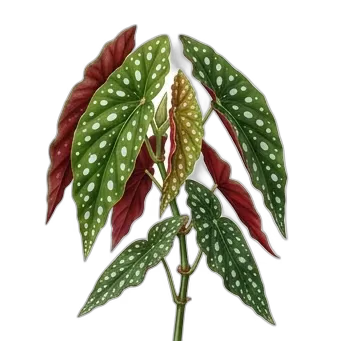
Botanically, Begonia maculata is an evergreen, perennial cane begonia characterized by its distinctively jointed, bamboo-like stems. These stems can reach heights of 3 to 5 feet (90 to 150 cm) indoors when provided with adequate vertical support. The leaves are the primary attraction: asymmetrical, oblong-to-lanceolate shapes measuring 4 to 8 inches (10 to 20 cm) in length, featuring a deep olive-green to forest-green upper surface punctuated by distinctive, silvery-white circular spots. Turn a leaf over, and you are greeted by a striking, deep-crimson underside that protects the foliage from intense UV radiation by reflecting light back through the chloroplasts.
During its active growing season, the plant produces pendulous cymes of delicate, coral-pink to white flowers that dangle like tiny porcelain ornaments. Unlike many tropical houseplants that rely strictly on vegetative growth, Begonia maculata blooms readily indoors if light and temperature thresholds are met.
For a broader scientific classification and historical context of the genus, you can consult the Royal Horticultural Society Plant Finder.
2. Essential Environmental & Care Requirements
Replicating the Brazilian rainforest canopy within a modern home or greenhouse requires a careful balance of environmental factors. Because Begonia maculata sits at the intersection of delicate foliage and robust woody canes, minor miscalculations in watering or light can quickly manifest as cosmetic or structural decline.
| Parameter | Optimal Condition | Common Mistake | Why It Matters |
|---|---|---|---|
| Light | Bright, indirect light (10,000–15,000 lux) | Direct midday sun | Direct rays scorch the thin leaf epidermis, causing brown, papery necrosis. |
| Temperature | 65°F to 80°F (18°C to 27°C) | Exposure below 55°F (13°C) | Chilling temperatures halt metabolic processes and trigger rapid defoliation. |
| Humidity | 50% to 70% relative humidity | Dry air (below 40%) | Low moisture causes leaf tips to brown and curl, stunting new growth points. |
| Watering | Dry to 50% depth, then saturate | Keeping soil constantly soggy | Over-saturation starves roots of oxygen, rapidly inducing Pythium root rot. |
Light is perhaps the most frequent point of failure. While the plant tolerates lower light levels, growth becomes spindly, stems stretch dangerously, and the signature white dots fade in intensity. Place your begonia within 3 to 5 feet of an east- or north-facing window, or provide artificial full-spectrum LED lighting delivering a minimum of 1,200 lumens for 12 hours daily.
Substrate selection dictates watering success. Standard, dense peat mixes retain too much water around the delicate root system. Formulate a custom blend using 40% high-grade sphagnum peat moss, 30% coarse perlite or pumice, and 30% orchid bark or horticultural charcoal. This ensures high air porosity while maintaining a slight moisture retention buffer.
💡 Pro-Tip: When checking soil moisture, never rely solely on surface feel. Insert a plain wooden chopstick 3 inches (7.5 cm) down into the root ball, leave it for 10 seconds, and pull it out. If soil particles cling to the wood or the wood has darkened significantly from moisture, withhold water for another 48 hours.
3. Step-by-Step Cultivation, Feeding & Propagation
Maintaining a vigorous, bushier Begonia maculata requires an active approach to pruning and targeted nutrition. Because cane begonias naturally grow upward and can become top-heavy, strategic pruning encourages basal branching from dormant nodes near the soil line.
Here is the exact propagation protocol I use to turn a single leggy stem into a dense, multi-stemmed specimen:
- Select and Sanitize: Sterilize a pair of sharp bypass pruners using isopropyl alcohol (70% concentration) to prevent pathogen transfer. Choose a healthy cane with at least three visible leaf nodes.
- Execute the Cut: Make a clean, 45-degree angle cut approximately 0.25 inches (0.6 cm) below a lower node. Ensure the cutting length is roughly 4 to 6 inches (10 to 15 cm) long, retaining 2 to 3 upper leaves.
- Apply Rooting Hormone (Optional): Dip the basal cut end lightly into rooting hormone powder containing indole-3-butyric acid (IBA) to accelerate callus formation and primary root emergence.
- Choose the Medium: Insert the stem cutting 1.5 inches (3.8 cm) deep into a pre-moistened medium of 50% perlite and 50% vermiculite or directly into clean, filtered water changed weekly.
- Establish High Humidity: Enclose the potted cutting inside a clear polyethylene bag or propagation dome to trap ambient moisture, maintaining an internal humidity level above 80% and temperatures around 72°F to 75°F (22°C to 24°C).
- Monitor Root Development: Roots typically emerge within 21 to 28 days. Once secondary roots reach a length of 1 inch (2.5 cm), transplant the cutting into a permanent 4-inch (10 cm) container using your specialized soil blend.
Feeding should be approached with caution. Begonia maculata possesses a sensitive root system that easily suffers from fertilizer burn. During the active growing season from spring through early autumn, apply a balanced, water-soluble fertilizer (such as a 10-10-10 or 20-20-20 formulation) diluted to one-quarter strength every 3 to 4 weeks. Cease all fertilization completely from late November through February when natural photoperiods shorten and growth naturally pauses.
4. Common Problems, Pests & Troubleshooting
Even under optimal conditions, environmental fluctuations or pest incursions can compromise your Begonia maculata. Quick identification is the difference between a minor setback and plant mortality.
- Leaf Drop: Sudden dropping of green or slightly yellowed leaves almost always points to a drastic temperature drop, cold draft from a window, or severe underwatering followed by a heavy flood. Stabilize ambient temperatures and maintain a consistent watering cadence.
- Crispy Brown Leaf Margins: Low humidity or erratic watering intervals cause the delicate cell walls at the leaf edges to collapse. Increase local humidity using an ultrasonic cool-mist humidifier rather than misting the leaves directly, which invites fungal spores.
- Powdery Mildew (Erysiphe species): Appears as a white, talcum-powder-like substance on the upper and lower leaf surfaces, typically triggered by stagnant air combined with high humidity and cool temperatures. Improve air circulation immediately with a small oscillating fan, remove heavily infected leaves, and spray thoroughly with a horticultural oil or potassium bicarbonate solution.
- Spider Mites (Tetranychus urticae): Tiny, sap-sucking arachnids that thrive in warm, dry indoor air. Look for fine webbing on the undersides of leaves and a stippling, chlorotic appearance on the upper surface. Wash the foliage down in a sink or shower, then apply insecticidal soap or neem oil every 7 days for three consecutive cycles to break the hatching lifecycle.
⚠️ Important Caution: Begonia maculata contains soluble calcium oxalate crystals throughout its stems, leaves, and roots. When chewed or ingested by cats, dogs, or humans, these needle-like crystals release mechanical irritation, resulting in intense burning of the mouth, excessive drooling, and vomiting. Keep your plants elevated and out of reach of curious household pets.

5. Frequently Asked Questions
Why are the leaves on my Polka Dot Begonia turning yellow?
Yellowing leaves are primarily caused by overwatering, which suffocates the root system and prevents nutrient uptake. Check the soil moisture deeper in the pot; if it is soggy, allow it to dry out significantly and adjust your watering frequency. Yellowing can also be a sign of natural aging for the lowest, oldest leaves on the cane, or a deficiency in nitrogen if the plant has not been fertilized in several months.
How do I make my Polka Dot Begonia branch out?
Cane begonias naturally grow tall and upright before producing multiple side shoots. To force bushier growth, pinch or prune the growing tip of the main stem just above a leaf node. This disrupts the plant's apical dominance, redirecting auxin hormones to activate dormant nodes lower down on the cane, which will soon push out fresh secondary stems.
Can I grow Begonia maculata in water permanently?
While Begonia maculata cuttings root readily in water, growing them long-term in plain water is not recommended. Water lacks the structural support, oxygen availability, and essential macronutrients found in soil or chunky potting mixes. Plants kept in water indefinitely will eventually develop weak, water-adapted roots, exhibit slow growth, and become nutrient-deficient. Transition your water-propagated cuttings into a soil or a chunky aroid mix once roots hit 1 inch (2.5 cm) in length.
Why are the silver spots fading on my begonia leaves?
Fading spots are almost always a direct symptom of insufficient light exposure. When the plant receives too little light, it attempts to maximize its photosynthetic surface area by producing more chlorophyll across the entire leaf blade, drowning out the silvery, light-reflecting cells. Move your plant closer to a bright, indirect light source, and you should see the high-contrast contrast return on all newly emerging foliage.
📋 Table of Contents ▼ Click to expand
Tags:





