
Ponytail Palm
Beaucarnea recurvata

1. Botanical Overview & Natural Habitat
Despite its common name, the ponytail palm is not a true palm (Arecaceae family) at all. It belongs to the asparagus family (Asparagaceae) and is scientifically classified as Beaucarnea recurvata (formerly Nolina recurvata). Native to the semi-arid, scrub-forest regions of southeastern Mexico—particularly Veracruz, Tamaulipas, and San Luis Potosí—this succulent tree evolved in conditions defined by scorching dry seasons punctuated by intense, brief torrential rains.
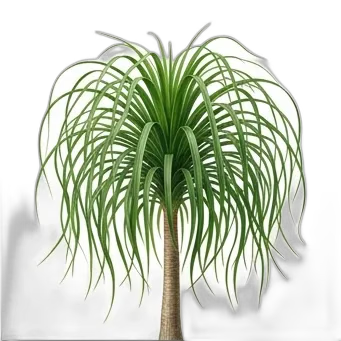
The plant's defining morphological feature is its swollen basal stem, known as a caudex. This woody, water-storing bulbous trunk acts as an internal reservoir, allowing the plant to survive extended droughts in its native limestone-rich, rocky soils. Atop this single or occasionally branching trunk emerges a rosette of long, flexible, linear leaves that arch gracefully downward, creating the signature "ponytail" silhouette.
In its natural habitat, Beaucarnea recurvata can mature into a small tree reaching heights of 30 feet (9 meters) with a base spanning 6 to 10 feet (1.8 to 3 meters). When grown indoors as a houseplant, container confinement restricts its size, typically capping vertical growth between 3 to 6 feet (0.9 to 1.8 meters) over many decades. Slow-growing and remarkably long-lived, a healthy ponytail palm is an architectural statement piece that can easily outlive its caretaker.
| Parameter | Optimal Condition | Common Mistake | Why It Matters |
|---|---|---|---|
| Light Exposure | Bright, direct sunlight; minimum 6 hours daily. | Placing in a dark northern window or dim interior corner. | Low light leads to etiolation, weak, stretched leaves, and permanently waterlogged soil due to reduced transpiration. |
| Soil Composition | Gritty, fast-draining succulent or cactus mix (pH 6.0–7.5). | Using dense, organic-heavy potting soil or garden loam. | Heavy soils retain moisture too long, suffocating roots and inviting fungal pathogens that rot the caudex. |
| Watering Frequency | Soak thoroughly only when the soil is 100% dry to a depth of 3 inches (7.6 cm). | Watering on a strict calendar schedule (e.g., every 7 days). | Overwatering causes the caudex to burst or rot from the inside out; underwatering stunts frond production. |
| Temperature Range | 65°F to 85°F (18°C to 29°C) actively; tolerates drops to 40°F (4°C). | Exposing to sudden frost or freezing temperatures below 32°F (0°C). | Freezing turns the water-dense caudex to mush, killing the plant instantly. |
2. Essential Environmental & Care Requirements
Mastering ponytail palm care requires understanding its evolutionary adaptations. Because it evolved under blazing Mexican sun, it craves high light intensities. Position your plant directly in front of a south-facing or west-facing window where it can receive unobstructed sunlight for several hours a day. While it adapts to medium-light indoor environments, its growth will slow to a crawl, and its leaves will become thinner and less vibrant.
Temperature management is straightforward, as indoor climates generally mirror their comfort zone. They thrive in normal room temperatures between 65°F and 85°F (18°C to 29°C). If you choose to move your ponytail palm outdoors for the summer months—a practice I highly recommend for vigorous growth—gradually acclimate it to direct sunlight over 14 days to prevent sunburn on the foliage.
Humidity is rarely an issue. Beaucarnea recurvata handles dry indoor winter heating with absolute ease, requiring no misting or pebble trays. In fact, excessive ambient humidity combined with stagnant air is far more dangerous than dry air.
Watering is where most growers stumble. You must treat this plant like a desert succulent. Allow the potting medium to dry out completely throughout the entire depth of the container. When you do water, drench the soil until water flows freely out of the drainage holes, then empty the saucer immediately. Never let the pot sit in standing water. During the active growing season (spring and summer), watering every 14 to 21 days is typical. In the winter dormancy period, stretch watering intervals to every 30 to 45 days.
For deeper insights into arid landscape adaptation and regional cultivation guidelines, consult the University of Florida IFAS Extension.
💡 Pro-Tip: When checking soil dryness, don't rely on your finger alone. Push a wooden dowel or a bamboo chopstick 3 inches (7.6 cm) into the soil mix. Pull it out after 10 seconds. If any damp soil clings to the wood or if it feels cool and dark, hold off on watering for another week.
3. Step-by-Step Cultivation, Feeding & Propagation
Repotting and propagating ponytail palms requires a delicate touch and an understanding of their root architecture. Their root systems are surprisingly shallow and delicate compared to the mass of the trunk.
Step-by-Step Repotting & Propagation Protocol
- Select the Right Container: Choose a pot that is only 1 to 2 inches (2.5 to 5 cm) wider in diameter than the current caudex. Ponytail palms actually prefer being slightly root-bound, and oversized pots hold excess moisture that rots the roots. Ensure the pot features generous drainage holes.
- Mix the Ideal Substrate: Combine 40% standard organic potting mix, 40% coarse horticultural pumice or perlite, and 20% coarse builder's sand. This creates an open, aerated matrix that mimics rocky Mexican soils.
- Unpot and Inspect: Gently ease the plant from its current container. Shake away old soil and use sterilized shears to trim away any brown, mushy, or brittle roots. Leave healthy, firm white or light tan roots intact.
- Position the Plant: Place a layer of fresh soil mix at the bottom of the new pot. Set the plant so that the top of the swollen caudex sits right at or slightly above the soil line. Never bury the caudex deeply, as this invites trunk rot.
- Backfill and Settle: Fill in around the root ball with your custom soil mix, pressing down gently to stabilize the plant. Do not water immediately; wait 5 to 7 days to allow any bruised roots to callous over before introducing moisture.
- Propagate via Offsets (Pups): Mature specimens often produce small side shoots (offsets or "pups") near the base of the trunk. In spring, use a sterile, sharp knife to slice a pup away cleanly with a small piece of base tissue. Let the cutting dry in a shaded, dry area for 4 to 7 days until the wound forms a hard, dry callus. Plant the callused pup in a small pot filled with dry succulent mix, and keep it lightly misted until roots establish in 30 to 45 days.
Feeding should be approached conservatively. Beaucarnea recurvata is a slow grower and does not require heavy fertilization. Apply a balanced, water-soluble houseplant fertilizer diluted to half-strength just twice a year—once in mid-spring and once in mid-summer. Cease fertilizing entirely from autumn through winter.
⚠️ Important Caution: Never use heavy garden soil or pure topsoil when repotting. Compacted clay holds onto moisture like a sponge, cutting off oxygen to the root zone and triggering fatal root rot within weeks.
4. Common Problems, Pests & Troubleshooting
Even the toughest houseplants experience setbacks. By paying attention to the foliage and the trunk, you can diagnose and correct issues before they become terminal.
Brown Leaf Tips: Dry, crispy brown tips are almost universally caused by low humidity, underwatering, or tap water containing high levels of fluoride and salts. While purely cosmetic, you can trim the tips off using sterilized scissors, cutting at a natural angle that mimics the leaf shape. If the issue stems from water quality, switch to filtered water or rainwater.
Yellowing and Drooping Leaves: If lower leaves turn yellow, droop, and eventually pull away easily, the plant is likely receiving too much water or experiencing root shock. Check the firmness of the caudex. If the trunk is rock-hard, the plant is simply shedding older foliage as part of its natural growth cycle. If the trunk feels spongy or gives under pressure, you are dealing with advanced stem rot.
Stem Rot and Soft Caudex: This is the most critical threat to a ponytail palm. When the base turns soft, watery, or smells foul, action must be taken immediately. Unpot the plant, slice away all rotted roots and soft trunk tissue using a sterile blade until you hit completely white, firm, unblemished tissue. Dust the cut surfaces with sulfur powder or ground cinnamon (a natural antifungal), and let the plant dry bare-root for 7 to 10 days before repotting into completely dry, sterile soil.
Pest Infestations: Ponytail palms are generally resistant to pests due to their tough, fibrous leaves, but indoor specimens occasionally host mealybugs or spider mites. Mealybugs appear as white, cottony masses tucked deep within the leaf folds. Dab them individually with a cotton swab dipped in 70% isopropyl alcohol. Spider mites thrive in dry indoor heat; wipe the long leaves down with insecticidal soap or neem oil to clear minor outbreaks.

5. Frequently Asked Questions
Can I cut the top off my ponytail palm to make it branch?
Yes, but do so with caution. Mature ponytail palms naturally branch over many decades, but decapitating the main trunk forces dormant buds below the cut to activate, often resulting in multiple new heads sprouting in a dramatic candelabra shape. Use a razor-sharp, sterilized saw or knife during the active growing season in spring. Seal the cut with horticultural wax or keep it completely dry to prevent fungal entry. Understand that the original aesthetic will be altered permanently, and recovery takes several years.
Why is the trunk of my ponytail palm shrinking and wrinkling?
A shrinking, wrinkled trunk indicates severe underwatering over an extended period. While the caudex stores water, it will eventually exhaust its internal reserves if deprived of moisture for months. Submerge the entire pot in a basin of water for 30 minutes to ensure the root ball is thoroughly rehydrated, then drain completely. The trunk should plump back up within 7 to 14 days.
Is the ponytail palm toxic to cats and dogs?
No. According to the ASPCA, Beaucarnea recurvata is completely non-toxic to cats, dogs, and horses. You can display it safely in homes with curious pets, though you may want to place it on a plant stand to protect the cascading, ribbon-like leaves from being chewed into decorative fringe.
How fast do ponytail palms grow?
They are exceptionally slow growers. Indoors, expect a vertical height increase of only 2 to 6 inches (5 to 15 cm) per year, depending entirely on light exposure and warmth. In optimal bright light with proper seasonal feeding, growth is slightly more noticeable, but patience is an absolute requirement when cultivating this species.
📋 Table of Contents ▼ Click to expand
Tags: