Arrowhead Vine
Syngonium podophyllum
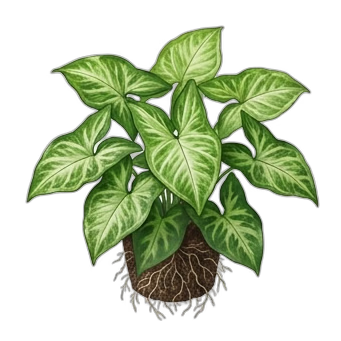
I am standing in front of a thirty-year-old Syngonium podophyllum that drapes four feet down the side of a mahogany bookcase in my conservatory, its leaves deeply lobed and splashed with silvery-white. People often mistake it for a philodendron until they notice how the leaf shape morphs as the vine matures. When I first brought a modest four-inch pot of this plant home decades ago as a struggling horticulture student, I let it dry out completely on a sunny windowsill, turning its delicate arrow-shaped leaves into crispy paper. That mistake taught me more about its natural understory origins than any textbook could.

1. Botanical Overview & Natural Habitat
Native to the humid, tropical rainforests of Central and South America—stretching from southern Mexico through Brazil and Bolivia—Syngonium podophyllum belongs to the Araceae family. In its native habitat, it functions as a hemiepiphyte. It begins life as a terrestrial seed germinating on the dark forest floor, then climbs upward using aerial roots to latch onto massive hardwood tree trunks in search of filtered, dappled sunlight.
As the juvenile vine ascends higher into the canopy, its morphology undergoes a dramatic ontological shift. Juvenile leaves are simple, sagittate (arrowhead-shaped), and typically measure 3 to 6 inches (7.6 to 15.2 cm) in length, often boasting striking variegation of cream, pink, or white. Once the vine climbs past 6 to 10 feet (1.8 to 3.0 m) and reaches higher light intensity, the leaves mature into deeply pedately divided forms with 5 to 11 distinct leaflets, losing much of their juvenile variegation in favor of a leathery, deep green texture.
Understanding this natural cycle is vital for indoor cultivation. When kept in a hanging basket, the plant stays permanently in its juvenile, cascading phase. When provided with a moss pole or wooden plank, it receives the hormonal trigger to produce thicker stems, larger leaves, and robust aerial roots.
2. Essential Environmental & Care Requirements
Replicating a tropical rainforest understory indoors requires attention to specific environmental parameters. Because Syngonium podophyllum evolved beneath dense tree canopies, it despises harsh, direct midday sun, which scorches its delicate foliage, yet it languishes in deep, dark corners.
| Parameter | Optimal Condition | Common Mistake | Why It Matters |
|---|---|---|---|
| Light | Bright, indirect light (10,000–20,000 lux) | Direct afternoon sun or deep shade | Direct sun burns leaf tissue; low light causes leggy, pale growth and reverts variegation. |
| Temperature | 65°F to 85°F (18°C to 29°C) | Exposure to drafts below 50°F (10°C) | Cold temperatures cause cellular collapse, root shock, and black, mushy foliage drop. |
| Humidity | 50% to 70% relative humidity | Dry indoor air below 30% | Low humidity triggers crispy brown leaf tips and attracts sap-sucking spider mites. |
| Soil pH | 5.5 to 6.5 (slightly acidic) | Heavy, compacted garden soil | Acidic, well-aerated media allows delicate roots to access oxygen and prevents root rot. |
Temperature management is straightforward in most homes, but seasonal shifts demand vigilance. Keep your arrowhead vine away from drafty windows during winter and HVAC vents that blow dry, heated air.
Watering technique is where most growers stumble. Allow the top 1 to 2 inches (2.5 to 5.0 cm) of soil to dry completely before watering thoroughly until liquid escapes the drainage holes. Never let the pot sit in standing saucer water, as Syngonium roots suffocate rapidly in waterlogged anaerobic conditions. For comprehensive data on tropical plant physiology and soil science, consult the University of Florida IFAS Extension.
💡 Pro-Tip: If you notice your highly variegated cultivar (like 'Confetti' or 'Pink Splash') producing all-green leaves, your plant is compensating for a lack of light by increasing chlorophyll production. Move it two feet closer to an east-facing window to restore its brilliant pastel tones.
3. Step-by-Step Cultivation, Feeding & Propagation
Propagating and repotting Syngonium podophyllum is deeply satisfying because the plant responds with aggressive, visible growth within days. Spring and early summer mark the optimal window for these interventions, aligning with the plant's natural active growth cycle.
- Select a Healthy Mother Stem: Inspect your mature vine and identify a vigorous stem section containing at least 2 to 3 nodes (the swollen bumps where leaves and aerial roots emerge).
- Sanitize Your Cutting Tools: Wipe down a pair of sharp floral shears or a razor blade with 70% isopropyl alcohol to prevent transferring pathogens to the open wounds.
- Make the Cut: Snip the stem precisely 0.5 inches (1.3 cm) below the lowest targeted node, ensuring you leave at least one healthy leaf on the cutting to drive photosynthesis.
- Choose Your Propagation Medium: Place the cutting into a clean glass of filtered water, ensuring the bottom node is submerged while the leaves remain above the water line. Alternatively, insert the cutting directly into a pre-moistened propagation mix of 50% perlite and 50% peat moss.
- Provide Optimal Rooting Conditions: Maintain ambient temperatures between 70°F and 80°F (21°C to 27°C) with bright, indirect light. If rooting in water, change the liquid every 5 to 7 days to maintain oxygen levels.
- Transplant to Soil: Watch for root emergence within 14 to 21 days. Once the water roots reach 1 to 2 inches (2.5 to 5.0 cm) in length, gently plant the cutting into a well-draining potting mix composed of standard potting soil amended with 30% perlite or orchid bark.
Feeding should occur monthly during the spring and summer active growing season using a balanced, water-soluble houseplant fertilizer diluted to half-strength (e.g., 10-10-10 NPK). Cease fertilization entirely from late autumn through winter when plant metabolism slows down. For advanced botanical insights on plant nutrition and cutting propagation, reference the Royal Horticultural Society.
⚠️ Important Caution: All parts of Syngonium podophyllum contain needle-like calcium oxalate crystals (raphides). If ingested by curious cats, dogs, or small children, these crystals cause immediate, intense irritation, painful burning of the mouth and tongue, excessive drooling, and difficulty swallowing. Always place hanging baskets well out of reach of household pets.
4. Common Problems, Pests & Troubleshooting
Even with meticulous care, indoor environments present unexpected challenges. Learning to read your arrowhead vine's physical symptoms saves you from guessing games.
- Yellowing Lower Leaves: When older leaves at the base of the plant turn uniformly yellow and feel mushy, you are experiencing the classic symptom of overwatering and root rot. Cut back watering frequency, inspect the root system for brown, decaying tissue, and repot into fresh, dry, fast-draining soil after trimming away dead roots.
- Brown, Crispy Leaf Margins: Low ambient relative humidity or erratic watering habits cause the tips of the leaves to desiccate. Increase local humidity using a room humidifier or group your plants together; never rely solely on misting, which provides only temporary relief and can promote fungal leaf spot diseases.
- Leggy, Stretched Stems: Spindly growth with long internodal distances and tiny leaves indicates severe light deprivation. Relocate the plant to a brighter location with unobstructed indirect light.
- Spider Mites and Mealybugs: Dry indoor air frequently invites sap-pisters. Spider mites manifest as fine stippling on the top of leaves with delicate webbing underneath, while mealybugs resemble small white cotton tufts in the leaf axils. Treat infestations immediately by wiping down all foliage with insecticidal soap or neem oil diluted according to product instructions, repeating every 7 days for three cycles to break the pest life cycle.

5. Frequently Asked Questions
Why are the leaves on my Arrowhead Vine turning pale and losing their variegation?
Variegated cultivars require significantly higher light levels than their all-green ancestors to maintain their pigmentation. When light is insufficient, the plant produces more chlorophyll to maximize energy capture, causing cream or pink patches to revert to solid green. Move the plant closer to an east- or bright north-facing window to restore contrast.
Can Arrowhead Vines grow outdoors in the ground?
Yes, but only if you live within USDA Hardiness Zones 10 through 12. In these frost-free tropical environments, Syngonium podophyllum makes a phenomenal, aggressive ground cover or tree climber in shady garden beds. In any cooler climate, it must be grown strictly as an indoor houseplant or brought indoors before nighttime temperatures dip below 50°F (10°C).
Should I cut off the aerial roots growing along the stems?
You can safely snip off aerial roots for aesthetic reasons without harming the plant, but they serve a natural biological purpose. In nature, these roots anchor the vine to trees and absorb ambient atmospheric moisture. If you are training your arrowhead vine up a moss pole, tucking those aerial roots directly into the damp moss encourages faster vertical growth and larger leaf development.
How do I make my Arrowhead Vine bushy instead of trailing?
To achieve a full, bushy appearance, you must prune the vine regularly. Cutting the long trailing vines just above a leaf node forces the plant to activate dormant lateral buds lower down on the stem, resulting in multiple new growth points. Additionally, you can plant several individual rooted cuttings together in a single pot to create a denser, fuller canopy right from the start.
📋 Table of Contents ▼ Click to expand
Tags: