
Areca Palm
Dypsis lutescens
The yellowed, papery tips on my first mature Dypsis lutescens still haunt me. Back in my early conservatory design days, I brought home a magnificent seven-foot Areca Palm for a gardener's sunroom, assuming its native tropical resilience would shield it from indoor winter neglect. Within three weeks, the delicate fronds began browning at the edges, and spider mites staged a silent, devastating coup in the dense, clustered stalks. That humbling rescue mission taught me that the Areca Palm—while one of our most celebrated interior design statements—operates under strict botanical rules that cannot be negotiated. Today, I approach this iconic species with immense respect for its evolutionary adaptations and specific domestic demands.
1. Botanical Overview & Natural Habitat

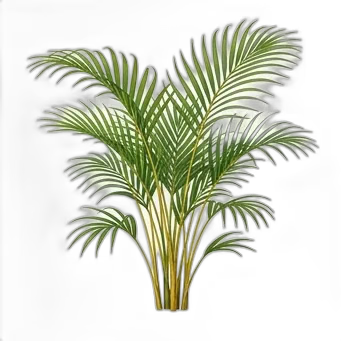
Taxonomically, Dypsis lutescens is distinguished by its clustering growth habit. Unlike single-trunked palms like the Coconut or Royal, the Areca emerges as a multi-stemmed clump, throwing up numerous smooth, ringed canes from a subterranean root crown. These canes feature a distinct golden-yellow pigment—hence the specific epithet lutescens, meaning "becoming yellow"—which intensifies when the plant receives optimal ambient lighting. The fronds are pinnate (feather-shaped), arching gracefully outwards, and divided into 40 to 60 pairs of narrow, linear leaflets that measure between 18 to 24 inches (45 to 60 cm) in length.
In its native Madagascar, populations are currently threatened by habitat loss, yet the species has found prolific, almost naturalized success across tropical and subtropical landscapes worldwide, from the humid gardens of Florida to the courtyards of Southern Europe. For a deeper scientific classification and historical context of this species, consult the Royal Botanic Gardens, Kew Plant of the World Online database.
2. Essential Environmental & Care Requirements
Replicating a Madagascan rainforest microclimate inside a modern residential or commercial space requires absolute precision. When designing indoor landscapes, I always remind gardeners that the Areca Palm is an architectural focal point that demands strict adherence to environmental parameters.
| Parameter | Optimal Condition | Common Mistake | Why It Matters |
|---|---|---|---|
| Light | 6–8 hours of bright, indirect light; tolerates 1–2 hours of gentle morning sun | Placing in deep interior shade or scorching direct afternoon sun | Insufficient light halts photosynthesis and weakens stem integrity; harsh sun bleaches and burns fronds. |
| Watering | Maintain consistent moisture; water when the top 1.0 to 1.5 inches (2.5 to 3.8 cm) dries | Allowing the root ball to dry out completely or keeping it waterlogged | Extended drought kills feeder roots; continuous saturation starves roots of oxygen, causing root rot. |
| Temperature | 65°F to 85°F (18°C to 29°C) | Exposing to cold drafts below 50°F (10°C) or sudden HVAC temperature swings | Cold shock causes immediate cellular collapse, resulting in blackening fronds and rapid decline. |
| Humidity | 50% to 65% relative humidity | Placing near forced-air heating vents or dry, unhumidified winter rooms | Low humidity triggers rapid tip browning, crispy frond margins, and attracts spider mite infestations. |
Soil composition is equally critical. The root system of Dypsis lutescens requires an aerated, moisture-retentive medium that drains excess water instantly. A custom blend comprising 40% high-grade organic potting soil, 30% coco coir, 20% coarse horticultural perlite, and 10% worm castings provides the ideal structural matrix.
💡 Pro-Tip: Never rely solely on visual cues for watering. Push your index finger a full 2 inches (5 cm) deep into the soil mix. If it feels cool and damp at your fingertip, withhold the watering can for another 48 hours. Areca palms despise "wet feet" just as much as absolute drought.
3. Step-by-Step Cultivation, Feeding & Propagation
Establishing a thriving Areca Palm from a nursery container or managing its expansion requires a methodical, seasonal protocol. Because these palms are heavy feeders and rapid cluster-formers, routine maintenance directly dictates their longevity.
Step 1: Selecting the Right Container and Soil
Choose a heavy ceramic or terracotta pot that features a minimum of three drainage holes. Ensure the new container is only 2 to 3 inches (5 to 7.5 cm) wider in diameter than the existing root ball. Over-potting introduces excess damp soil that remains uncolonized by roots, inviting fungal pathogens.
Step 2: Repotting and Root Crown Placement
Gently tip the palm out of its nursery container, teasing apart any tightly bound outer roots with your fingers. Position the plant in the new vessel so that the base of the stem sits precisely 0.5 inches (1.2 cm) below the rim of the pot, ensuring the root crown is never buried deeper than it was previously. Fill the surrounding space with your custom soil blend, tamping down gently to eliminate large air pockets.
Step 3: Initial Post-Repotting Hydration
Water the newly potted palm thoroughly until water streams freely from the bottom drainage holes. Allow the pot to drain completely for 30 minutes before placing it back onto its saucer, ensuring it never sits in standing water.
Step 4: Establishing a Precision Feeding Schedule
Feed your Areca Palm strictly during its active growing season, which runs from early spring (March) through late summer (August). Utilize a balanced, slow-release granular fertilizer formulated for palms, or a water-soluble liquid fertilizer with an N-P-K ratio of 3-1-3 enriched with secondary micronutrients like magnesium, manganese, and iron. Apply the fertilizer every 4 weeks at half the manufacturer’s recommended dosage to prevent salt burn. Cease all fertilization completely between November and February when daylight hours shorten and growth naturally halts.
Step 5: Propagation by Division
Because Areca Palms produce multiple underground suckers, propagation is achieved exclusively through clump division rather than stem cuttings or seed germination indoors. During early spring repotting, slice through the central root mass using a sterilized, sharp serrated knife, ensuring each separated section retains at least three healthy canes and an intact root system. Pot each division individually using the standard soil protocol.
⚠️ Important Caution: Never prune away green fronds simply because they possess minor cosmetic imperfections at the tips. The Areca Palm draws vital energy, potassium, and mobile nutrients from aging leaves. Only cut away fronds that have turned completely brown and dry, utilizing sterile pruning shears snipped flush with the base of the cane, taking care not to nick or lacerate the smooth, green stem tissue.
4. Common Problems, Pests & Troubleshooting
Diagnosing issues on an Areca Palm requires evaluating environmental stressors before reaching for chemical treatments. Most physiological disorders present clear visual signatures.
- Tip Browning and Crispy Margins: Typically caused by low relative humidity or chemical accumulation from fluorinated or chlorinated tap water. Flush the soil thoroughly with distilled or rain water every 6 weeks to leach out accumulated mineral salts, and run an ultrasonic humidifier near the canopy to maintain humidity above 50%.
- Yellowing Lower Fronds: Older fronds naturally yellow and drop as part of the palm's normal life cycle. However, if multiple fronds yellow simultaneously across the canopy, it indicates either chronic overwatering (leading to root hypoxia) or a severe nitrogen and magnesium deficiency.
- Stunted Growth and Pale Stems: A definitive sign of insufficient lighting or a lack of seasonal fertilization. Transition the plant closer to an east- or unblocked west-facing window.
- Spider Mites (Tetranychus urticae): These microscopic arachnids thrive in the warm, dry air typical of centrally heated homes. They spin fine webbing along the underside of the leaflets, causing stippling, chlorosis, and eventual leaf drop. Combat infestations immediately by wiping down every frond with insecticidal soap or horticultural neem oil diluted to a 1% concentration, repeating the application every 7 days for a 3-week cycle to disrupt the pest's reproductive cycle. For comprehensive pest management guidelines, reference the University of Florida IFAS Extension guide on indoor palm pests.

5. Frequently Asked Questions
Can an Areca Palm survive in low-light office environments?
While an Areca Palm will not instantly die in a dim office, it will not thrive either. Over a period of 6 to 12 months, low light causes the canes to weaken, the foliage to become sparse and dark green rather than its signature golden-green, and the plant becomes acutely vulnerable to pest attacks. To maintain vitality indoors, provide at least 200 foot-candles of light or supplement with full-spectrum LED grow lights for 10 hours daily.
Why are my Areca Palm tips turning brown despite regular watering?
Tap water frequently contains high concentrations of fluoride, chlorine, and soluble salts that accumulate in the soil over time, causing chemical burn on the delicate tips of the fronds. Switch to watering your palm exclusively with distilled, reverse-osmosis, or collected rainwater, and ensure you run water through the pot until it flushes out the bottom drainage holes every month.
How do I safely prune dead fronds without damaging the plant?
Wait until the frond has turned completely brown and papery from tip to base. Using a pair of sharp, isopropyl-alcohol-sterilized bypass pruners, cut the frond stem approximately 1 inch (2.5 cm) away from the main trunk. Avoid peeling or ripping fronds away by hand, as tearing the delicate, ringed bark of the cane creates open entry wounds for fungal pathogens.
Are Areca Palms safe for cats and dogs?
Yes. According to the ASPCA, Dypsis lutescens is completely non-toxic to cats, dogs, and horses. You can place this lush tropical palm in homes with inquisitive pets without worrying about systemic poisoning if they happen to nibble on the arching fronds.
📋 Table of Contents ▼ Click to expand
Tags: