African Violet
Saintpaulia ionantha
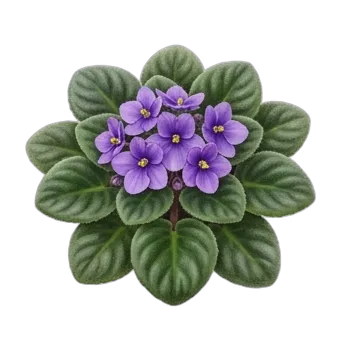
The tea kettle was whistling in my studio kitchen when I noticed the crown of my oldest Saintpaulia ionantha beginning to lean toward the eastern window, its velvety leaves telling me precisely what my hygrometer had already confirmed: the winter heating had dropped our ambient humidity to a desiccating 32 percent. For over twenty years these tactile indicators have been my primary diagnostic tools. African Violets are not merely houseplants; they are sophisticated ecological barometers that respond instantly to subtle shifts in light, moisture, and nutrition. When we understand their native cloud-forest origins, cultivation transforms from a guessing game into an exact science.
1. Botanical Overview & Natural Habitat

Botanically, African Violets belong to the Gesneriaceae family, characterized by succulent, fleshy leaves coated in fine trichomes (hairs) that trap atmospheric moisture and deter crawling predators. The species name ionantha translates from Greek as "violet-flowered," though modern hybridization has expanded the palette from deep indigos to corals, bi-colors, and whites, accompanied by single, double, or ruffled corollas.
In their natural habitat, they receive filtered light beneath a dense forest canopy, soaking up morning sun while remaining protected from scorching midday radiation. The soil they anchor into is porous, highly organic, and constantly replenished by decomposing leaf litter, ensuring rapid drainage alongside high moisture retention. Recreating these microclimatic conditions in an indoor or greenhouse environment is the absolute key to unlocking their full botanical potential.
2. Essential Environmental & Care Requirements
Creating an optimal indoor ecosystem for African Violets requires balancing light, temperature, humidity, and substrate mechanics. Let us examine the parameters that separate a struggling rosette from a floriferous specimen.
| Parameter | Optimal Condition | Common Mistake | Why It Matters |
|---|---|---|---|
| Light | 10–12 hours of bright, indirect light (10,000–12,000 lux) | Direct midday sun | Leaves scorch and bleach; excess light halts blooming. |
| Temperature | 65°F–75°F (18°C–24°C) | Drafts below 60°F (15°C) | Cold shock causes root stasis, yellowing, and cellular collapse. |
| Humidity | 50%–60% relative humidity | Dry indoor air (<35% RH) | Trichomes fail to function; bud drop and tip necrosis occur. |
| Substrate | pH 6.0–6.5, highly porous peat-perlite blend | Heavy garden soil | Suffocates fine root hairs and induces root rot (Pythium). |
Light quality dictates flowering frequency. South- or west-facing windows require sheer curtains to block direct rays, while east-facing exposures offer ideal morning illumination. If natural light falls short, fluorescent or full-spectrum LED fixtures positioned 10 to 12 inches (25 to 30 cm) above the foliage for 12 hours a day will reliably trigger continuous bud production.
Temperature management is equally critical. Keep ambient temperatures stable between 65°F and 75°F (18°C–24°C). Temperatures dropping below 60°F (15°C) trigger metabolic slowdowns, while sustained heat above 85°F (29°C) forces the plant into dormancy and distorts new leaf emergence.
💡 Pro-Tip: When assessing light levels, place your hand six inches above the plant's crown at noon. If your hand casts a soft, blurry shadow, the light intensity is ideal. If the shadow is razor-sharp, the light is too intense and will burn the foliage.
Watering technique remains the single greatest hurdle for growers. African Violets demand a strict "moist-dry" cycle. Allow the top 0.5 inches (1.2 cm) of soil to dry completely before re-watering with tepid water—never ice-cold, which causes unsightly yellow rings on the leaves through thermal shock. Bottom watering via capillary matting or placing pots in a shallow tray of water for 20 minutes prevents crown rot by keeping moisture away from the delicate central petioles.
For deeper insights into specialized gesneriad care, consult the University of Florida IFAS Extension guidelines on indoor ornamental management.
3. Step-by-Step Cultivation, Feeding & Propagation
Repotting and propagation are high-stress events for African Violets if executed incorrectly. Because these plants prefer being slightly root-bound, repotting should occur only once every 12 to 18 months, preferably in spring when daylight increases.
Step-by-Step Repotting and Crown Renewal Protocol
- Select the Proper Vessel: Choose a plastic or unglazed terra-cotta pot whose diameter is roughly one-third the width of the plant's leaf span (typically a 4-inch or 10 cm pot for mature standards). Ensure at least one unobstructed drainage hole at the base.
- Prepare the Specialized Soil Mix: Combine 50 percent professional peat-based potting mix, 30 percent horticultural perlite, and 20 percent vermiculite. This ratio achieves an ideal pH range of 6.0 to 6.5 while ensuring maximum aeration.
- Unpot and Clean the Root Ball: Gently slide the plant from its current container. Tease apart matted roots with a clean dibble, and brush away exhausted soil. Inspect the root system; trim away any dark, mushy, or decaying roots using sterilized shears.
- Address Neck Exposure: Over time, lower leaves drop off, exposing a woody stem or "neck." Scrape this exposed stem gently with a sterile blade to encourage adventitious root formation.
- Position and Backfill: Place the plant in the new container so the bottom-most leaves rest just above the soil line. Never bury the central crown, as this invites fungal pathogens. Firm the substrate gently around the roots to eliminate air pockets.
- Initial Watering: Water the newly potted plant thoroughly with a diluted, balanced 10-10-10 or specialized African Violet fertilizer (7-9-5 formulation) mixed at one-quarter strength to reduce transplant shock.
Propagation via leaf cuttings is an exceptionally reliable method for producing genetically identical offspring. Select a firm, turgid, disease-free leaf from the middle tier of the rosette. Using a razor blade sterilized in isopropyl alcohol, slice the petiole at a clean 45-degree angle, leaving a length of 1.5 inches (3.8 cm). Insert the petiole into a pre-moistened mixture of 50 percent perlite and 50 percent peat moss at a 45-degree angle, burying the stem approximately 0.75 inches (1.9 cm) deep. Enclose the container in a clear polyethylene bag to trap humidity, and place it under indirect light. Within 45 to 60 days, adventitious plantlets will emerge from the base of the petiole, ready to be separated and potted individually once they reach 1 inch (2.5 cm) in height.
⚠️ Important Caution: Never use tap water containing high levels of sodium, fluoride, or heavy chloramines. Over time, these mineral salts accumulate in the potting medium, burning delicate roots and causing necrotic leaf margins. Always use filtered, distilled, or rain water allowed to reach room temperature.
4. Common Problems, Pests & Troubleshooting
Even with meticulous care, environmental imbalances manifest quickly on African Violet foliage and flowers. Learning to read these symptoms allows for immediate course correction.
- Powdery Mildew (Oidium species): Appears as a white, powdery dusting on leaves and flower stems. This occurs when high humidity is paired with stagnant air and cool temperatures. Increase air circulation immediately with an oscillating fan, and treat affected areas with horticultural neem oil or potassium bicarbonate sprays.
- Crown Rot (Pythium or Phytophthora): Characterized by sudden collapse, translucent black stems, and a mushy central crown. Caused by overwatering or splashing water directly into the growing tip. Affected plants are rarely salvageable, but healthy outer leaves can be salvaged for propagation.
- Cyclamen Mites (Phytonemus pallidus): Microscopic pests that cause new leaves to become distorted, hairy, thickened, and brittle, often with a stunted, grayish center. Because these mites are invisible to the naked eye, isolate the plant immediately and treat with a miticide or insecticidal soap, or discard severely infested specimens to protect your collection.
- Ring Spot: Yellow or brown rings, blotches, or streaks on upper leaf surfaces. This is an immediate physiological reaction triggered when cold water touches warm foliage. Adjust your watering technique to ensure all liquids go directly into the soil or saucers.

5. Frequently Asked Questions
Why are the leaves on my African Violet turning yellow and dropping off?
Yellowing lower leaves typically indicate natural aging, overwatering, or low nitrogen levels. If the soil feels constantly soggy and the stem feels soft, root rot has likely set in, requiring emergency propagation of healthy upper leaves and discarding the ruined root system.
How do I get my African Violet to bloom consistently?
Continuous blooming requires three non-negotiable factors: 10 to 12 hours of bright, indirect light daily; a phosphorus-rich fertilizer (such as a 7-9-5 formulation) applied at one-quarter strength with every watering; and being slightly root-bound in a small pot. If the pot is too large, the plant diverts its energy into root production rather than flowering.
Can I propagate African Violets in plain water?
Yes, leaf petioles placed in a small jar of water will successfully develop roots and tiny plantlets within 30 to 50 days. However, water-grown roots are structurally different and often brittle; transitioning them to soil can cause transplant shock. Direct soil or perlite propagation generally yields stronger, more resilient root systems.
What causes brown, dead spots in the centers of the leaves?
This is almost universally caused by cold water splashing onto warm leaves during the watering process. The sudden thermal shock collapses the leaf's cellular walls, leading to necrotic spots. Always use room-temperature water and apply it directly beneath the leaf canopy.
📋 Table of Contents ▼ Click to expand
Tags: