
Thanksgiving Cactus
Schlumbergera truncata
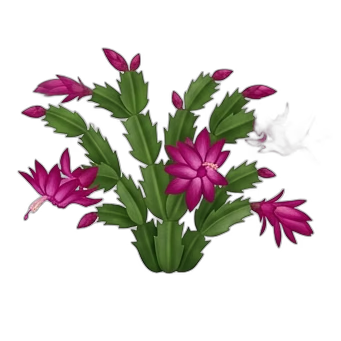
Last November, growers Eleanor called me in an absolute panic. Her prize specimen—a thirty-year-old Thanksgiving cactus passed down from her grandmother—was suddenly shedding segments by the handful, its once-plump, scalloped stems wrinkling like dehydrated prunes just as the first translucent flower buds began to form. When I arrived at her sunroom, the diagnosis was instantaneous: a classic case of root rot triggered by a well-meaning neighbor who kept the soil perpetually soggy while Eleanor was away, compounded by a sudden shift in ambient temperature. We managed to salvage three healthy stem cuttings, and today, those propagations are thriving. That rescue mission reminded me why I love writing about Schlumbergera truncata. These resilient epiphytes are botanical time capsules, yet they mystify even seasoned houseplant owners when their specific environmental cues are missed.
1. Botanical Overview & Natural Habitat

In its natural habitat, sitting at elevations between 2,300 and 4,900 feet (700 and 1,500 meters), the plant experiences filtered sunlight piercing through a dense tropical canopy. Its root system is not designed to burrow deep into heavy terrestrial soil; instead, roots anchor lightly into pockets of decaying leaf mold, moss, and bark, where they enjoy maximum aeration and rapid drainage.
Morphologically, what we perceive as "leaves" are actually flattened stem segments called cladodes. Each cladode features distinct, sharp, claw-like teeth or projections along its margins—a reliable diagnostic trait that separates Schlumbergera truncata (the Thanksgiving cactus) from its close relative Schlumbergera russelliana (the Easter cactus, which has smooth, rounded stem margins). True leaves are entirely absent; photosynthesis occurs entirely within these succulent, green cladodes. Understanding this evolutionary history explains why standard cactus care—blistering sun and bone-dry desert soil—will rapidly kill a Thanksgiving cactus.
2. Essential Environmental & Care Requirements
Recreating a Brazilian cloud forest inside a heated home requires paying close attention to specific environmental parameters. Let us examine the exact thresholds that dictate success.
| Parameter | Optimal Condition | Common Mistake | Why It Matters |
|---|---|---|---|
| Light | Bright, indirect light (1,500–2,500 foot-candles) | Direct, unshaded afternoon sun | Intense rays scorch cladodes, turning them a bleached purple-red and causing permanent cellular damage. |
| Temperature | 60°F–70°F (15°C–21°C) active; 55°F–65°F (13°C–18°C) set | Placing near heating vents or drafty windows | Rapid temperature fluctuations trigger heavy bud drop and inhibit flowering cycles. |
| Humidity | 50% to 60% relative humidity | Ambient home humidity dropping below 30% in winter | Low humidity causes distal segment shriveling and prevents proper bud expansion. |
| Watering | Water thoroughly when top 1.5 inches (3.8 cm) are dry | Keeping soil constantly saturated | Suffocates the delicate root hairs, inviting Pythium and Phytophthora root rot pathogens. |
Soil composition is equally critical. Never plant a Thanksgiving cactus in dense, clay-heavy potting soil or standard garden dirt. You need an open, highly porous epiphytic mix. My preferred formula combines 40% high-quality peat moss or coco coir, 30% coarse orchid bark (ranging from 0.25 to 0.5 inches / 0.6 to 1.3 cm in particle size), and 30% perlite or pumice. This ensures that even immediately after a heavy watering, pockets of oxygen remain trapped around the roots.
For further reading on maintaining optimal indoor humidity and light conditions for tropical epiphytes, consult the University of Florida IFAS Extension.
💡 Pro-Tip: When calculating your watering schedule, remember that Schlumbergera truncata has two distinct metabolic phases. During active summer growth, they consume water quickly. However, during their post-bloom resting period in winter, their water uptake drops by half. Always poke your index finger 1.5 inches (3.8 cm) into the substrate; if it feels cool and damp, withhold the watering can for another 5 to 7 days.
3. Step-by-Step Cultivation, Feeding & Propagation
Getting a Thanksgiving cactus to bloom reliably year after year is entirely about mastering its photoperiod and temperature triggers. In the wild, days shorten and temperatures drop as autumn arrives in the Southern Hemisphere, signaling the plant to set buds. We must mimic these exact cues indoors.
Here is the step-by-step protocol for forcing blooms, feeding, and propagating new specimens:
- Initiate the Budding Cycle (Late September): Move your plant to a room where it receives 12 to 14 hours of absolute, uninterrupted darkness every night (a spare bedroom or a closet works well) and daytime temperatures between 55°F and 65°F (13°C and 18°C). Keep nights consistently dark—even a stray reading lamp or hallway light will disrupt the photoperiod and prevent bud formation. Maintain this routine for 6 weeks, or until you spot tiny pearl-like buds forming at the stem tips.
- Adjust Placement and Watering During Bud Set: Once buds reach the size of a match head (roughly 0.12 inches / 3 mm), return the plant to its permanent display location with bright, indirect light. Do not rotate or move the pot drastically; sudden shifts in light angle or drafts will cause the plant to drop its developing buds entirely.
- Execute Post-Bloom Pruning (Late Winter): After the flowering display finishes in January or February, let the plant rest for 4 weeks with reduced watering. Then, use clean, sterilized shears to twist or cut off the terminal 1 to 2 segments of each stem. This light pruning encourages lateral branching, creating a denser, bushier plant that will produce twice as many flowers next season.
- Feed Strategically: Fertilize monthly from April through August using a balanced, water-soluble houseplant fertilizer (such as a 10-10-10 or 20-20-20 formulation) diluted to one-quarter strength. Cease all fertilization completely by September 1st to allow the plant to harden off its tissues before the cooling and dark-treatment phase.
- Propagate via Stem Cuttings (Late Spring): Select a robust, healthy stem section containing 3 to 4 linked cladodes. Hold the base of the stem and gently twist it off, or cut cleanly through the node with a sterile razor blade. Allow the basal wound to callus over by placing the cutting flat on a clean paper towel in a shaded, dry spot for 48 to 72 hours.
- Root the Cuttings: Insert the callused end of the cutting approximately 0.75 inches (1.9 cm) deep into a small pot filled with pre-moistened propagation mix (50% perlite and 50% peat moss). Enclose the pot in a clear plastic bag to lock in humidity, placing it in bright, indirect light at 70°F (21°C). Roots will successfully form in 21 to 28 days, after which you can remove the plastic bag and pot them up individually.
For comprehensive botanical guidelines on maintaining holiday cacti collections, visit the Royal Horticultural Society.
4. Common Problems, Pests & Troubleshooting
Even with meticulous care, physiological disorders and opportunistic pests occasionally appear. Here is how to diagnose and correct them before they compromise your specimen.
- Bud Drop (Premature Flower Abscission): If your unopened flower buds turn pale, shrivel, and drop off onto the floor, you are dealing with environmental shock. The primary culprits are sudden drafts from opening exterior doors, drastic temperature swings exceeding 10°F (5.5°C) within a 24-hour window, or erratic soil moisture (allowing the root ball to bone-dry out completely while buds are forming).
- Segment Limpness and Wrinkling: When cladodes lose their turgor pressure and feel flaccid, check the root system immediately. If the soil is bone dry, water deeply and the plant should plump back up within 48 hours. However, if the soil is wet and the base of the stem feels mushy or dark brown, you are facing advanced root rot.
- Root Rot (Pythium spp.): Caused by chronic overwatering and compacted, oxygen-starved soil. The roots turn black, slimy, and slough off their outer cortex. To save the plant, unpot it, rinse all old soil away under lukewarm water, use sterile shears to cut away every trace of mushy, blackened root tissue, and repot the remaining healthy upper stems into fresh, dry epiphytic mix.
- Mealybugs (Pseudococcus spp.): These sap-sucking insects look like tiny, cottony white masses tucked tightly into the crevices between cladodes and nodes. They weaken the plant and secrete sticky honeydew, which attracts sooty mold. Dab individual bugs with a cotton swab dipped in 70% isopropyl alcohol, or spray the entire plant with insecticidal soap every 7 days for a 3-week lifecycle cycle.
⚠️ Important Caution: Never use petroleum-based horticultural oils or heavy dormant oils on Schlumbergera truncata. The delicate, succulent structure of the cladodes cannot process heavy oils; phytotoxic reactions will occur rapidly, dissolving the plant's cuticular layer and resulting in unsightly black necrotic patches across the stems.

5. Frequently Asked Questions
Why is my Thanksgiving cactus turning purple?
A purplish-red tinting on the edges of the cladodes is usually a plant's natural physiological defense against excess light or mild cold stress. If your plant is sitting directly on a cold windowsill where nighttime temperatures dip below 50°F (10°C), or if it is receiving too much direct midday sunlight, the anthocyanin pigments surge to protect the cellular machinery. Move the plant a few feet back from the glass or into a spot with gentler, filtered light, and the green coloration will return within two to three weeks.
How can I tell if I have a Thanksgiving cactus or a Christmas cactus?
Look closely at the individual stem segments (cladodes). A Thanksgiving cactus (Schlumbergera truncata) features distinct, pointed, claw-like projections or teeth (usually 2 to 4 per side) along the margins of each segment. A true Christmas cactus (Schlumbergera bridgesii or S. Russelliana) has completely smooth, scalloped, teardrop-shaped segment margins with zero sharp points. Additionally, Thanksgiving cacti typically bloom in November, whereas true Christmas cacti bloom in December to January.
Should I mist my Thanksgiving cactus daily?
Daily misting is generally unnecessary and can actually invite fungal leaf spot pathogens if the water does not evaporate within two hours. Instead of misting the foliage directly, place your Thanksgiving cactus on a wide pebble tray filled with water, ensuring the bottom of the pot sits comfortably above the water line on top of the stones. This elevates the ambient relative humidity right around the plant to the desired 50% to 60% threshold without wetting the delicate cladodes.
Why won't my Thanksgiving cactus bloom at all?
If your plant grows healthy green stems year after year but never produces a single flower bud, it has likely missed its critical photoperiod cue. Schlumbergera truncata is a short-day plant, meaning it requires a minimum of 12 hours of uninterrupted, pitch-black darkness every single night for at least 6 consecutive weeks starting in autumn. If your plant sits in a room where lamps are turned on late into the evening, or where outdoor streetlights shine through the window at night, the interruption inhibits the phytohormones responsible for floral initiation.
📋 Table of Contents ▼ Click to expand
Tags: