


Did you know the actual color of your grow light completely changes how your plant behaves?
Written with AI assistance, edited and checked against horticultural sources.
Under what I thought were "bright shop lights," my seedlings were stretching into paper-thin, spindly ghosts. That painful failure taught me that light color is biological nutrition, not mere room illumination.
If you have ever wondered why a houseplant positioned directly beneath a bright light fixture still develops weak stems or refuses to bloom, the answer lies in the narrow nanometer bands of light color reaching its foliage. Light is not just an energy source for photosynthesizing plants; it is a complex stream of genetic instructions.

PLAY22 Gardening Tools Set of 10
A 10-piece hand tool set with a carry bag — trowel, transplanter, pruners and weeder. Suited to repotting and general container work.
View on Amazon ↗1. Botanical Overview & Natural Habitat
To understand why light color alters plant growth, we must step into the natural habitats where tropical houseplants and crops evolved. In an understory environment—such as a rainforest floor in Costa Rica or South America—sunlight is filtered through a dense upper canopy. The light reaching the forest floor is deprived of high-energy blue and red wavelengths, which are absorbed by upper canopy trees, leaving behind a spectrum enriched in green and far-red wavelengths.
Plants interpret these light variations using photoreceptors. The most prominent among these are chromophores, cryptochromes, and phytochromes:
- Cryptochromes & Phototropins: Sensitive to blue wavelengths (400–500 nanometers), these photoreceptors control directional bending toward light (phototropism), stomatal opening for gas exchange, and the suppression of stem elongation. High blue light signals open space with direct access to the sky, prompting plants to build thick, stocky stems and broad, chlorophyll-dense leaves.
- Phytochromes: These switchable protein sensors toggle between two states: Phytochrome Red ($P_r$, absorbing around 660nm) and Phytochrome Far-Red ($P_{fr}$, absorbing around 730nm). The ratio of red to far-red light ($R:FR$) acts as a signal to the plant. High red light indicates full sun, promoting leaf development, branching, and eventual flowering. A lower ratio (excess far-red relative to red) triggers the shade avoidance response, causing the plant to stretch rapidly to escape perceived competition.
At the root zone (rhizosphere), gas exchange is just as critical as moisture. When potting mix becomes dense, muddy, or suffocated by standing drainage water, fine root hairs quickly suffer from hypoxia (oxygen deprivation), leaving the door wide open for opportunistic fungal pathogens like Pythium and Phytophthora. Conversely, an open, biologically active substrate enables robust nutrient uptake and rapid vegetative vigor. When high-intensity PAR (Photosynthetically Active Radiation) is matched with proper rhizosphere aeration, roots pump water and minerals seamlessly to support accelerated photosynthesis.
"Light spectrum is the biological software that commands whether your plant grows stout and resilient or tall, weak, and leggy."
Understanding Light Spectrum Wavelengths
Photosynthesis relies heavily on chlorophyll a and chlorophyll b, which exhibit peak absorbance within the blue (430nm and 453nm) and red (642nm and 660nm) bands. However, full-spectrum photobiology involves broader interactions across the light band:
For a detailed biological breakdown of how spectral quality influences plant morphology, refer to research provided by the Michigan State University Extension on Light Spectrum.
2. Essential Environmental & Care Requirements
Balancing light spectrum requires tuning the surrounding environment. Under precise blue- and red-enriched spectral lighting, plants increase their metabolic activity, raising their demand for water, carbon dioxide, and nutrients.
Light Intensity (PPFD) and Daily Light Integral (DLI)
Providing the right color spectrum is insufficient if the light's intensity—measured in Photosynthetic Photon Flux Density (PPFD) in $\mu\text{mol/m}^2/\text{s}$—is off. Tropical foliage houseplants (e.g., Monstera, Philodendron, Pothos) generally require a PPFD of 100 to 300 $\mu\text{mol/m}^2/\text{s}$, while high-light species like succulents, cacti, or flowering orchids demand 400 to 600+ $\mu\text{mol/m}^2/\text{s}$.
Key Environmental Metrics
Maintaining temperatures between 68–78°F (20–25.5°C) preserves cell turgor and enzymatic reaction speed within the Calvin cycle. If ambient temperatures fall below 60°F (15.5°C), root uptake slows, rendering even the highest-quality spectrum ineffective.
3. Step-by-Step Cultivation, Feeding & Propagation
Transitioning your plants from standard home ambient light or weak fixtures to targeted grow light spectrums requires a systematic approach. Here is the proven, systematic protocol I personally follow in a greenhouse:
- Optimize Container Aeration: Ensure containers have generous drainage holes and amend standard potting mix with 30% coarse perlite or pumice to prevent compaction. High spectral light increases transpirational pull; a well-aerated substrate prevents oxygen starvation around fine root hair membranes.
- Stabilize Climate & Micro-Environment: Position plants at least 3 feet (0.9 meters) away from cold winter drafts and forced-air heating registers to prevent humidity shock. Maintain ambient temperatures between 68–78°F (20–25.5°C).
- Calibrate Light Fixture Height & Photoperiod: Position full-spectrum LED fixtures 12 to 18 inches (30 to 45 cm) above the plant canopy for standard tropicals, or 8 to 12 inches (20 to 30 cm) for seedlings and sun-loving species. Set an automated timer for a reliable photoperiod of 14 hours ON and 10 hours OFF.
- Select Wavelength Ratios for Plant Stage:
- For vegetative propagation & seedlings: Use a fixture emitting 4000K–5000K with a distinct blue peak (450nm) to drive strong roots and short internodes.
- For flowering & mature foliage buildup: Shift toward a warmer spectrum (3000K–3500K) or supplement with supplemental deep red (660nm) LEDs to spur foliage expansion and inflorescence.
- Apply Dilute Organic Nutrients: During active vegetative phases under dedicated lighting, nourish with half-strength organic liquid feeds (such as cold-processed kelp and fish hydrolysate) to gently fuel cell division without root burn. Water when the top 1 to 2 inches (2.5 to 5 cm) of soil feels dry to the touch.
💡 Pro-Tip: Invest in full-spectrum white LEDs (4000K–5000K) with a Color Rendering Index above 90 (CRI > 90) for maximum PAR efficiency. If you grow prized variegated Monstera or Anthurium varieties, maintaining high blue spectrum (450nm) alongside high humidity prevents leaf scorch while maximizing chlorophyll efficiency in green sectors.
⚠️ Important Caution: Never leave grow lights running 24 hours continuously; plants require an uninterrupted dark period for starch respiration. Without 8 to 10 hours of darkness daily, carbohydrate translocation stalls, causing chlorosis and leaf tip necrosis over time.
4. Common Problems, Pests & Troubleshooting
When modifying light quality and intensity, plants display specific signs indicating whether their new environment is suitable.
Diagnosing Spectral Stress vs. Intensity Stress
- Etiolation (Shade Avoidance Response): If stems are stretching, internodes are wider than 2–3 inches (5–7.5 cm), and leaves remain small, your spectrum lacks sufficient blue light (450nm) or the PPFD is below 100 $\mu\text{mol/m}^2/\text{s}$. Move the fixture closer by 4 to 6 inches (10 to 15 cm) or switch to a high-blue growth bulb.
- Photobleaching & Leaf Scorch: Bleached white or straw-colored patches on upper leaf surfaces—accompanied by leaf curling—signal excessive light intensity or extreme localized heat. Raise the fixture 6 inches (15 cm) higher.
- Root Hypoxia & Root Rot: Under weak lighting, plants absorb minimal water. Soil that remains saturated for more than 7 days leads to root hypoxia, causing leaves to drop while yellowing. Check for dark, slimy roots infected by Pythium. Trim damaged tissue, repot into a mix amended with 30% perlite or bark, and increase PAR levels to drive natural transpirational water movement.
Managing Pests Under High-Intensity Lighting
Warm, enclosed grow spaces illuminated by strong lighting microclimates can foster rapid pest cycles:
- *Spider Mites (Tetranychidae):* Spider mites thrive under warm lights with low relative humidity (below 40%). Rinse foliage thoroughly with room-temperature water every 7 days and introduce neem or horticultural oil applications during dark cycles.
- *Fungus Gnats (Sciaridae): Prolonged moisture in poorly lit or overwatered media attracts fungus gnats. Treat soil with Bacillus thuringiensis israelensis* (BTI) and let the top 2 inches (5 cm) of media dry completely between waterings.
For further reference on managing indoor environmental microclimates and lighting, explore guidelines provided by the Royal Horticultural Society Guide on Growing Under Lights.
5. Frequently Asked Questions
Can I just use standard household LED bulbs as grow lights for my indoor plants?
Standard household LED bulbs are engineered for human vision (typically emphasizing green and yellow light) rather than optimal plant photosynthesis. While a 100-watt-equivalent household LED outputting 5000K daylight color can maintain low-light foliage plants, it generally lacks the photosynthetically active photon flux density (PPFD) and precise 450nm blue and 660nm deep red wavelengths necessary for vigorous indoor growth and flowering.
When is the best time of year to implement these changes?
Early spring through mid-summer represents the active metabolic window when plants can rapidly utilize increased light and fresh nutrients. However, installing dedicated spectral grow lights in autumn or early winter is an effective way to prevent seasonal dormancy, leaf drop, and etiolation caused by short natural days. During winter, adjust hydration frequency while keeping photoperiods consistent at 12–14 hours.
How quickly will I see visible improvements?
Most tropical foliage houseplants respond within 7 to 14 days with noticeable leaf turgidity, deeper emerald color, and active apical shoot emergence. Succulents and woody species may require 3 to 4 weeks to demonstrate structural thickening and compact internode growth.
Is this technique suitable for all indoor plant varieties?
Yes! Adjusting the light spectrum is exceptionally effective for Monstera, Philodendron, Pothos, Snake Plants (Sansevieria), orchids, and tropical foliage collections. You need only tailor the intensity (PPFD) and duration to match the specific light tolerance of shade-loving understory species versus sun-loving succulents.
Have you tried this technique with your own houseplants? Share your results with our global grower community on the Community Forum, explore more expert guides on Plant Tips, or visit our Home Page for comprehensive plant care archives.
📋 Table of Contents ▼ Click to expand
PlantSavvyWorld
Editorial team
PlantSavvyWorld is an independent botanical education project. Articles are drafted with AI assistance, then edited and checked against university extension services, botanical garden collections and other published horticultural sources.
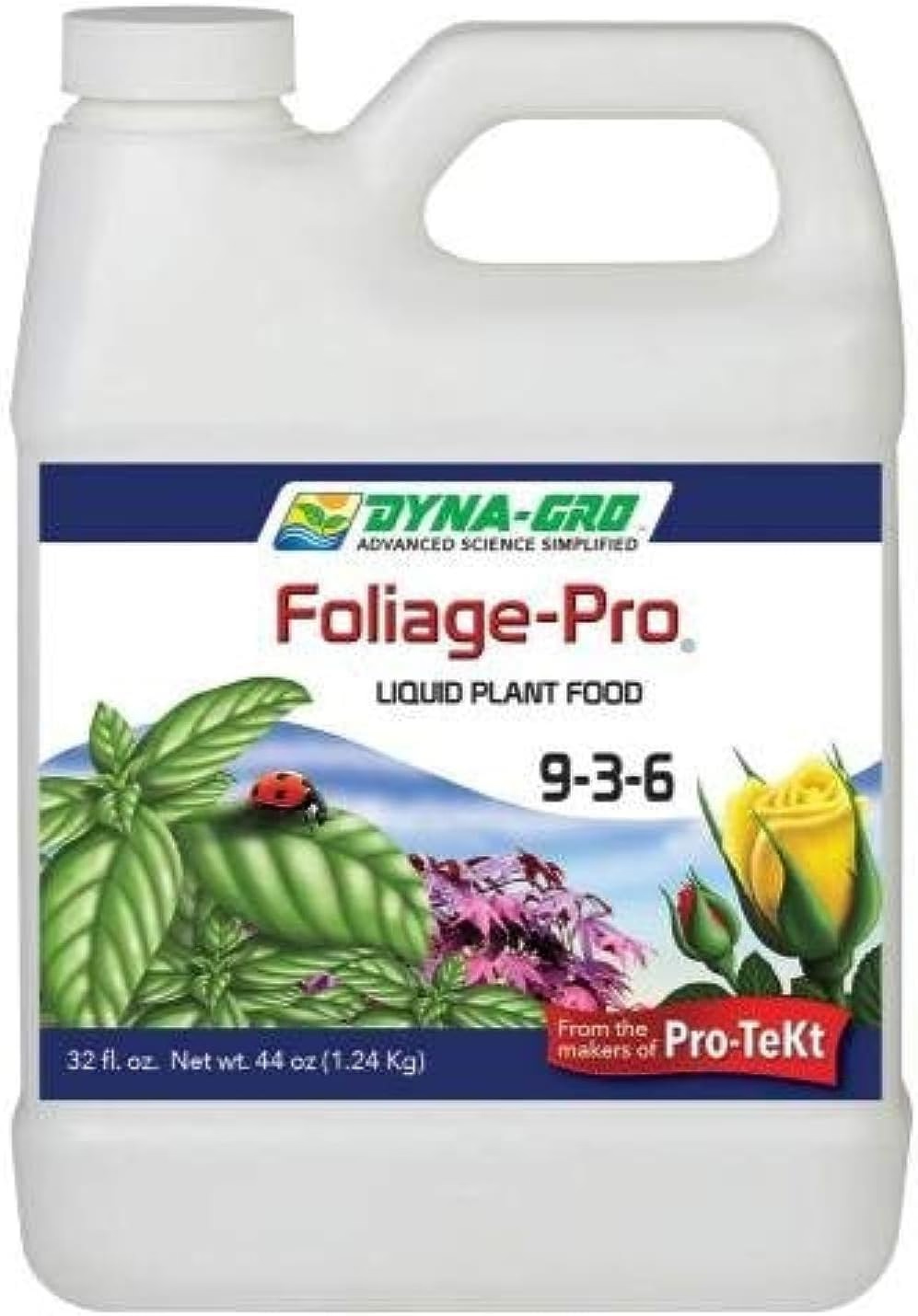
Organic Liquid Plant Food (FoxFarm)
A liquid organic plant food. Applied at label rate during active growth; most houseplants do better at reduced strength and not at all in winter.
View on Amazon ↗
PlantSavvyWorld
Editorial team
PlantSavvyWorld is an independent botanical education project. Articles are drafted with AI assistance, then edited and checked against university extension services, botanical garden collections and other published horticultural sources.
💬 Discussion