

Swedish Ivy vs English Ivy
Detailed botanical comparison of Swedish Ivy and English Ivy. Light needs, watering schedule, pet toxicity, propagation, and care difficulty compared side-by-side.
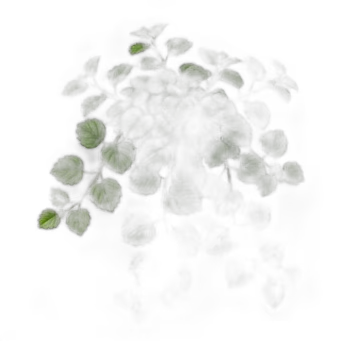
Swedish Ivy
Plectranthus verticillatus

English Ivy
Hedera helix
At-A-Glance Specification Comparison
| Feature | Swedish Ivy | English Ivy |
|---|---|---|
| Care Difficulty | Easy | Moderate |
| Light Requirement | Bright Indirect | Medium to Bright |
| Watering Schedule | Moderate (When top inch dry) | Moderate (When top inch dry) |
| Humidity Need | Average (40-50%) | High (60%+) |
| Pet Safety | 100% Non-Toxic | Toxic to Pets |
| Growth Rate | Fast | Fast |
| Ideal Temperature | 60°F - 75°F (15°C - 24°C) | 50°F - 70°F (10°C - 21°C) |
| Soil Mix | Moist, organic-rich potting soil | Rich, fertile, well-draining garden soil |
| Propagation | Stem Cuttings in Water or Soil | Stem Cuttings |
| Best Suited For | Pet-friendly hanging baskets, cascading desk displays | Wall trellises, topiaries, air purification in cool rooms |
Detailed Botanical Breakdown
1. Overview & Aesthetic Difference
Swedish Ivy (Plectranthus verticillatus) originated in Southern Africa. Swedish Ivy is a fast-growing, pet-safe trailing beauty with aromatic glossy scalloped leaves that cascades gracefully from hanging pots.
In contrast, English Ivy (Hedera helix) traces its roots to Europe & Western Asia. English Ivy is a classic evergreen climbing vine that excels at air filtration and vertical trellis growth, but needs humidity to avoid spider mites.
2. Light & Positioning Showdown
Light is the #1 factor determining indoor plant success. Swedish Ivy performs best when provided with Bright Indirect. Without adequate light, it may suffer from dull foliage or leggy growth.
Meanwhile, English Ivy demands Medium to Bright. If your living space has darker corners or low ambient light, make sure to evaluate which species aligns best with your window orientation.
3. Watering & Humidity Needs
Swedish Ivy requires Moderate (When top inch dry) and thrives under Average (40-50%). Using a Moist, organic-rich potting soil prevents moisture stagnation around the root zone.
On the other hand, English Ivy prefers Moderate (When top inch dry) combined with High (60%+). Its ideal potting medium is Rich, fertile, well-draining garden soil.
4. Pros & Cons Head-to-Head
Swedish Ivy
- Pet safe and completely non-toxic
- Glossy scalloped leaves with purple undersides
- Roots in water in under a week
- Can get leggy without periodic pinching
- Sensitive to freezing temperatures
English Ivy
- Climbs walls and trellises with aerial rootlets
- Strong air purifier against indoor mold particles
- Tolerates cold temperatures down to 45°F
- Highly prone to spider mites in dry indoor air
- Invasive outdoors in many US regions
- Toxic to pets
5. The Decision Matrix: Which Should You Buy?
Choose Swedish Ivy if:
- You want pet-friendly hanging baskets, cascading desk displays.
- Your space provides bright indirect.
- You enjoy moderate (when top inch dry) care routine.
Choose English Ivy if:
- You want wall trellises, topiaries, air purification in cool rooms.
- Your space provides medium to bright.
- You prefer a moderate (when top inch dry) approach.
Botanist Verdict & Recommendation
By Dr. Mary Kate, Senior Botanist at PlantSavvyWorld
Both Swedish Ivy and English Ivy are exceptional botanical specimens with distinct strengths. If your priority is maximum resilience and low fuss, evaluate the difficulty ratings carefully. Don't forget to verify pet toxicity if you share your home with animals.
Frequently Asked Questions
Which is easier to care for: Swedish Ivy or English Ivy?
Swedish Ivy is rated as Easy care while English Ivy is rated as Moderate care. Swedish Ivy is generally more forgiving for beginners.
Are Swedish Ivy and English Ivy safe for cats and dogs?
Swedish Ivy is 100% non-toxic and pet-safe. English Ivy is toxic to pets (Toxic to pets; contains triterpenoid saponins).
Can Swedish Ivy and English Ivy grow together in the same room?
Yes, Swedish Ivy and English Ivy can comfortably share the same room if placed in their preferred light micro-climates. Swedish Ivy prefers Bright Indirect, while English Ivy thrives in Medium to Bright.
Which plant grows faster: Swedish Ivy or English Ivy?
Swedish Ivy has a fast growth rate, whereas English Ivy has a fast growth rate under optimal indoor conditions.